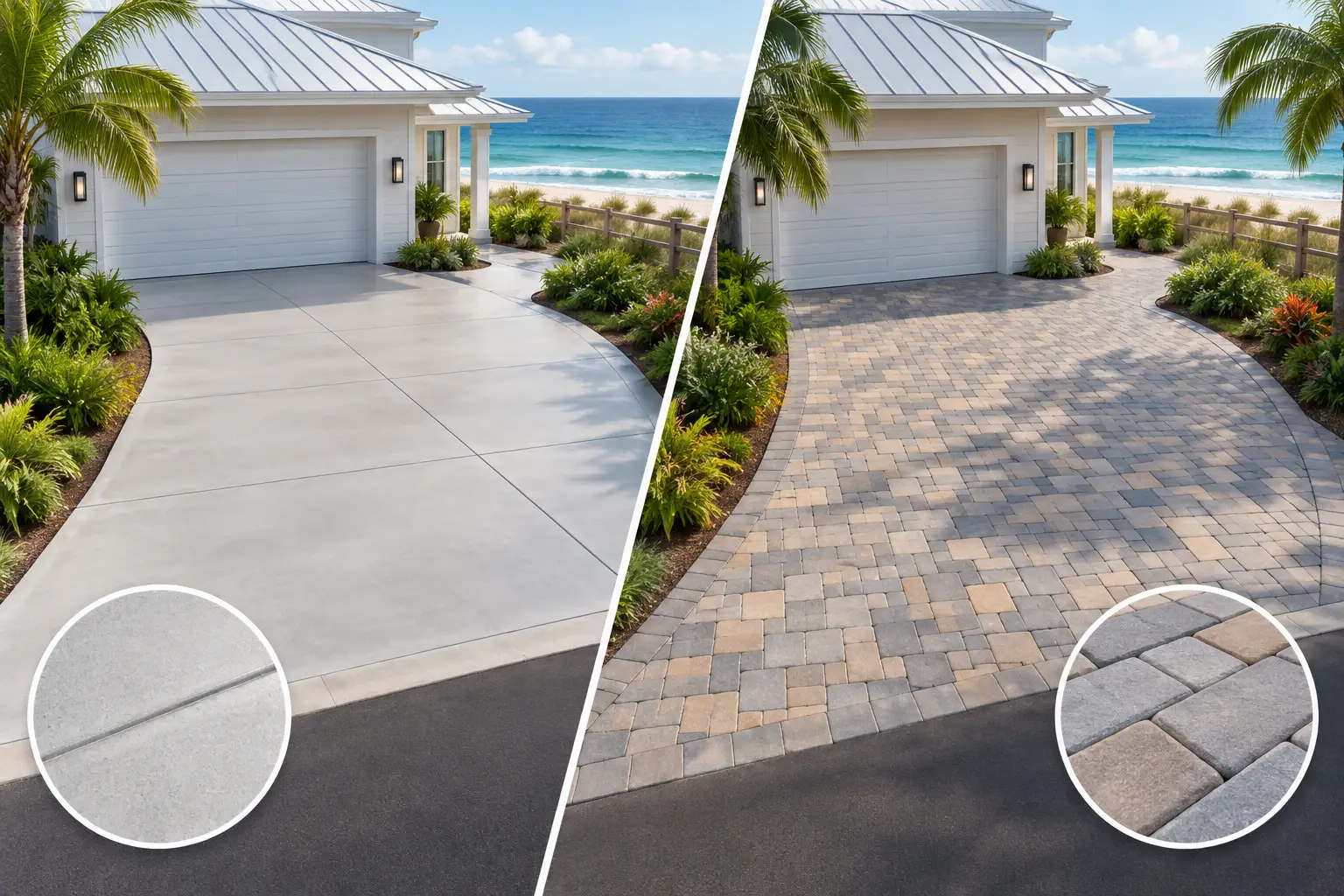
A coastal driveway has to handle more than daily vehicle traffic. In the Coastal Bend, intense sun, salt air, heavy rain, high groundwater, and shifting soils all work against the surface and the base below it. When comparing concrete versus pavers for coastal driveways, the right answer depends less on appearance alone and more on drainage, preparation, traffic load, and how much maintenance the owner is willing to take on.
For many South Texas homes and commercial properties, reinforced concrete is the practical long-term choice. Pavers can be a good fit for the right project, especially when appearance and localized repairs are priorities. But neither material performs well when the site is poorly graded or the base is underbuilt.
Why Coastal Driveways Need a Different Standard
A driveway in Corpus Christi, Rockport, Aransas Pass, or another nearby coastal community is exposed to conditions that can shorten the life of ordinary flatwork. Salt-laden moisture can accelerate corrosion in exposed or poorly protected metal components. Summer heat causes expansion and stresses joints. Sudden rain events test whether water is moving away from the home, garage, and driveway base.
The soil matters just as much. Parts of South Texas have clay-rich or variable soils that expand when wet and shrink when dry. If a driveway is installed over weak, wet, or poorly compacted subgrade, surface material alone will not prevent movement. Concrete can crack. Pavers can settle, separate, or develop low spots. A durable driveway starts with site evaluation, excavation, compaction, base preparation, and proper slope.
Concrete Versus Pavers for Coastal Driveways
Concrete and pavers solve the same basic problem in different ways. Concrete creates a continuous, rigid surface. Pavers create an interlocking surface made of individual units over a compacted base and bedding layer. That difference affects cost, installation, drainage, repair, and long-term appearance.
Where Concrete Has the Advantage
Concrete is a strong choice for homeowners and property managers who want a clean, dependable driveway with straightforward maintenance. A properly installed concrete driveway is built to carry regular vehicle loads across a continuous slab. Reinforcement, control joints, thickness, and base preparation all help manage the stresses that come with traffic and soil movement.
For coastal properties, concrete also offers a simple surface that is easy to wash down after salt spray, windblown sand, mud, or storm debris. There are no individual joints between units where weeds, loose sand, or debris can collect. With the right finish, it provides reliable traction while remaining easy to maintain.
Concrete usually makes the most sense when the driveway will see heavier vehicles, frequent use, or a wide turning area. It is also a practical option for properties that need a driveway tied into sidewalks, parking pads, garage approaches, or other concrete work. A continuous design can create a more uniform finished look across the site.
The trade-off is that concrete is rigid. Cracks can occur as soil moves or the slab experiences temperature changes. Control joints help direct cracking into planned locations, but they do not eliminate the possibility entirely. If a section settles because of a drainage or base problem, repair may require cutting out and replacing a larger area than a comparable paver repair.
Where Pavers Have the Advantage
Pavers are often selected for curb appeal. They offer more color, pattern, and border options than standard broom-finished concrete, making them popular for entry drives, courtyard-style homes, and properties where the driveway is a major design feature.
Their biggest practical advantage is repairability. If an isolated area settles or a utility repair requires access, individual pavers can be removed and reset. That can be useful in areas with active soils, provided the underlying base is repaired correctly before the pavers go back in place.
Pavers can also allow water to move through joints in certain system designs. That does not mean a paver driveway automatically solves drainage. Water still needs a controlled path away from structures and toward appropriate drainage areas. In coastal ground conditions, water that infiltrates through the surface must not saturate and weaken the base below.
The trade-offs are ongoing maintenance and installation precision. Joint sand may need replenishment. Weeds can emerge in joints if the driveway is neglected or surrounding landscaping is not controlled. Pavers can shift at edges if restraints fail, and a poor base can lead to uneven areas that become noticeable over time. Salt, sand, and rain do not automatically damage pavers, but coastal exposure makes correct installation and periodic upkeep more important.
Cost Is More Than the Initial Price
A basic concrete driveway is often less expensive upfront than a paver installation of the same size. The final price depends on access, demolition, excavation, thickness, reinforcement, drainage requirements, grading, finish, and whether the old driveway must be removed. Decorative finishes, staining, stamping, curves, and difficult site conditions can raise the cost of concrete work.
Pavers typically cost more at installation because the process involves excavation, a carefully compacted aggregate base, bedding material, edge restraints, the pavers themselves, cutting, and jointing sand. Complex patterns and premium paver styles add labor and material costs.
Owners should not compare bids based on square footage alone. A low price can leave out the work that determines whether the driveway lasts: removing unsuitable material, establishing proper elevation, compacting the base in lifts, reinforcing concrete where appropriate, and directing water away from the structure. Ask what is included below the finished surface, not just what will be visible on day one.
Drainage Can Decide the Project
Many driveway problems are water problems wearing a different disguise. Water that ponds at the garage, flows toward the foundation, runs under a slab edge, or washes out a paver base can create expensive issues over time.
A contractor should look at the existing grade, downspout discharge, street elevation, nearby drainage paths, and the transition between the driveway and garage. The finished surface needs enough slope to shed water without creating an uncomfortable approach for vehicles. In some cases, a drain, swale, curb detail, or additional site grading may be needed before the driveway is installed.
For concrete, the goal is a well-supported slab that drains cleanly off the surface. For pavers, the goal includes protecting the base and edge restraints from water movement. Neither material is a substitute for a drainage plan.
Maintenance Expectations Over Time
Concrete maintenance is generally simple. Keep the surface clean, avoid harsh deicing chemicals, address joint and crack issues before they worsen, and watch for standing water or edge erosion. Sealing may be appropriate for decorative concrete or areas exposed to stains, though the right schedule depends on the finish and product used.
Paver maintenance requires more hands-on attention. Periodic cleaning, replacing lost joint sand, checking edges, and resetting any early settlement can preserve the surface. If a paver driveway develops recurring low areas, adding more sand on top is not the real fix. The affected pavers should be removed so the base condition can be corrected.
For either option, do not ignore changes around the driveway. A new gutter discharge, landscaping change, leaking irrigation line, or heavy vehicle pattern can alter how the surface performs.
Choosing the Right Driveway for Your Property
Choose concrete when you want a durable, low-maintenance driving surface, expect regular or heavier vehicle traffic, or need a driveway that connects cleanly with other concrete improvements. It is especially effective when installed with the right thickness, reinforcement, joints, and drainage for the site.
Choose pavers when architectural appearance is a leading priority and you are comfortable with periodic maintenance. They can be an excellent choice for a well-prepared residential driveway where the owner values design flexibility and the ability to make localized repairs.
The best choice may also be a combination. Some properties use a concrete main drive for dependable vehicle traffic and pavers for an entry court, walkway, or decorative border. That approach can control cost while still adding visual character where it matters most.
Haylo Construction evaluates the full driveway system, including removal, grading, drainage, base conditions, reinforcement, and finished concrete work. Before selecting a surface, get a clear scope for what your property needs below grade. A driveway that sheds water correctly and sits on a properly prepared base will serve you better long after the initial finish has stopped looking new.