When an HVAC unit rocks, a generator settles, or pool equipment starts leaning, the problem usually starts below the machine. If you need to pour concrete equipment pad work that will actually hold up, the pad has to do more than look level on day one. It has to stay stable through heat, rain, runoff, soil movement, and daily vibration.
That is where a lot of property owners get burned. A small pad sounds simple, but bad prep, weak edges, poor drainage, or the wrong thickness can shorten the life of both the concrete and the equipment sitting on it. For homeowners and commercial property owners alike, the goal is straightforward – build a pad that stays put, drains properly, and supports the load without constant maintenance.
What a concrete equipment pad needs to do
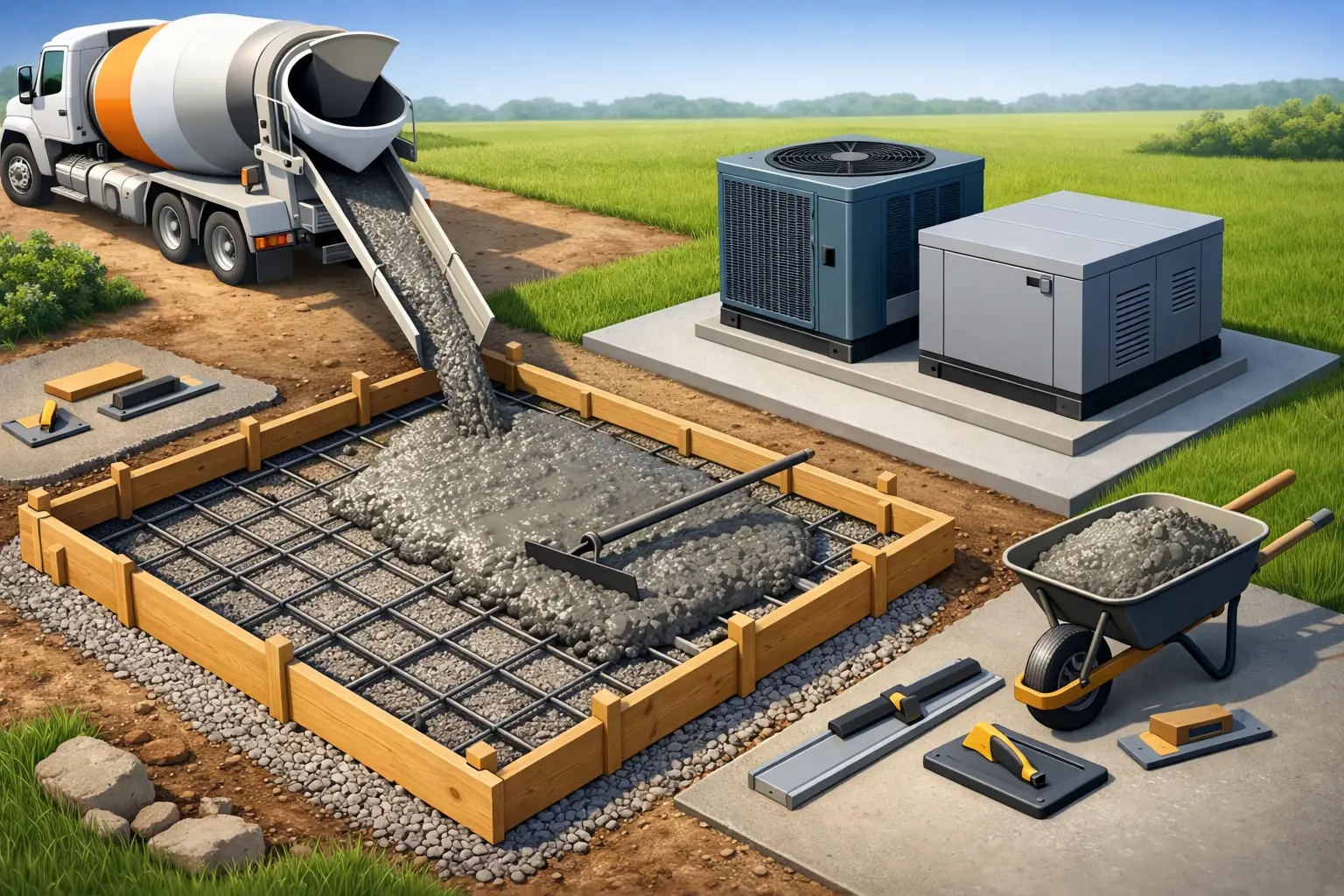
An equipment pad is not just a flat slab. It is a load-bearing surface designed for a specific purpose. Depending on the job, it may support an AC condenser, dumpster enclosure footing, generator, irrigation controls, pool equipment, grease trap access equipment, or other mechanical systems.
Each use changes the requirements. A residential condenser pad may need less thickness and reinforcement than a commercial generator pad. Some pads mainly deal with static weight. Others also handle vibration, maintenance traffic, anchor bolts, or exposure to washdown water. That is why the right answer is rarely one-size-fits-all.
In South Texas, drainage and soil behavior matter just as much as load. If water sits around the pad or runs under it, settlement becomes more likely. If the site was not compacted well before the pour, even a decent-looking pad can crack early and shift out of plane.
Before you pour concrete equipment pad work, start with the site
The biggest mistake on small concrete projects is assuming small means forgiving. It does not. A compact equipment pad still needs proper excavation, a stable base, and attention to final grade.
The first question is location. The pad should give the equipment proper clearance, service access, and safe separation from structures or walkways as required by the manufacturer or local code. It also needs to sit high enough to avoid ponding water but not so high that it creates trip hazards or awkward connections.
Once the location is set, the subgrade has to be evaluated. Soft spots, organic material, roots, loose fill, and saturated soil all need to be addressed before concrete is placed. On many projects, that means excavating to competent material, placing a compacted base, and checking grade again before forms go in.
For coastal and near-coastal properties, moisture management is a practical issue, not a theory. Heavy rain can expose weak prep fast. If runoff from roofs, pavement, or adjacent grade pushes water toward the pad, that drainage problem should be fixed before or during the project, not after the equipment is installed.
Why base preparation matters more than most people think
Concrete gets the credit, but the base does the work. If the material under the slab shifts, the slab follows it. That is why a properly compacted granular base is often the difference between a pad that lasts and one that cracks at the corners within a season.
Base depth depends on the site and intended load. Lighter residential applications may need a simpler section than heavy mechanical equipment. The key is not guessing. The contractor should match the base and slab design to the actual use, the site conditions, and the weight involved.
Thickness, reinforcement, and edge strength
One of the most common questions is how thick the pad should be. The honest answer is that it depends on the equipment and the ground below it. A thin pour over weak soil is a bad combination, even if the equipment itself is not especially heavy.
For many standard applications, the slab needs enough thickness to resist cracking under load and enough edge strength to avoid breaking down over time. Edges are where many failures show up first, especially if the pad is too shallow, undermined by erosion, or hit during service work.
Reinforcement also matters, but it should match the job. Wire mesh, rebar, or fiber reinforcement may all have a place depending on the design. Reinforcement does not fix poor subgrade prep, but it can help the slab perform better when properly specified and placed.
For generator pads or equipment with anchors, vibration, or concentrated loads, design requirements can be more demanding. In those cases, anchor layout, slab dimensions, reinforcement schedule, and compressive strength should be planned before the pour instead of improvised on site.
Flat is not enough – the pad has to be level and properly graded
People often use flat and level like they mean the same thing. On concrete work, they do not. Equipment may require a level surface for proper function, but the surrounding area still needs positive drainage so water moves away from the slab.
That balance matters. If a pad is perfectly level but surrounded by low spots, standing water can collect at the perimeter. If the slab is pitched carelessly to chase drainage, the equipment may not sit correctly. Good layout solves both problems by controlling finished elevation and adjacent grade together.
Forming and placement should fit the equipment, not just the opening in the yard
A good equipment pad gives enough room for the unit itself and for future service. Crowding the pad to save a little concrete often creates problems later. Technicians need clearance. Connections need room. In some cases, surrounding site features such as fencing, gates, walkways, or utility lines also affect the right size and shape.
The formwork should hold dimensions cleanly and keep edges consistent. Sloppy forms lead to crooked pads, thin corners, and poor appearance. For visible residential installs, that matters. For commercial work, clean forming also supports safer access and a more professional finish.
During placement, the crew should control thickness, finish, and consolidation. Overworking the surface or adding water at the wrong time can weaken the slab. Small pads still need disciplined concrete practices if long-term durability is the goal.
Curing is where a lot of decent pours go bad
Fresh concrete is not finished when the crew leaves. Curing has a direct effect on strength, surface durability, and crack resistance. In hot, windy conditions, moisture can leave the slab too quickly. That increases the risk of shrinkage cracking and weak surface performance.
South Texas weather can speed up that problem. Heat and sun are great for drying clothes, not for uncontrolled concrete cure. The slab should be protected and cured appropriately so it gains strength the way it is supposed to.
Equipment should also stay off the pad until the concrete has reached adequate strength. Setting units too early can damage edges, leave impressions, or stress the slab before it is ready. Timing matters here, especially on fast-moving installations.
Common reasons equipment pads fail early
Most early failures trace back to a short list of issues. Bad base prep is near the top. After that, the usual problems are poor drainage, undersized slab thickness, weak edges, and rushing the cure.
There are also cases where the concrete itself was never matched to the application. A basic pad for a light residential unit is not the same as a foundation-style pad for heavier equipment. If the pad needs anchors, sleeves, conduit coordination, or vibration resistance, those details should be part of the plan from the start.
Tree roots, irrigation overspray, roof discharge, and vehicle traffic are often overlooked too. A pad can be poured correctly and still fail if surrounding site conditions keep undermining it.
When a contractor should handle the job
Some equipment pads look simple enough for a quick weekend pour. Sometimes they are. But once load, drainage, access, utilities, or long-term performance matter, contractor-built work usually pays off.
A professional crew can handle excavation, grading, compaction, forms, reinforcement, concrete placement, and finish with the full site in mind. That matters even more when the project ties into other work such as demolition, replacement slabs, fencing, paving, or equipment relocation. Keeping those scopes coordinated reduces rework and keeps the site safer.
For property owners who want the job done once and done right, that is usually the real value. Not just getting concrete in the ground, but getting a pad that supports the equipment, fits the site, and holds up under local conditions. Companies like Haylo Construction approach pad work that way – practical, properly prepared, and built for durability rather than speed alone.
What to ask before approving the pour
Before moving forward, ask how the pad thickness was determined, what base prep is included, how drainage will be handled, and whether reinforcement is part of the scope. If the equipment has manufacturer requirements, those should be reviewed before forms are set.
It is also worth asking about access and surrounding grades. A pad can be structurally sound and still create service headaches if it is boxed into a tight corner or set below runoff. Good planning avoids both the structural issues and the usability issues.
A concrete equipment pad is a small part of a property, but it carries a big job. When the pad is built correctly, the equipment above it performs better, lasts longer, and causes fewer problems over time. That is the kind of concrete work worth doing carefully the first time.