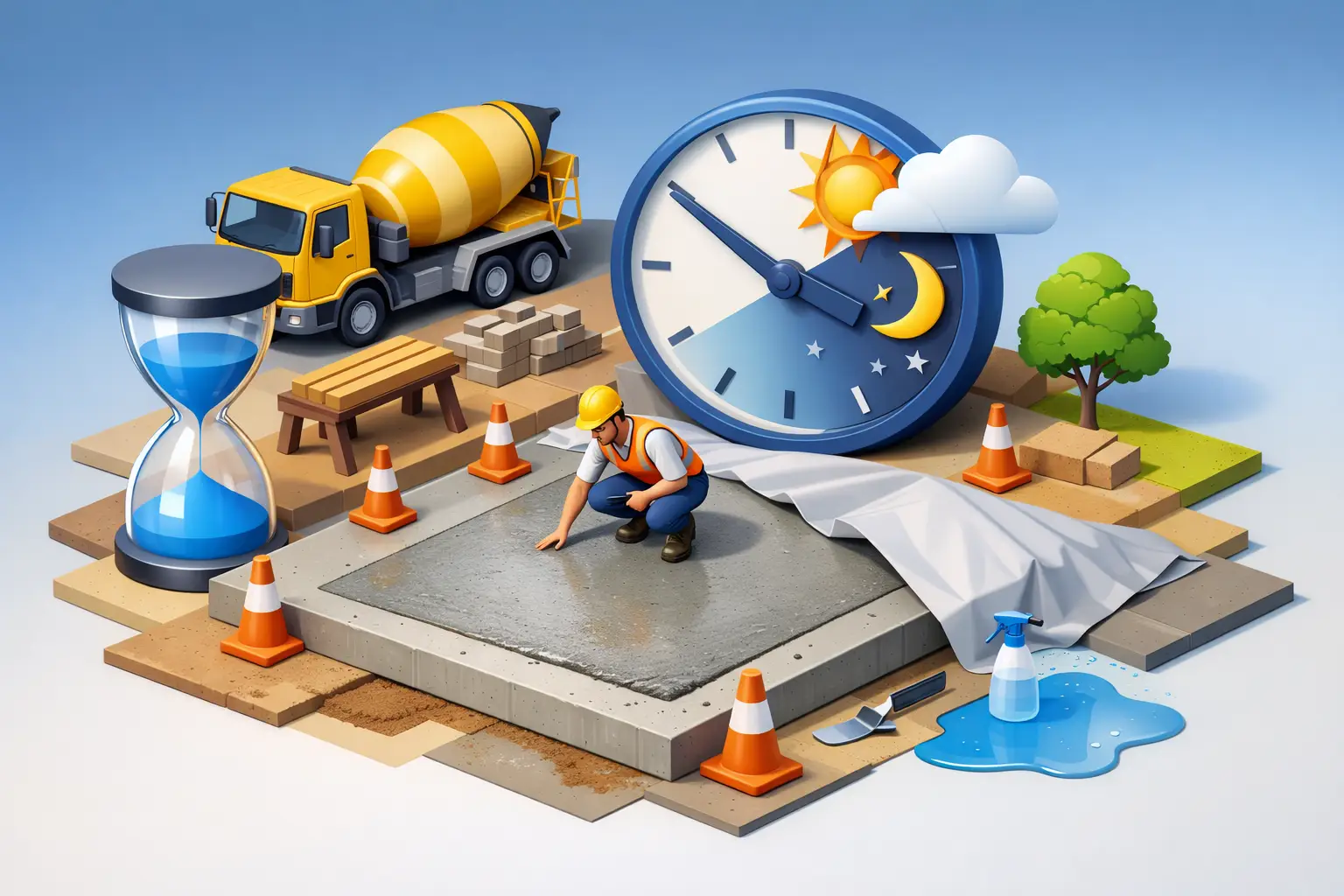
Fresh concrete can look solid by the next day, but that does not mean it is fully cured. If you are asking how long does concrete take to cure, the short answer is about 28 days for full design strength in normal conditions. The longer answer matters more, because concrete can be walked on, driven on, or loaded at different stages depending on the mix, weather, thickness, and the kind of project.
That distinction is where a lot of costly mistakes happen. A driveway that gets vehicle traffic too soon, a slab that dries out too fast in South Texas heat, or a commercial pad that is loaded before it is ready can all lose strength and durability. Concrete work is not just about pouring and finishing. It is about protecting the cure so the slab performs the way it was built to.
How long does concrete take to cure in real conditions?
Under standard conditions, concrete reaches about 70 percent of its strength in 7 days and about 100 percent of its intended design strength in 28 days. That 28-day benchmark is the industry standard used for testing and performance expectations.
Still, curing is not the same as drying. Concrete hardens because of a chemical reaction between cement and water called hydration. As long as moisture and temperature stay in a workable range, the concrete keeps gaining strength. If it dries out too quickly, that process gets cut short.
For most property owners, the practical timeline looks like this: foot traffic is often okay after 24 to 48 hours, light vehicle traffic may be possible after about 7 days, and full curing takes around 28 days. Those are general windows, not guarantees. A residential walkway and a heavy-duty parking lot do not follow the same risk profile.
What happens during the first 24 hours
The first day is when concrete is most vulnerable to surface damage, rapid moisture loss, and finishing issues. It may begin to set within a few hours, especially in hot or windy weather, but the slab is still far from ready for use.
This early period is critical because the surface can crust over before the inside develops enough strength. That is one reason experienced crews pay close attention to timing, finishing, and curing methods right after the pour. On a coastal jobsite, heat, wind, and salt air can all speed up evaporation and make curing more demanding.
If the slab is disturbed too soon, the result might not show up right away. Sometimes the damage appears later as surface dusting, scaling, hairline cracking, or premature wear.
When can you walk on new concrete?
In many cases, you can walk on concrete after 24 hours, but that should be limited and careful. For better protection, 48 hours is safer, especially for decorative surfaces, residential patios, and any slab that needs a clean finish.
That does not mean the concrete is strong. It only means the surface has hardened enough for light foot traffic without a high chance of marking or damage. Pets, equipment, ladders, and concentrated point loads are a different story.
When can you drive on new concrete?
Passenger vehicles should usually stay off new concrete for at least 7 days. For heavier trucks, delivery vehicles, dumpsters, or commercial traffic, the wait may need to be longer depending on the slab design and expected loads.
This is where project type matters. A driveway at a home and a loading area behind a business may both be concrete, but they are not built for the same use. Reinforcement, thickness, subgrade prep, and expected traffic all affect how soon the surface can safely handle weight.
Why 28 days matters
The 28-day mark is the standard because that is when concrete is generally considered fully cured for design purposes. Test cylinders are commonly measured at that point to confirm compressive strength.
That does not mean the concrete stops gaining strength after 28 days. It can continue to strengthen beyond that if conditions allow. But 28 days is the accepted milestone for evaluating whether the slab has reached the strength it was engineered for.
For owners, the takeaway is simple: even if the slab looks finished in a day or two, its long-term durability is still being built over the next several weeks.
What can slow down or speed up curing?
Weather is one of the biggest variables. In South Texas, high heat can make concrete set faster on the surface while also increasing the risk of moisture loss. That can create a slab that appears ready quickly but is more likely to shrink, crack, or underperform if curing is not managed correctly.
Cooler temperatures usually slow the process down. Very cold weather can delay strength gain significantly, and freezing conditions can damage fresh concrete before it develops enough internal strength. Rain is another factor. Light moisture can help during curing if managed properly, but heavy rain on fresh concrete can damage the surface and affect the finish.
Mix design also matters. Some mixes are engineered for faster strength gain, while others are designed for durability, workability, or specific structural needs. Water content matters too. Adding too much water on site may make the mix easier to place, but it can reduce final strength and increase shrinkage.
Thickness and reinforcement play a role as well. Large commercial slabs, foundations, and structural pours often have different curing demands than sidewalks or patio extensions. There is no one-size-fits-all answer if the goal is long-term performance.
Curing vs drying
A lot of people use these terms like they mean the same thing. They do not.
Drying is about moisture leaving the concrete. Curing is about maintaining the right moisture and temperature so the cement can hydrate properly and build strength. If concrete dries too fast, curing suffers.
That is why proper curing methods matter. Depending on the job, crews may use curing compounds, wet coverings, plastic sheeting, or controlled watering to help retain moisture. The right method depends on the surface, the weather, and the schedule for the project.
For decorative concrete, this is even more sensitive. Stamped and stained surfaces need good curing control to protect both appearance and performance.
How long does concrete take to cure for different projects?
A basic sidewalk may tolerate light use sooner than a driveway. A residential patio may not carry major loads, but it still needs proper curing to resist cracking and weathering. A foundation, parking lot, retaining wall, or equipment pad usually calls for a more cautious timeline because the structural and load demands are higher.
Repairs can vary even more. Some repair materials are designed for fast return to service, while standard concrete patching may still need a longer cure window. That is why timing should always be based on the actual application, not just a general rule pulled from a search result.
For contractors, that means setting expectations early. For property owners, it means asking the right question: not just when the concrete looks done, but when it is truly ready for how the space will be used.
Signs concrete is not being cured properly
Poor curing does not always show up immediately, but there are warning signs. Early surface cracking, a chalky or dusty finish, discoloration, edge weakness, and scaling can all point to curing problems. In some cases, the slab may also show lower-than-expected strength or premature wear once traffic starts.
These issues are often preventable. Good site prep, proper mix selection, careful finishing, and active curing practices all work together. Skipping any one of those steps can reduce the life of the concrete, especially in tough environments where heat, moisture, and soil movement already put pressure on the slab.
The bottom line for property owners
If you want the simplest answer to how long does concrete take to cure, use 28 days as the full-strength benchmark. If you want the practical answer, expect limited foot traffic after 24 to 48 hours, possible vehicle traffic around 7 days in many cases, and a cure timeline that depends on weather, mix design, and intended use.
The safest move is to follow the contractor’s timeline for your specific project instead of guessing based on appearance. Concrete that is poured right but rushed afterward can still fail early. Concrete that is properly placed, protected, and cured has a much better shot at delivering the durability you paid for.
When the job matters, the cure matters just as much as the pour. Give the slab the time it needs, and it will usually return the favor for years to come.