A retaining wall usually does not fail because the blocks, timber, or concrete were too weak. It fails because water got trapped behind it.
That is why retaining wall drainage solutions matter from day one. If water cannot move out from behind the wall, hydrostatic pressure builds, soil gets heavier, and the wall starts to lean, crack, bow, or wash out at the base. On South Texas properties, where heavy rain, shifting soil, and runoff can all show up on the same job, drainage is not an add-on. It is part of the structure.
Why drainage matters more than most owners expect
A retaining wall holds back soil, but it also ends up dealing with everything that moves through that soil. Rainwater, irrigation overspray, roof runoff, and groundwater all find the easiest path. If the wall system was built without a way to relieve that pressure, the wall becomes the barrier that takes the full load.
This is where many property owners get caught off guard. A wall can look solid when it is first installed, then start showing trouble months later. Small warning signs matter – staining on the face, soft spots near the base, washed-out joints, or sections that are no longer straight. By the time the movement is obvious, the drainage problem has usually been there for a while.
Good drainage extends wall life, helps protect nearby flatwork and foundations, and reduces repair costs later. It also helps keep the surrounding grade stable, which matters if the wall is supporting a driveway, patio, parking area, or building pad.
The most effective retaining wall drainage solutions
There is no single fix that works for every wall. The right approach depends on wall height, soil type, slope, water source, and what sits above and below the wall. Still, the best-performing systems usually combine a few core elements rather than relying on one feature.
Perforated drain pipe behind the wall
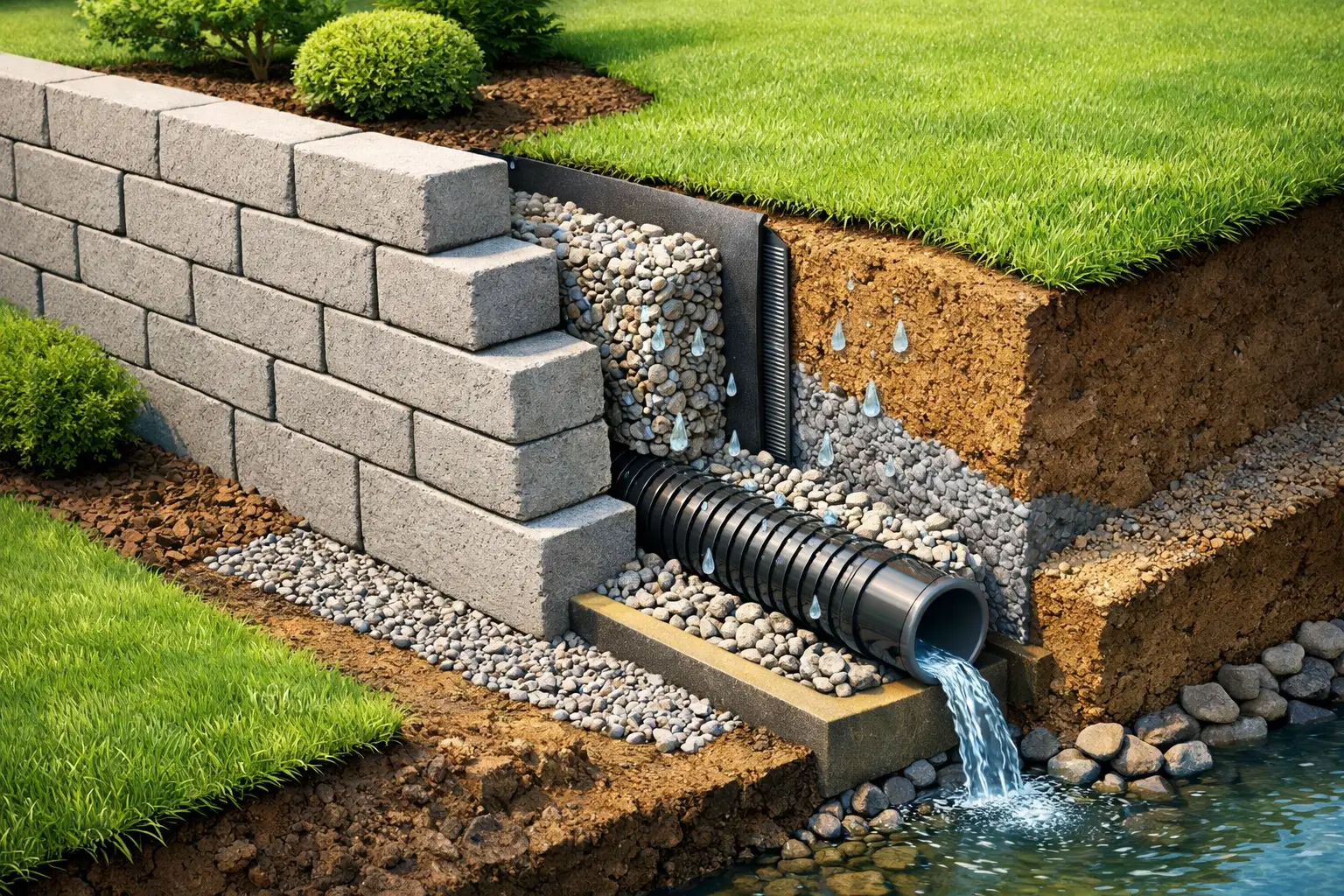
A perforated drain pipe is one of the most common and effective retaining wall drainage solutions. It is typically installed at the base of the wall, behind the first course or footing area, and surrounded by clean drainage stone. The goal is simple – collect water before it builds pressure and move it to a safe discharge point.
Pipe selection and placement matter. A pipe that is too high, poorly sloped, or blocked with fines will not do the job. In some cases, daylighting the pipe works well. On other sites, especially flatter properties, the outlet may need more planning. If there is nowhere for that water to go, the pipe only solves part of the problem.
Free-draining gravel backfill
Backfill is not just fill. That distinction matters.
One of the biggest mistakes in wall construction is placing native clay or mixed jobsite soil directly behind the wall. Those materials can hold water, compact unevenly, and increase pressure. Clean gravel or drainage stone creates space for water to move down toward the drain pipe instead of sitting against the wall.
The depth of the gravel zone depends on the wall design, but the principle stays the same. Better drainage behind the wall means less pressure on the wall. For taller walls or walls carrying surcharge loads from vehicles or structures, this becomes even more important.
Filter fabric to keep the system from clogging
Drainage stone and pipe can still fail if surrounding soil migrates into the system. That is where filter fabric comes in.
A properly installed geotextile fabric helps separate soil from the drainage layer while still allowing water to pass through. Without it, fine particles can wash into the gravel over time and reduce flow. This is one of those details that is easy to skip on a rushed job and expensive to fix later.
Weep holes in certain wall types
Weep holes are commonly used in poured concrete, masonry, and some older wall systems. They allow water to escape through openings in the face of the wall rather than building up behind it.
They can work well, but they are not a complete drainage plan by themselves. If there is no drainage layer or collection system behind the wall, weep holes may relieve some water while still leaving the wall exposed to pressure and saturation. They are best used as part of a broader design, not as the only answer.
Proper grading above and below the wall
Some drainage failures begin before water even reaches the backfill. If the grade above the wall funnels runoff straight toward it, the wall is being overloaded from the start.
Proper grading directs surface water away from the retained area when possible. Downspouts, swales, and adjacent paving should also be considered. A well-built wall can still struggle if roof drains empty behind it or if a concrete surface channels water straight to the back edge.
The area below the wall matters too. If water erodes the toe or footing support, the wall can lose stability even when the back drainage is decent.
What changes the right drainage design
Wall height is a big factor, but it is not the only one. A short landscape wall may need a simpler system than a structural wall holding back a cut slope or supporting a parking lot edge. Soil conditions also matter. Expansive or poorly draining soils hold moisture longer and can create more pressure.
Local weather plays a role as well. In coastal Texas, intense rainfall can dump water fast, and drainage systems need to handle that volume without backing up. Salt air is another reason material choice matters, especially for exposed metal components or outlets.
The load above the wall changes the stakes. If vehicles, equipment, or foundations are near the top, water-related movement becomes a bigger risk. In those cases, drainage and reinforcement need to be planned together, not treated as separate issues.
Common drainage mistakes that lead to wall failure
A lot of wall problems come from shortcuts, not from rare engineering issues. One common mistake is using the wrong backfill because it is already on site. Another is installing a drain pipe with no real outlet. Water has to leave the system, not just collect in it.
Skipping compaction in lifts is another problem. Poorly compacted backfill settles unevenly, changes how water moves, and can create voids. On the other hand, overcompacting the wrong material near certain wall types can also cause issues. It depends on the wall system and design.
Some contractors also treat decorative walls and structural retaining walls the same way. That can be a costly assumption. A wall that looks clean from the front may still be undersized or poorly drained for the conditions behind it.
When repair is enough and when replacement makes more sense
Not every drainage issue means the wall has to come out. If the wall is still structurally sound and the main problem is poor water relief, targeted drainage improvements may help. That could include adding a drain line, improving grading, or rebuilding part of the backfill zone.
But if the wall is already bowing, rotating, cracking through key structural sections, or losing base support, a patch may only buy time. In those cases, replacement is often the safer and more cost-effective path. The hard part is that cosmetic fixes can hide serious movement for a while, which is why a field evaluation matters.
A dependable contractor will tell you when a repair is realistic and when it is not. That honesty saves money and reduces the chance of doing the same job twice.
Choosing a contractor for retaining wall drainage solutions
Drainage is one of those parts of a project that owners rarely see once the work is done. That makes contractor selection even more important.
Ask how water will move from behind the wall to a discharge point. Ask what backfill will be used and whether filter fabric is part of the system. Ask how grading around the wall will affect drainage after the job is complete. If the answers are vague, that is a red flag.
For properties in Corpus Christi and nearby coastal areas, local experience matters. Soil behavior, rain events, and site drainage patterns are not the same everywhere. A contractor who understands those conditions is more likely to build a wall that performs well after the first hard storm, not just on install day.
At Haylo Construction, that practical approach drives every site and concrete project we take on. The goal is not to oversell a feature list. It is to build something that drains correctly, holds up, and does not create a bigger problem six months later.
A better wall starts behind the wall
If you are planning a new retaining wall or dealing with signs of water pressure on an existing one, focus on what is happening out of sight. The face of the wall gets the attention, but the drainage system is what protects the investment. Get that part right, and the wall has a much better chance of doing its job for years to come.