
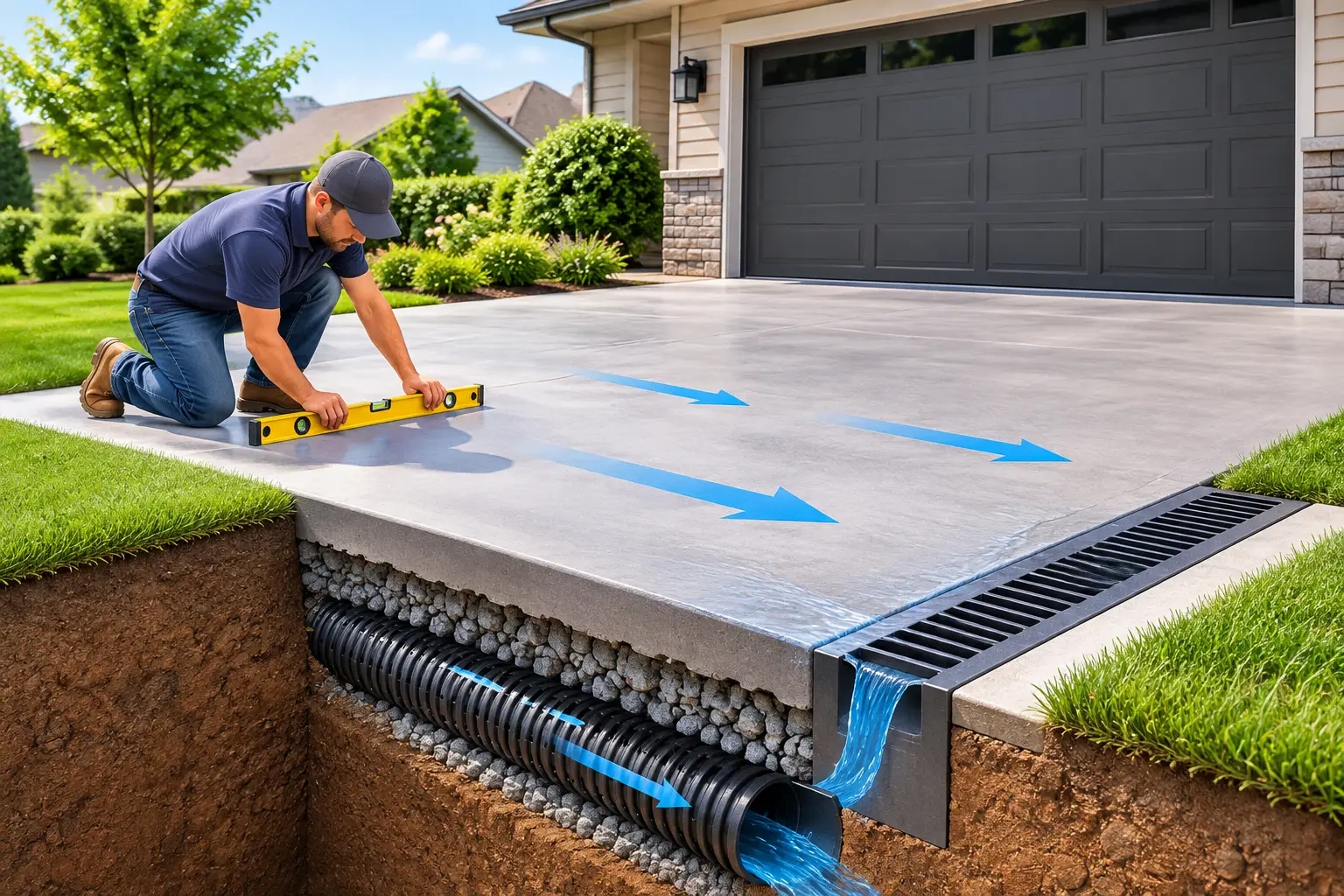
A driveway can look level, clean, and properly finished while still sending every hard rain toward the garage, foundation, or neighboring property. That is why learning how to grade driveway drainage starts before concrete is poured. The finished surface matters, but the real work is in the elevations, base preparation, and path water takes after it leaves the pavement.
In Corpus Christi and across the Coastal Bend, short, heavy storms can expose drainage mistakes quickly. Flat terrain, coastal soils, and existing homes or commercial buildings often leave little room for error. A properly graded driveway moves water away from structures, avoids standing water, and supports a concrete slab that is less likely to settle, crack, or deteriorate prematurely.
Start With the Water’s Destination
Before choosing a slope, identify where the runoff can safely go. Water should move away from the house, garage, and building foundations toward a suitable low point, drainage swale, curb, street inlet, or approved drainage area. It should not be directed onto a neighbor’s lot, against a fence, or into a spot that already stays wet.
Walk the property after a rain if possible. Look for puddles at the garage entrance, water marks on masonry, eroded soil along the driveway edge, and areas where the lawn remains soft for days. These conditions reveal the real drainage pattern better than a quick visual inspection on a dry afternoon.
The street is often the natural outlet for a front driveway, but it is not automatically the answer. Local curb elevations, sidewalks, drainage ditches, and municipal requirements can affect the design. On rural or larger properties, runoff may need to reach a swale or properly designed collection system instead. The goal is controlled drainage, not simply moving the problem farther downhill.
How to Grade Driveway Drainage With the Right Slope
A driveway needs enough fall for water to keep moving, but not so much that entering the garage becomes difficult or vehicles bottom out. For many concrete driveways, a slope of about 1% to 2% is a practical target. That equals roughly 1/8 inch to 1/4 inch of fall per foot.
For example, a 20-foot driveway section at a 1% slope drops about 2.4 inches from the high end to the low end. At 2%, it drops about 4.8 inches. Those measurements may seem small, but they make a major difference during a downpour.
The exact grade depends on the property. A driveway that slopes from a garage toward the street usually needs a consistent outward fall. A side-entry driveway may drain across its width toward a swale. On a wide commercial drive or parking area, the pavement may use multiple slopes to move water toward a drain structure or edge collection point.
Avoid treating every driveway as a simple straight slope. Existing structures, lot lines, sidewalks, gates, and drainage routes can require a more detailed layout. The right approach is the one that maintains positive drainage across the entire paved area without creating a sharp transition that damages vehicles or traps runoff.
Measure elevations instead of guessing
A string line and line level can help on a small, straightforward project, but a laser level provides a clearer picture of elevations across the whole site. Establish the fixed points first: garage slab, house foundation, sidewalk, street curb, property boundaries, and any existing drains.
From there, determine the finished driveway elevation at the building and the intended elevation at the outlet. Mark the proposed grade with stakes, string, paint, or grade hubs before excavation begins. This step prevents a common failure: building a driveway that looks right from the street but has a low spot near the garage or along one edge.
Do not assume the existing driveway grade is correct. If the old slab held water, replacing concrete at the same elevation will usually recreate the same issue.
Build the Base to Hold the Grade
Drainage is not only a surface concern. A driveway can lose its intended slope if the soil and base below it move. Poorly compacted fill, soft subgrade, and weak edges allow settlement, which creates low spots where water stands.
After demolition or excavation, the subgrade should be shaped to support the planned finished slope. Soft material should be addressed instead of covered up. Depending on soil conditions and project design, the contractor may need to remove unsuitable material, stabilize the area, add properly graded base, and compact it in controlled lifts.
In South Texas, soil behavior deserves close attention. Some sites contain clay-heavy soils that expand when wet and shrink during dry periods. Other areas have sandy material that can shift if it is not properly contained and compacted. Neither condition is a reason to avoid concrete, but both are reasons to take grading and base preparation seriously.
The concrete thickness, reinforcement, joints, and edge support should also match the expected traffic. A residential driveway used by passenger vehicles has different needs than an access drive serving delivery trucks, work vehicles, or trailers. Heavy loads can damage a slab more quickly when water has already weakened the base beneath it.
Protect the Garage and Foundation
The garage threshold is one of the most sensitive points in driveway drainage. Water should never be allowed to collect directly outside the door or run under it. Where the driveway approaches a garage, the slope must be planned around the threshold elevation, not forced into place after the slab is poured.
Some properties need a trench drain in front of the garage. This is especially useful when the driveway slopes toward the building, when site constraints prevent a clean outward slope, or when a lower garage sits below the surrounding grade. A trench drain collects runoff before it reaches the opening and carries it to an approved discharge point.
A drain is not a substitute for proper grading. It is a backup and collection method for specific conditions. If the surrounding pavement funnels water toward the drain from every direction but the outlet is undersized, blocked, or poorly located, the system can still overflow during a major storm.
Foundation protection also matters beyond the driveway itself. Maintain positive grade away from the home, and do not raise the driveway or adjacent soil so high that it covers weep screeds, siding clearances, or other critical building details. Concrete work has to fit the full site, not just the rectangle being poured.
Plan for Edges, Swales, and Runoff Control
A driveway edge can either guide water safely or create erosion. If water leaves the concrete and drops into bare soil, it may cut a channel alongside the slab, wash out base material, and undermine the edge over time. The solution may be a shaped swale, stabilized soil, curb, gutter, drainage rock, or another site-specific detail.
For larger properties, it helps to think of the driveway as part of the entire drainage system. Roof runoff, neighboring grades, landscape beds, parking areas, and access roads can all add water to the same low point. A driveway that handles its own rainfall may still flood if it receives runoff from the rest of the site.
Watch for these four warning signs after installation: standing water that remains more than a day, water flowing toward a building, soil erosion along the slab edge, and repeated cracking or settlement in the same area. Each can point to a grading, base, or runoff-control issue that should be corrected before it gets worse.
Common Driveway Grading Mistakes
The most expensive mistakes are usually simple ones made early. One is grading by eye instead of verifying elevations. Another is using a very shallow slope that appears flat but cannot move water reliably. A third is directing runoff toward the garage because the street-side elevation was not checked first.
Poor compaction is another major issue. Fresh concrete can hide an unstable base for months, then low spots begin to form as the material below settles. Contractors should also avoid placing concrete over organic material, loose fill, or saturated soil without proper correction.
Finally, do not create a drainage solution that causes a property-line dispute. Water must be managed responsibly. The right plan considers local conditions, existing drainage routes, and any applicable requirements before construction begins.
When Professional Site Grading Is Worth It
A simple replacement on a level lot may only need careful measurement and disciplined concrete work. Projects involving a garage below street level, recurring flooding, retaining walls, drainage channels, commercial traffic, or major elevation changes call for experienced site evaluation.
That is where a contractor can coordinate demolition, base preparation, concrete placement, and drainage features as one job instead of treating each piece separately. Haylo Construction evaluates the full driveway area so the finished concrete is built for the water, traffic, and soil conditions it will face.
A driveway should do more than provide a place to park. Set the grade correctly before the pour, give runoff a safe route, and the finished surface will protect the property every time the next hard rain arrives.