A driveway should carry vehicles, not rainwater. When water pools at the garage, runs toward a foundation, or cuts channels along the edges of the concrete, the problem is usually bigger than a puddle. The best driveway drainage solutions control where water goes before it undermines soil, damages concrete, or creates a slippery entrance.
For property owners in Corpus Christi and across the Coastal Bend, drainage deserves attention from the start. Heavy rain, flat lots, coastal weather, and shifting soils can expose weak grading fast. A good drainage plan protects the driveway itself, but it also helps protect adjacent structures, landscaping, sidewalks, and parking areas.
Start With Proper Driveway Grading
The strongest drainage system is often built into the driveway layout. Concrete needs a deliberate slope that moves water away from buildings and toward a safe discharge area. If a driveway is level, back-pitched toward the garage, or blocked by raised edges, water has nowhere useful to go.
For many residential driveways, the concrete should slope away from the home and carry runoff toward the street, a swale, or a suitable collection point. The exact pitch depends on the size of the driveway, nearby elevations, local drainage conditions, and where runoff is legally allowed to discharge. Too little slope allows standing water. Too much can create a steep approach, make parking less comfortable, and send water too quickly toward another problem area.
Proper grading starts below the concrete. The subgrade must be prepared, compacted, and shaped so the slab has consistent support. Placing new concrete over poorly graded, soft, or saturated ground may hide the issue for a while, but water can continue moving beneath the slab. That can lead to settlement, cracking, edge failure, and uneven sections over time.
Best Driveway Drainage Solutions for Common Problems
The right solution depends on what the water is doing, not simply where it is visible. A contractor should identify the source of runoff, the low point, soil conditions, existing drainage paths, and any nearby structures before recommending a fix.
Surface Grading and Swales
A shallow swale is a graded channel that guides water across a yard or open area. It can be an effective option when there is enough space beside or below the driveway and water can be directed away from structures without affecting neighboring property.
Swales are often a practical choice for larger residential lots, commercial sites, and driveways with open side yards. They cost less than installing extensive drain piping in some situations, but they need room to work. They are not a good fit where a narrow property line, fence, retaining wall, or building leaves no place for surface runoff to travel.
Trench Drains at Garage Entrances
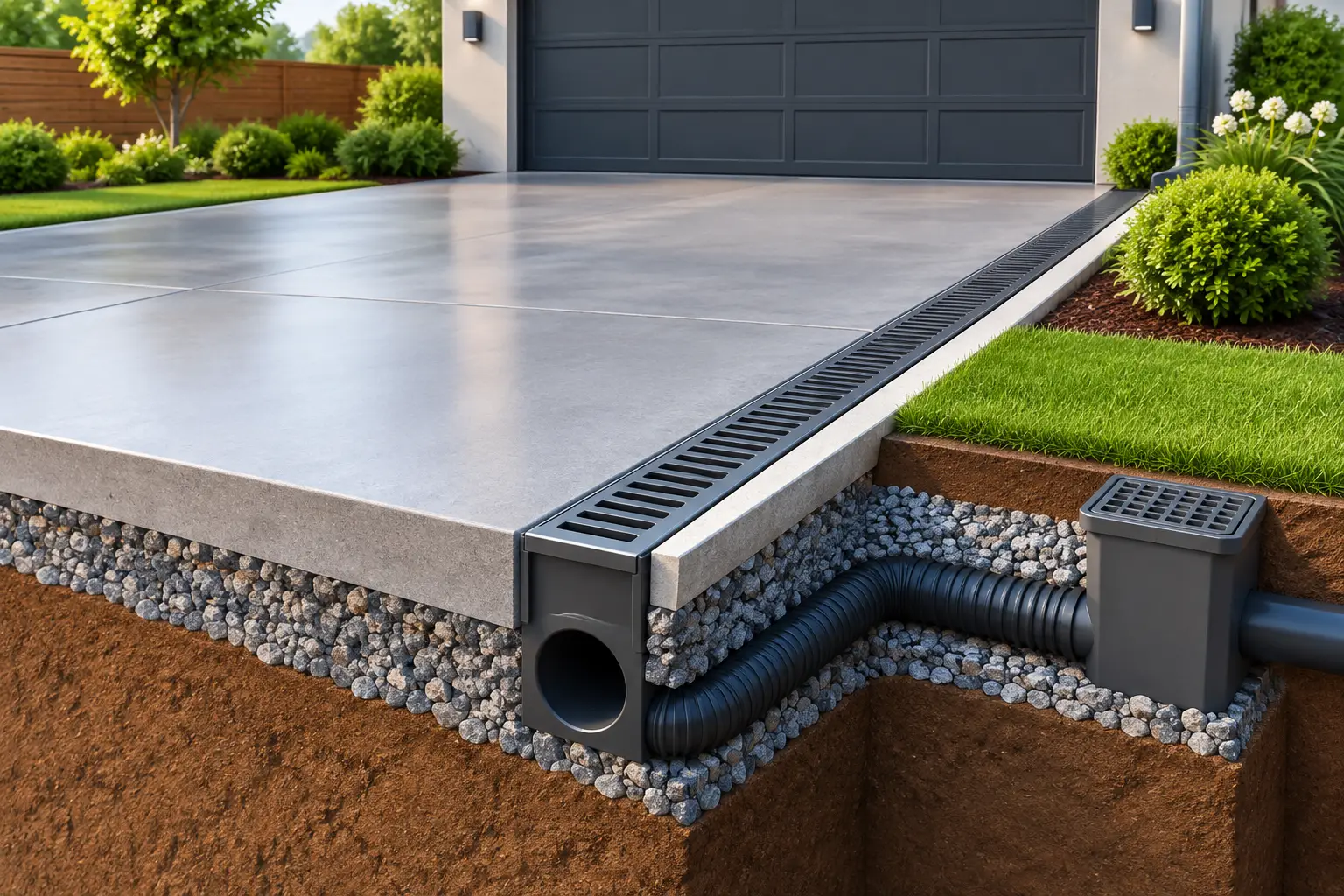
A trench drain, also called a channel drain, is one of the most effective choices for a driveway that slopes toward a garage, carport, shop, or commercial entrance. It is installed across the path of water before the doorway, collecting runoff in a long narrow channel and moving it through a connected outlet pipe.
This system is especially useful when regrading the entire driveway is not realistic. A trench drain can intercept water at the critical location, but it must have a proper outlet. Installing a drain channel without a workable place for water to go only moves the problem underground. The grate also needs routine cleaning so leaves, sediment, and debris do not block flow.
Catch Basins for Low Spots
Catch basins collect runoff at specific low points. They are commonly used where several paved surfaces meet, such as the bottom of a sloped driveway, near parking areas, or at the corner of a concrete pad. Water enters through a grated inlet and travels through underground pipe to an approved discharge point.
Catch basins work well when a single area consistently holds water. They are not a substitute for correcting widespread bad slope. If the surrounding concrete is pitched incorrectly, a basin may have to handle more water than it was designed for, and debris can collect quickly during storms.
French Drains Along Driveway Edges
A French drain is a perforated pipe surrounded by washed gravel, usually wrapped in filter fabric. It is designed to collect water moving through the soil rather than heavy surface flow rushing across concrete. Along a driveway edge, it can help relieve wet ground, protect landscaping, and reduce water pressure near a retaining wall or foundation area.
French drains are useful where groundwater, saturated soil, or runoff from an adjacent yard is contributing to the problem. They are less effective as the only solution for a driveway that receives fast, concentrated sheet flow in a heavy rain. In that case, surface grading or a trench drain usually needs to do the main work.
Culverts and Driveway Cross Drains
Properties with roadside ditches or natural drainage paths may need a culvert beneath the driveway. This allows water to continue moving through the ditch line rather than backing up on one side of the entrance.
Culvert size, elevation, and placement matter. An undersized pipe can clog or restrict flow, while a poorly installed pipe can cause erosion at the ends and weaken the driveway approach. Depending on the location, municipal or county requirements may apply before altering a roadside ditch or drainage route.
When Driveway Drainage Requires Concrete Repair
Drainage problems often leave visible evidence in the concrete. Cracks that widen near a low corner, settled sections, exposed aggregate at the edges, and soil washing out beside the slab are signs that water may be affecting support below or around the driveway.
A surface patch may improve appearance, but it will not correct water moving under the slab. If portions of the driveway have settled or cracked due to poor drainage, the repair plan may include removing damaged concrete, rebuilding the base, correcting the grade, and installing collection drains where needed. This approach costs more than a cosmetic repair, but it addresses the cause instead of repeating the same failure.
For commercial properties, drainage also affects safety and operations. Standing water near parking stalls, loading areas, storefront entrances, and accessible routes can create slip hazards and accelerate pavement damage. A drainage assessment should account for vehicle traffic, pedestrian paths, curb lines, existing utilities, and stormwater requirements.
Drainage Mistakes That Create Bigger Problems
The most common mistake is sending water away from one structure without considering where it ends up next. Directing roof or driveway runoff toward a neighbor, a property line, a retaining wall, or a low area beside a foundation can create liability and damage.
Another mistake is treating every wet area with gravel. Gravel can improve the appearance of a muddy edge, but it does not automatically provide drainage. Without proper slope, filter fabric, and a place for water to exit, gravel can fill with sediment and remain wet.
Drainpipe installation also needs care. Pipes should have consistent fall, secure connections, suitable cleanouts where appropriate, and protection from crushing under vehicle areas. A buried pipe that is flat, clogged, or damaged is difficult to diagnose after concrete has been poured above it.
Choosing the Right Contractor and Scope
A reliable driveway drainage project begins with site evaluation, not a one-size-fits-all recommendation. The contractor should inspect the driveway elevation, existing runoff patterns, nearby structures, soil condition, drainage outlets, and the condition of the concrete. For replacement work, those details should be resolved before the new driveway is placed.
Ask how water will move during a hard rain, where the system will discharge, and what maintenance the installed components will require. A clear answer matters more than a vague promise that the driveway will drain better. For projects involving public ditches, substantial grading, or commercial stormwater concerns, confirm whether permits or local approvals are required.
Haylo Construction helps property owners plan concrete and site work with drainage, durability, and long-term performance in mind. A properly graded driveway with the right drainage measures is easier to maintain, safer to use, and far less likely to become the source of the next expensive repair.
Before replacing a driveway or covering another low spot with patch material, have the water path evaluated. The best fix is the one that gives rain a controlled route away from the concrete and the property you need to protect.