A driveway usually does not fail in the middle first. It breaks at the edges, where tires ride too close, soil gives way, and water starts working underneath the slab. That is why concrete driveway edge reinforcement matters. If the edge is weak, the whole driveway becomes more vulnerable to cracking, spalling, and settlement long before the main slab should be wearing out.
For homeowners and property managers, edge failure is often frustrating because the driveway can still look solid from a distance. Then a corner chips off, a side drops, or a long crack starts running in from the perimeter. In many cases, the problem is not the concrete mix alone. It is the support system around it, the reinforcement inside it, and the way the site handles water after every storm.
Why driveway edges fail first
Driveway edges take more abuse than most people realize. They do not have support on both sides like the middle of the slab does. One side is carrying vehicle loads, and the other side may be exposed to soft soil, landscaping, irrigation, or erosion. When the base under that outer section shifts or washes out, the edge starts acting like a shelf with less backing underneath.
That problem gets worse when heavy vehicles use a residential driveway not designed for that weight. Delivery trucks, work trailers, RVs, and dumpsters can overload the perimeter, especially when drivers cut turns tightly near the edge. Even a well-finished driveway can crack early if the slab thickness, base prep, and reinforcement were not matched to actual use.
In South Texas, weather and soil movement add another layer. Heat, sudden rain, drainage issues, and expansion-contraction cycles can all stress a slab. Along coastal areas, moisture management is a big part of concrete performance. If water sits near the slab or repeatedly softens the subgrade, edge stability drops fast.
What concrete driveway edge reinforcement actually does
Concrete driveway edge reinforcement is not one single product or method. It is a combination of design choices that help the outer section of the slab resist cracking, breaking, and settlement. The right approach depends on the driveway layout, expected traffic, soil conditions, and how water moves across the property.
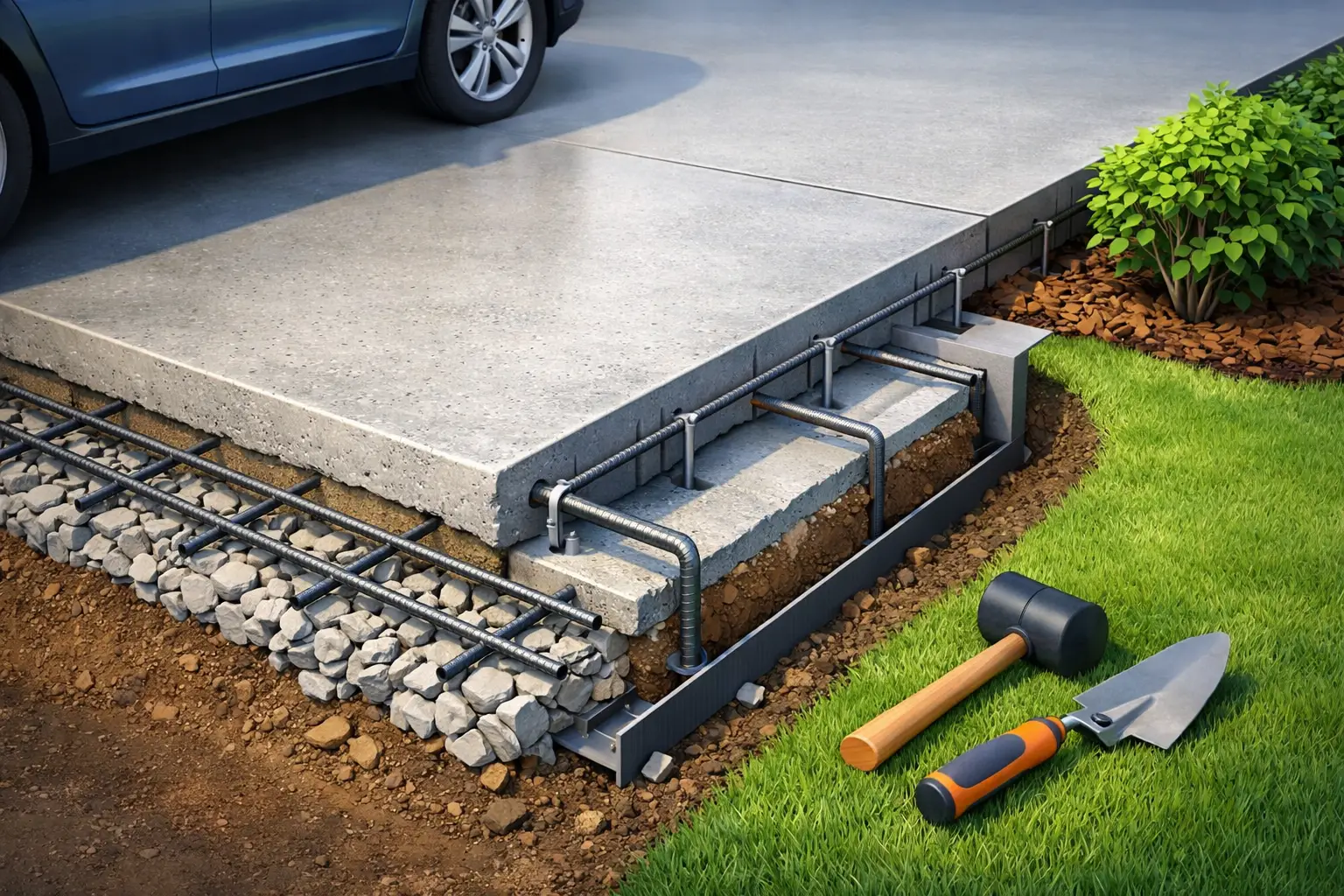
At the slab level, reinforcement helps control crack behavior and adds strength across vulnerable areas. That may include rebar, wire mesh, or fiber reinforcement, depending on the project. Around the slab, edge support can also include thicker perimeter sections, properly compacted base material, and grading that keeps runoff from washing out the shoulder.
The important point is this: reinforcement is only part of the answer. Steel inside a slab cannot make up for poor subgrade prep or bad drainage. If the base is unstable, the edge can still settle, crack, or break off even with reinforcement present.
Common reinforcement methods that work
Rebar in the driveway perimeter
For many driveways, rebar is one of the most reliable ways to strengthen slab edges. When placed correctly, it helps the concrete handle tension forces and reduces the chance that edge cracks turn into full breakouts. Rebar is especially useful where vehicles will regularly load the perimeter or where the driveway transitions into the street, a parking area, or a gate entrance.
The key is proper placement. Rebar that sits too low, too high, or without enough coverage will not perform the way it should. It also needs to work with the slab thickness and not be treated as a shortcut for underbuilt concrete.
Thickened edges
A thickened edge gives the perimeter more mass and more bearing strength. This is a practical option when the outside of the driveway has limited lateral support or when the soil profile calls for a stronger edge section. In real-world terms, a thickened edge can better resist chipping and help reduce the risk of vertical drop-off along the sides.
This approach is often valuable in areas where the driveway borders lawn, shell, or open soil rather than curb and gutter. It gives the edge more ability to handle occasional off-center loading.
Compacted base and subgrade stabilization
This is the part many property owners do not see, but it is often what decides whether the edge lasts. A properly compacted base distributes weight more evenly and helps prevent voids under the slab. If the soil is soft, wet, or inconsistent, stabilization may be needed before any concrete is poured.
Without that support, edge reinforcement inside the slab is doing too much work. The concrete may still crack because the problem is below it, not inside it.
Fiber reinforcement and welded wire mesh
These can play a role, but they need to be chosen for the right application. Fiber reinforcement can help with shrinkage cracking and overall slab performance, while wire mesh may add crack control if it is installed properly and kept in position during the pour. Neither should be treated as a cure-all.
For some driveways, especially those carrying heavier use, rebar and stronger edge design may offer better long-term value. It depends on traffic, thickness, and site conditions.
Concrete driveway edge reinforcement and drainage go together
A driveway edge can be reinforced well and still fail if water is allowed to sit beside it. That is why drainage has to be part of the conversation from the start. Water softens supporting soils, creates erosion channels, and can leave parts of the slab unsupported over time.
Good grading moves runoff away from the driveway instead of trapping it along the perimeter. In some cases, that means reshaping the surrounding area. In others, it means adjusting elevation, adding drainage features, or changing how downspouts and yard flow discharge near the concrete.
This is one reason experienced contractors look at the whole site, not just the formwork. A clean finish means very little if the water path is wrong. At Haylo Construction, that practical approach matters because driveway performance in coastal Texas depends on more than what happens on pour day.
Signs your driveway edges need attention
Some edge problems start small and are easy to ignore. That usually costs more later. If you notice crumbling along the sides, corners breaking away, visible settlement, or long cracks starting from the perimeter, the driveway may already be losing support.
You may also see soil pulling away from the slab, standing water near one side, or tire tracks running dangerously close to a weak edge. On commercial or multi-vehicle properties, those conditions can get worse quickly. Once chunks begin breaking off, the slab is exposed to more water intrusion and heavier stress at the damaged point.
Not every edge crack means full replacement is required. Some driveways can be repaired or stabilized if the damage is caught early. But if the failure is tied to poor base preparation, thin concrete, or widespread washout, patching alone usually does not hold up.
When reinforcement should be part of a new driveway project
The best time to address edge strength is before the concrete is poured. That is when slab thickness, reinforcement type, base depth, and drainage can all be planned together. Retrofitting strength into a failing edge is much harder than building it right the first time.
For residential driveways, that means thinking honestly about use. If the driveway will carry more than standard passenger vehicles, the design should reflect that. For commercial access areas, service entries, or properties with regular trailer traffic, stronger edge design is not optional.
This is also where local experience matters. Soil behavior, rainfall patterns, and site grading in the Corpus Christi area are not the same as inland markets with different conditions. A contractor who understands local concrete performance will know where edges typically fail and how to reduce that risk.
The trade-off between upfront cost and long-term durability
Some owners hesitate when reinforcement adds to the initial price. That is understandable. But edge failure is one of the most common reasons a driveway looks old before its time, and repair work is rarely as clean or cost-effective as proper installation.
There is no single best reinforcement package for every property. A light-duty residential driveway may need a different solution than a long approach, a shared access drive, or a commercial entrance. What matters is matching the build to the load, the soil, and the drainage conditions.
Cutting corners at the perimeter is a mistake because the edge is where real-life use shows up first. Tires drift. Water moves. Soil shifts. That is why dependable concrete work starts below the surface and carries all the way to the outside line of the slab.
If you are planning a new driveway or dealing with failing edges on an existing one, treat the perimeter like a structural detail, not a cosmetic one. A stronger edge gives the whole driveway a better chance to hold its shape, carry the load, and stay serviceable for years.