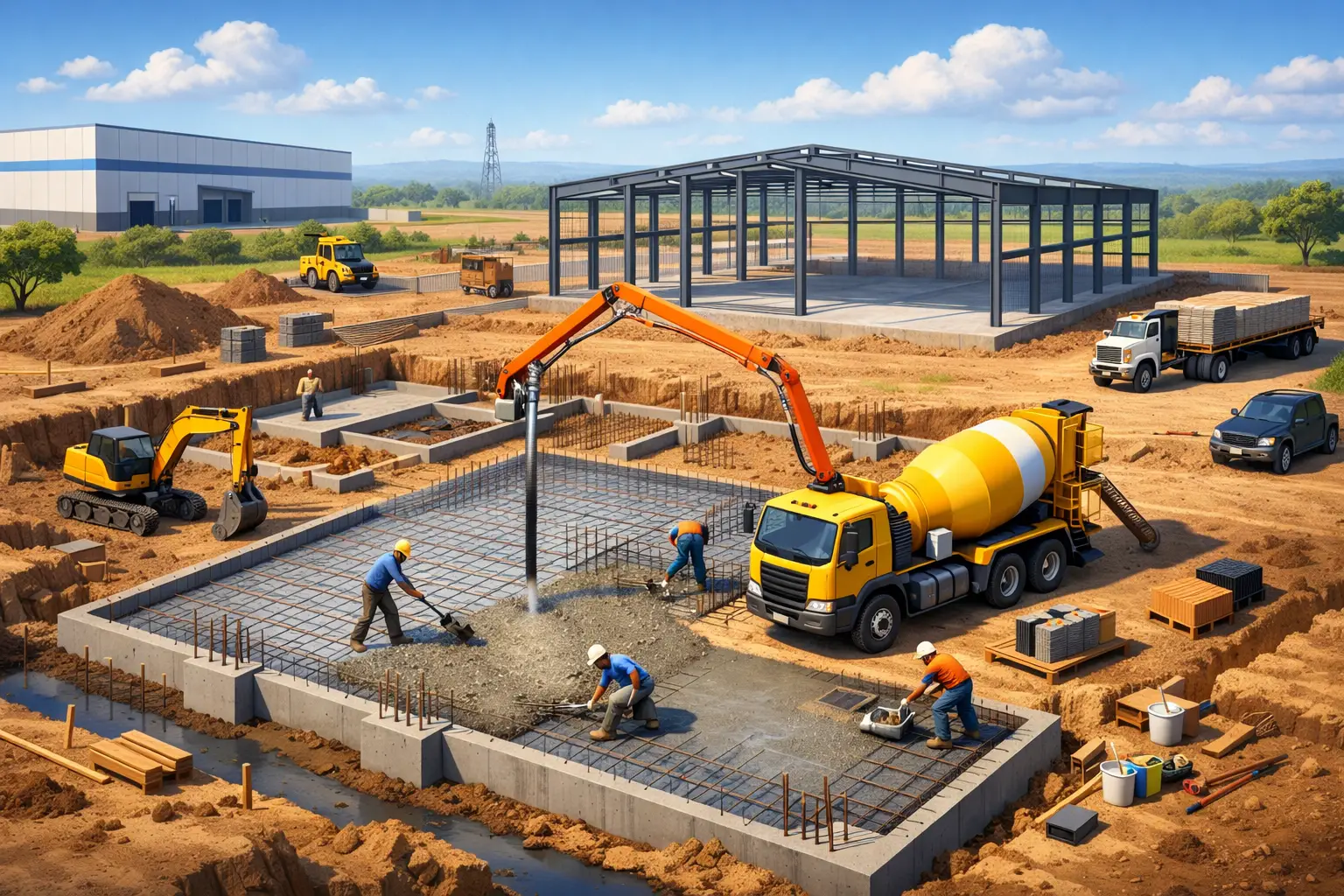
A warehouse floor can look fine on the day the concrete is placed and still become an expensive problem months later. When selecting a warehouse foundation contractor, South Texas owners need more than a crew that can pour a large slab. They need a contractor that understands site preparation, coastal soil conditions, drainage, reinforcing, truck traffic, and the operational demands placed on an industrial building every day.
Warehouse foundations carry more than the structure above them. They support racks, forklifts, inventory, loading activity, equipment, and the constant movement that comes with a working facility. A poorly prepared subgrade or underbuilt slab can lead to cracking, settlement, standing water, uneven rack lines, and repair work that disrupts operations. The right plan starts below the concrete.
What a Warehouse Foundation Must Handle
A warehouse foundation is not a residential slab scaled up to a larger footprint. Its design and construction requirements depend on the building, the site, and how the space will be used. A light-storage warehouse, for example, has different needs than a distribution center with loaded forklifts, pallet racking, dock traffic, or heavy machinery.
The first question is what loads the slab and foundation system must support. Point loads from rack legs, equipment pads, and columns can be more demanding than general floor traffic. Forklift routes can create repeated stress in the same areas. Loading docks, truck aprons, and exterior approaches need their own attention because they receive concentrated weight and are exposed to weather.
Foundation work also has to account for the building layout. Column locations, wall lines, door openings, utility penetrations, dock elevations, and expansion plans all affect how the project should be prepared. A contractor should review these details before earthwork and concrete placement begin, not try to work around them after forms are set.
Warehouse Foundation Contractor South Texas: Local Conditions Matter
South Texas construction requires practical planning for heat, rainfall, drainage, and variable ground conditions. Along the Coastal Bend, moisture movement and poorly controlled runoff can affect the soil supporting a slab. Water that ponds around a warehouse, runs toward a building, or enters poorly compacted fill can contribute to settlement and long-term performance issues.
Proper grading is one of the most valuable parts of the job. The finished site should direct water away from the building while maintaining the elevations needed for paving, docks, access drives, and drainage features. This is especially important on commercial sites where large roof areas shed significant amounts of water during heavy rain.
The subgrade needs equal attention. Before concrete is placed, the site may require clearing, demolition, excavation, fill placement, moisture conditioning, and compaction. The exact approach depends on site conditions and the engineer’s requirements. Skipping this work to move faster can create a slab that looks good initially but lacks uniform support underneath.
Concrete placement also needs to be managed for South Texas heat. High temperatures can shorten working time and affect finishing if the crew is not prepared. A capable contractor plans labor, delivery timing, joint layout, curing, and placement sequence to protect the finished surface and reduce unnecessary cracking.
Start With the Site, Not the Pour
The most dependable warehouse foundation projects begin with a clear scope and a realistic look at existing conditions. Before construction starts, the contractor should understand access to the site, existing structures, underground utilities, elevations, drainage paths, and whether demolition or removal is required.
For a new warehouse, the project may involve full site preparation before foundation work begins. For an expansion or replacement project, crews may need to remove old concrete, protect active operations, manage debris, and tie new work into existing paving or foundations. Those conditions affect cost, schedule, and the construction sequence.
A good contractor will also identify what is outside the contractor’s design responsibility. Structural foundation dimensions, reinforcement schedules, and load requirements should follow approved engineering and project plans where required. The contractor’s role is to build those plans accurately, coordinate the site work, and raise concerns early when field conditions do not match what is shown on paper.
That distinction matters. No contractor should guess at a warehouse slab thickness or reinforcing plan without understanding the building use and design requirements. The goal is not to overbuild every project. It is to build the right system for the actual loads, site conditions, and future use of the facility.
Key Construction Details That Protect the Investment
Concrete strength matters, but it is only one part of warehouse foundation performance. A sound project combines suitable concrete, correctly placed reinforcement, stable support below the slab, properly located joints, and controlled curing after placement.
Reinforcement must be installed at the specified location, not left resting on the subgrade where it provides less benefit. Forms and elevations need to be checked before the pour so wall lines, dock areas, and transitions are built accurately. Joint layout should be planned around the slab geometry, columns, and anticipated traffic whenever possible.
Edges and transitions deserve special attention. A warehouse may connect to exterior paving, a loading area, a dock approach, or a separate equipment pad. If those connections are not planned correctly, traffic can create edge failures, differential movement, or water entry points. The same is true around drains, sleeves, pits, and utility penetrations.
Curing is another step that should not be treated as an afterthought. Concrete gains strength over time, and the curing process helps support surface durability and long-term performance. Rushing heavy traffic onto a new slab before it is ready can damage a job that was otherwise placed correctly.
Questions to Ask Before Hiring a Contractor
Commercial property owners and developers should look past a basic price comparison. A low number may leave out earthwork, drainage work, demolition, reinforcement, haul-off, or other items needed to finish the project correctly. Clear scope language helps prevent change orders caused by assumptions.
Ask how the contractor plans to prepare and compact the subgrade, manage water around the building, and coordinate concrete placement. Ask whether they can handle associated work such as demolition, excavation, grading, and exterior paving. A contractor that can manage these connected services can reduce handoffs and keep the site moving in the right order.
It is also reasonable to ask about scheduling around active operations. An occupied warehouse may need phased construction, protected travel routes, temporary access, dust control, and a plan for keeping employees and deliveries separated from construction activity. Safety and communication matter as much as production speed on an active commercial site.
Finally, make sure the contractor is clear about permits, inspections, engineering coordination, and site access requirements. Warehouse work often involves multiple parties, from owners and general contractors to engineers, utility providers, and tenants. Straight answers early in the process make the work easier to manage later.
Build for Operations, Not Just Opening Day
The best time to think about future warehouse use is before construction. An owner may expect current forklift traffic to be light, then add taller racks, heavier inventory, or new equipment within a few years. A building may need future dock additions, fenced storage, expanded parking, or a new access drive.
Not every project should be designed for every possible future scenario. That can add unnecessary cost. But discussing likely operational changes helps owners make smarter decisions about foundation details, paving connections, drainage capacity, and where to leave room for expansion.
Haylo Construction provides concrete, demolition, grading, and site-related services for commercial projects across Corpus Christi and nearby South Texas communities. For warehouse work, that connected capability matters because the foundation is only as dependable as the ground preparation, drainage, and surrounding site work supporting it.
A warehouse foundation should give your operation a stable place to grow, not a list of repairs waiting to happen. Start with a clear scope, qualified plans, and a contractor prepared to do the work below grade with the same care as the finished concrete.