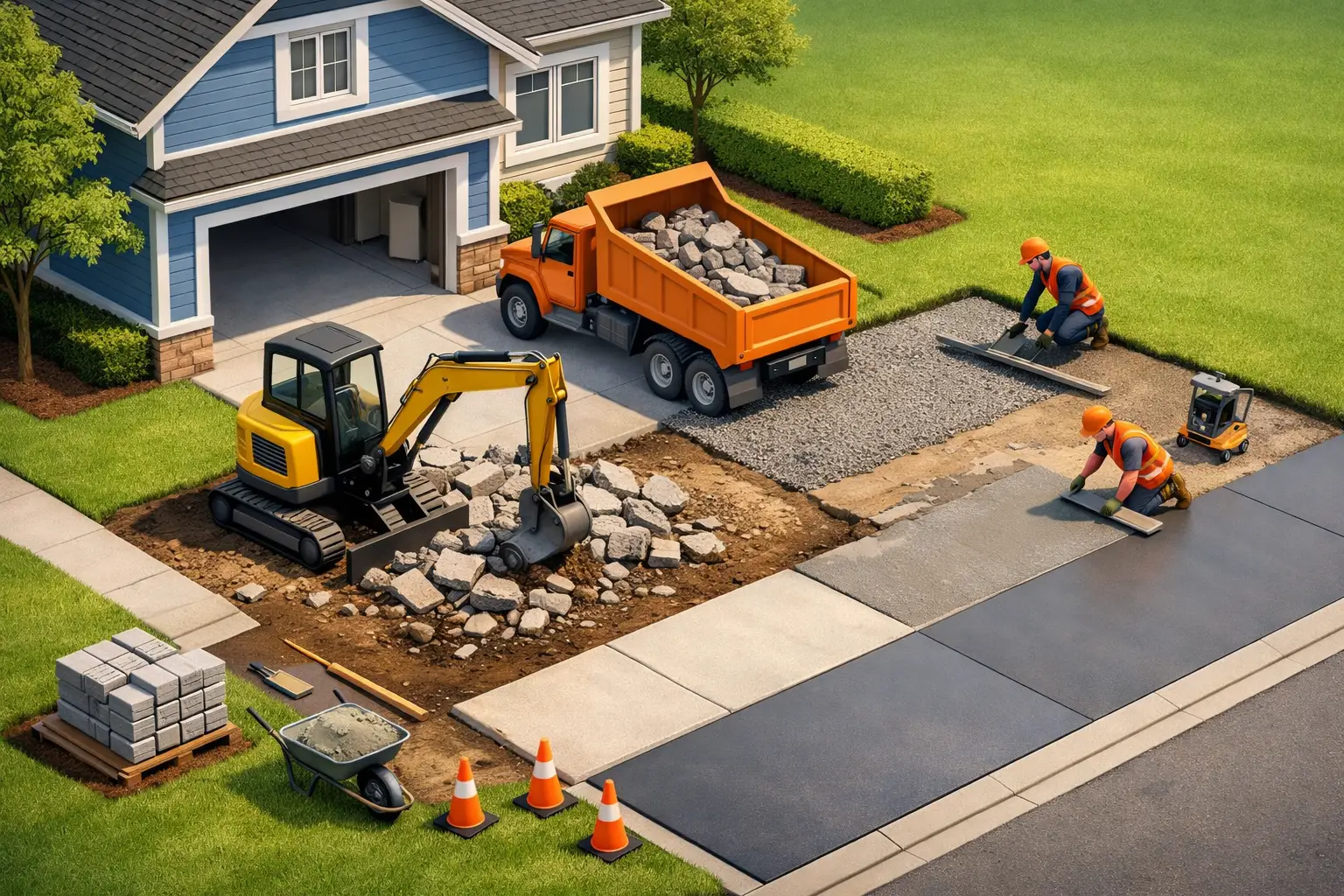
A driveway usually tells you what is wrong before it fully fails. Wide cracks, low spots that hold water, broken edges, and sections that shift under vehicle weight are all signs the slab is past a simple patch job. If you are comparing residential driveway replacement steps, the real goal is not just getting new concrete in place. It is making sure the base, drainage, reinforcement, and finish are built to last.
For homeowners, replacement is often the better investment once damage is structural instead of cosmetic. Surface repairs can buy time, but they do not fix weak subgrade, poor slope, or concrete that has reached the end of its service life. A proper replacement starts well before the truck arrives and ends well after the final finish is applied.
When replacement makes more sense than repair
Not every driveway needs to be torn out. If the problem is limited to a few small surface cracks or minor scaling, repair may still be worthwhile. But if you have repeated cracking across multiple sections, settled panels, drainage issues near the garage, or crumbling edges, patching usually turns into a short-term fix.
In coastal and South Texas conditions, soil movement and heavy rain can make weak spots worse fast. Water getting under the slab can soften the base and lead to more settling. Once that cycle starts, replacing the driveway the right way is often the cleaner and more cost-effective move.
Residential driveway replacement steps that matter most
Homeowners often think the job starts with demolition. In reality, the first step is a clear site evaluation. A contractor should inspect the current driveway, check thickness, look for settlement patterns, review drainage flow, and identify anything nearby that affects the work, such as sidewalks, utilities, fences, or garage elevations.
That early review shapes the rest of the project. If water has been running back toward the house, the replacement plan needs to correct slope. If vehicles are heavier than normal, the slab design may need thicker concrete or stronger reinforcement. If access is tight, equipment and staging have to be planned before work begins.
Step 1: Inspection, measurements, and scope
A reliable replacement starts with accurate measurements and a realistic scope of work. That includes the driveway dimensions, thickness targets, demolition limits, and whether adjoining sections need to be tied in or adjusted. This is also the time to confirm permits or neighborhood requirements if they apply.
Homeowners should expect straight answers here. What is being replaced, what is being protected, how drainage will work, and what the timeline looks like should all be clear before the job starts.
Step 2: Demolition and removal
The old concrete has to come out completely if the goal is a long-lasting replacement. Partial tear-outs can make sense in some cases, but only when the remaining sections are structurally sound and compatible with the new work. If the base under the old slab has failed, leaving part of it behind can create a weak transition.
Demolition should be controlled and safety-focused, especially around garage slabs, walkways, irrigation lines, and nearby structures. Clean removal matters. Broken concrete, loose debris, and leftover material can interfere with proper grading if they are not fully cleared.
Step 3: Subgrade preparation and grading
This is one of the most important residential driveway replacement steps, and it is where many failures begin. Concrete is only as strong as what sits under it. If the subgrade is soft, uneven, or poorly compacted, the new driveway can settle and crack long before it should.
After demolition, the exposed area should be shaped and compacted to support the slab evenly. In some projects, unstable material has to be removed and replaced with a stronger base. Proper grading also sets the direction of water runoff. That is critical in areas where heavy rain can quickly expose bad drainage decisions.
A driveway should move water away from the house and not create ponding near the slab. Getting the slope right now prevents a lot of trouble later.
Step 4: Base installation
Depending on site conditions, a compacted base layer may be installed to improve support and drainage. This step helps distribute weight and creates a more stable platform for the concrete. The exact base depth and material can vary based on soil conditions, driveway use, and local requirements.
This is also the stage where shortcuts cause expensive problems. A base that looks level but is not properly compacted can settle after the first season of rain and traffic. Good prep work is not flashy, but it is what gives the finished driveway real durability.
Step 5: Forms, reinforcement, and thickness control
Once the base is ready, forms are set to establish the driveway shape, edges, and final elevation. The forms need to be solid because they control alignment and help keep the pour consistent. This is also where transitions to sidewalks, streets, and garage slabs are fine-tuned.
Reinforcement is added based on the slab design. That may include rebar, wire mesh, or both. Reinforcement does not stop all cracking, but it helps the slab perform better by improving structural strength and crack control. Thickness matters too. A driveway built for everyday residential use needs enough concrete to handle vehicle loads without being underbuilt.
Step 6: Pouring and finishing the concrete
The pour has to be coordinated, efficient, and weather-aware. Concrete placement is not just about filling forms. It has to be spread evenly, consolidated as needed, and finished at the right time. If crews rush the surface or work it too much, the slab can lose strength or finish poorly.
A proper finish gives the driveway a clean appearance and usable texture. Most residential driveways need a surface that provides traction without being rough or inconsistent. Joint placement also happens during this stage. Control joints help guide shrinkage cracks so the slab cracks where planned instead of randomly across the surface.
Step 7: Curing and protection
Fresh concrete is not ready for traffic the next day just because it looks finished. Curing is what allows the slab to gain strength over time. If the surface dries too fast or is opened to use too early, the driveway can lose durability.
Weather plays a big role here. Heat, wind, and direct sun can affect curing speed, especially in South Texas. Contractors should protect the slab and give homeowners clear instructions about foot traffic, vehicle traffic, and when normal use can resume.
Step 8: Cleanup and final walkthrough
A professional replacement should end with a clean site and a clear final review. That means debris removal, form removal, edge cleanup, and a walkthrough of the completed work. Homeowners should know what to expect during the first few weeks, including normal color variation, curing timelines, and basic maintenance.
Good communication at the end of the job is just as important as the beginning. It is the difference between a project that feels managed and one that leaves the homeowner guessing.
What can change the scope or cost
Driveway replacement is not one-size-fits-all. The price and timeline can shift based on the size of the slab, thickness requirements, access to the site, drainage corrections, amount of demolition, and whether nearby concrete has to be adjusted. Decorative finishes, widened layouts, and apron replacements can also affect the scope.
So can hidden conditions. Once demolition starts, a contractor may find poor soil, buried debris, old repairs, or drainage issues that were not fully visible from the surface. That does not always mean a major increase, but it is why a thorough estimate and honest field review matter.
Questions homeowners should ask before work starts
Before hiring a contractor, ask how the base will be prepared, what reinforcement is included, how thick the slab will be, how water will drain, and how long curing will take before vehicles can use it. Those answers tell you a lot about whether the contractor is focused on appearance only or long-term performance.
It also helps to ask who is handling demolition, site prep, and concrete installation. A contractor that can manage the full process usually has better control over scheduling, accountability, and final quality. For homeowners in Corpus Christi and surrounding areas, local experience matters because coastal weather, drainage, and soil conditions are not minor details. They directly affect how a driveway performs.
Aftercare matters more than most homeowners think
Once the driveway is in place, a little care goes a long way. Avoid early heavy loads, keep runoff moving where it should, and address nearby drainage issues before they start washing out the edges. If the slab is sealed, follow the recommended timing for reapplication. If small issues show up later, deal with them early instead of waiting for them to spread.
A driveway replacement is a real investment in the function and appearance of your property. Done right, it improves access, drainage, curb appeal, and long-term value. Haylo Construction approaches that work the same way it should be approached on any property – with solid prep, clear communication, and a focus on durability that holds up after the crew leaves.