A concrete slab can look rough on the surface and still have years left in it. It can also look like a minor problem and already be failing underneath. That is why concrete repair vs replacement is not a guesswork decision. If you choose too small a fix, you spend money twice. If you replace concrete that could have been repaired, you take on more cost and downtime than necessary.
For homeowners, property managers, and business owners, the right call usually comes down to four things: the cause of the damage, how far it has spread, whether the concrete is still structurally sound, and what kind of traffic the area handles every day. A driveway, parking lot, foundation, walkway, or slab does not all get judged by the same standard. The real question is not whether the surface looks bad. It is whether the concrete can still do its job safely and hold up long term.
How to judge concrete repair vs replacement
The first step is to stop looking only at the crack or broken edge. Concrete problems usually start below or around the slab, not just on top of it. Poor drainage, soil movement, erosion, weak subgrade prep, salt exposure, heavy loads, and age all matter. Along the Texas coast, moisture swings, heat, and ground movement can speed up wear, especially where drainage was not handled properly from the start.
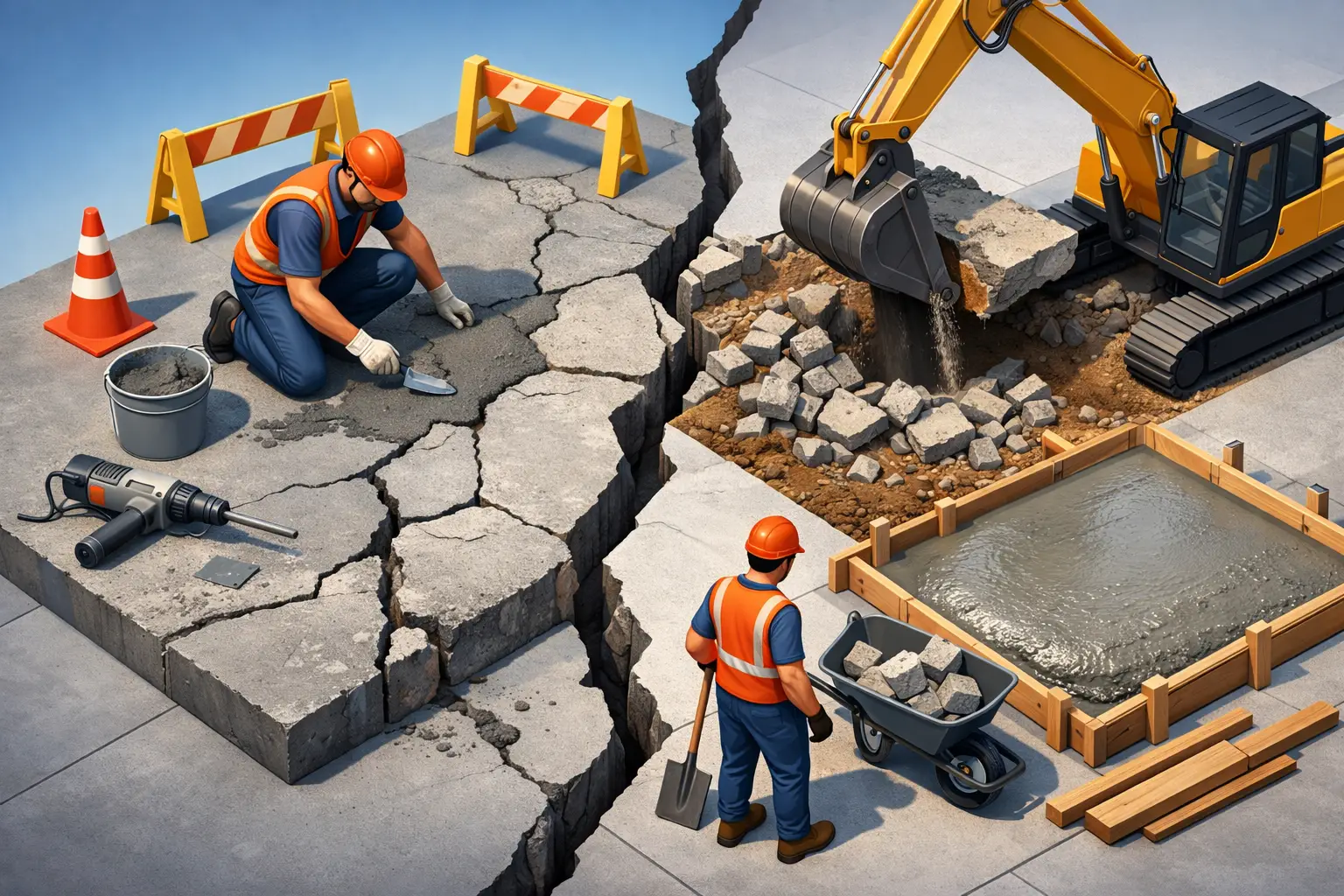
Repair makes sense when the damage is limited and the slab is still fundamentally stable. Replacement makes sense when the concrete has widespread failure, major settlement, or a structural issue that patching will not solve. That sounds simple, but there is a middle ground where experience matters. Some slabs can be cut out and partially replaced. Others need more than cosmetic work but less than a full tear-out.
A contractor should be looking at depth of cracking, edge breakdown, drainage patterns, trip hazards, base failure, and reinforcing conditions if visible. The goal is not to sell the biggest job. The goal is to recommend the option that will last.
When concrete repair is the better option
Concrete repair is usually the smarter move when the slab has isolated damage and the surrounding area remains sound. That might mean a few non-structural cracks, minor surface scaling, joint deterioration, small spalled areas, or localized damage from impact or water intrusion.
If the problem is caught early, repair can extend the life of the concrete without the cost and disruption of full replacement. That matters for driveways, patios, sidewalks, loading areas, and commercial surfaces where downtime affects access and operations.
Repair also makes sense when the underlying issue can be corrected at the same time. For example, if water is collecting along one edge and causing minor deterioration, the repair should address both the damaged section and the drainage issue. If you only patch the surface and leave the water problem in place, the repair will not hold up.
Typical repairs may include crack filling, surface patching, joint repair, partial section replacement, leveling in select situations, or removing and re-pouring a damaged portion instead of the entire slab. The right method depends on the use of the concrete. A residential patio repair is not held to the same performance demands as a commercial parking area with daily vehicle traffic.
Repair is often more budget-friendly up front, but only when it is being used for the right problem. A cheap patch on failing concrete is not a savings. It is a delay.
Signs a repair may be enough
If cracks are narrow and not shifting vertically, if damage is limited to one area, and if the slab is still draining correctly and carrying weight without movement, repair may be a solid option. Surface wear alone does not always justify replacement.
That said, appearance matters too. If decorative concrete has isolated staining or minor chipping, repair may restore function but not create a perfect visual match. Property owners should be realistic about that trade-off. Sometimes the slab can be saved, but the finish will still show its age.
When replacement is the better investment
Replacement becomes the smarter decision when the slab has lost structural reliability. That includes widespread cracking, sinking, rocking, major heaving, severe surface breakdown, exposed reinforcement, repeated patch failures, or obvious subgrade problems.
This is especially true for concrete that supports vehicles, equipment, walls, or building loads. Once the base has failed or the slab is breaking apart in multiple areas, repairs tend to become a cycle. You patch one section, then another gives way. At that point, replacement is not the expensive option. It is the option that stops ongoing expense.
For commercial properties, replacement can also reduce liability. Uneven sidewalks, broken approaches, and failing parking lots create trip hazards, drainage problems, and poor first impressions. For homeowners, a badly settled driveway or patio can direct water toward the house, damage landscaping, and lower curb appeal.
Replacement also gives you the chance to correct what caused the original failure. That may involve demolition, regrading, improving drainage, compacting or rebuilding the base, adding reinforcement, adjusting thickness, and installing concrete that matches the actual use of the space. A slab is only as good as what is under it and how well it was built.
Red flags that point to replacement
If sections are sinking or lifting, if cracks are wide and spreading, if multiple repairs have already failed, or if the slab shows deep deterioration across a large area, replacement is usually the right call. The same goes for concrete that no longer meets the demands of the property, such as a thin residential slab now being used for heavier vehicles or commercial traffic.
Age alone is not the deciding factor, but older concrete with recurring issues often reaches a point where replacement is more practical than continued repair.
Cost matters, but so does lifespan
A lot of property owners start with one question: which is cheaper? In the short term, repair usually is. In the long term, that depends on whether the slab is still worth saving.
A proper repair can buy years of service life at a fraction of the cost of replacement. But if the concrete is already near the end of its useful life, repair becomes a temporary measure. You may save money this season and spend more overall within the next few years.
Replacement costs more because it includes demolition, haul-off, site prep, formwork, reinforcement, placement, and curing time. It also creates more disruption. Vehicles may need to stay off the area. Access may be limited. Business operations may need to work around the schedule.
Still, new concrete offers a reset. When installed correctly with proper grading and reinforcement, it gives you a longer service life and fewer maintenance headaches. For many owners, that predictability is worth the higher upfront investment.
The coastal factor changes the decision
In South Texas, concrete does not just deal with traffic. It deals with heat, heavy rain, moisture exposure, and shifting ground conditions. Near the coast, drainage and base prep are not side details. They are part of whether the slab lasts.
That is one reason concrete repair vs replacement should be evaluated by someone who understands local conditions. Salt exposure, standing water, and unstable soils can turn a minor surface issue into a bigger structural problem over time. A repair plan that might work in a different region may not last here if the root cause is ignored.
This is where a full-service contractor brings value. If demolition, grading, drainage correction, and replacement all need to work together, the project gets handled more efficiently and with fewer gaps between trades. That matters when the goal is durability, not just getting through the next season.
What a contractor should inspect before recommending either option
Before anyone tells you to patch or tear out concrete, they should inspect more than the obvious damage. The decision should be based on slab thickness where relevant, reinforcement if visible, condition of joints, surrounding drainage, soil support, traffic load, and the history of previous repairs.
They should also ask how you use the space. A homeowner may accept minor cosmetic imperfections on a backyard slab if the structure is sound. A business owner with customer traffic may need a cleaner, safer, more uniform result. A warehouse approach or parking area has to be judged by performance first.
Good recommendations are specific. If repair is enough, you should hear why. If replacement is needed, you should hear what failed and what will be corrected this time.
The right answer is the one that holds up
There is no one-size-fits-all answer to concrete repair vs replacement. Some slabs need a targeted fix and will perform well for years. Others need to be removed and rebuilt the right way so the same problems do not come back.
If you are looking at cracked, uneven, or deteriorating concrete, the best next step is a straight assessment from a contractor who understands structural performance, drainage, and local site conditions. Haylo Construction works with residential and commercial clients who need practical answers, solid workmanship, and results built to last. The right choice is not the quickest patch or the biggest scope. It is the one that makes sense for the condition of the concrete and the demands of the property.