A driveway usually starts getting judged the first time a vehicle turns in. If it puddles after rain, cracks early, or breaks down at the edges, the problem is rarely just the surface. Reinforced concrete driveway installation works when the whole system is built correctly – excavation, base prep, steel reinforcement, grading, joint layout, and concrete placement all have to support each other.
That matters even more in South Texas, where heat, sudden rain, shifting soils, and heavy daily use can punish weak concrete fast. A good-looking pour is not enough. The driveway has to carry weight, shed water, and hold up over time without turning into a repair job a year later.
What reinforced concrete driveway installation actually involves
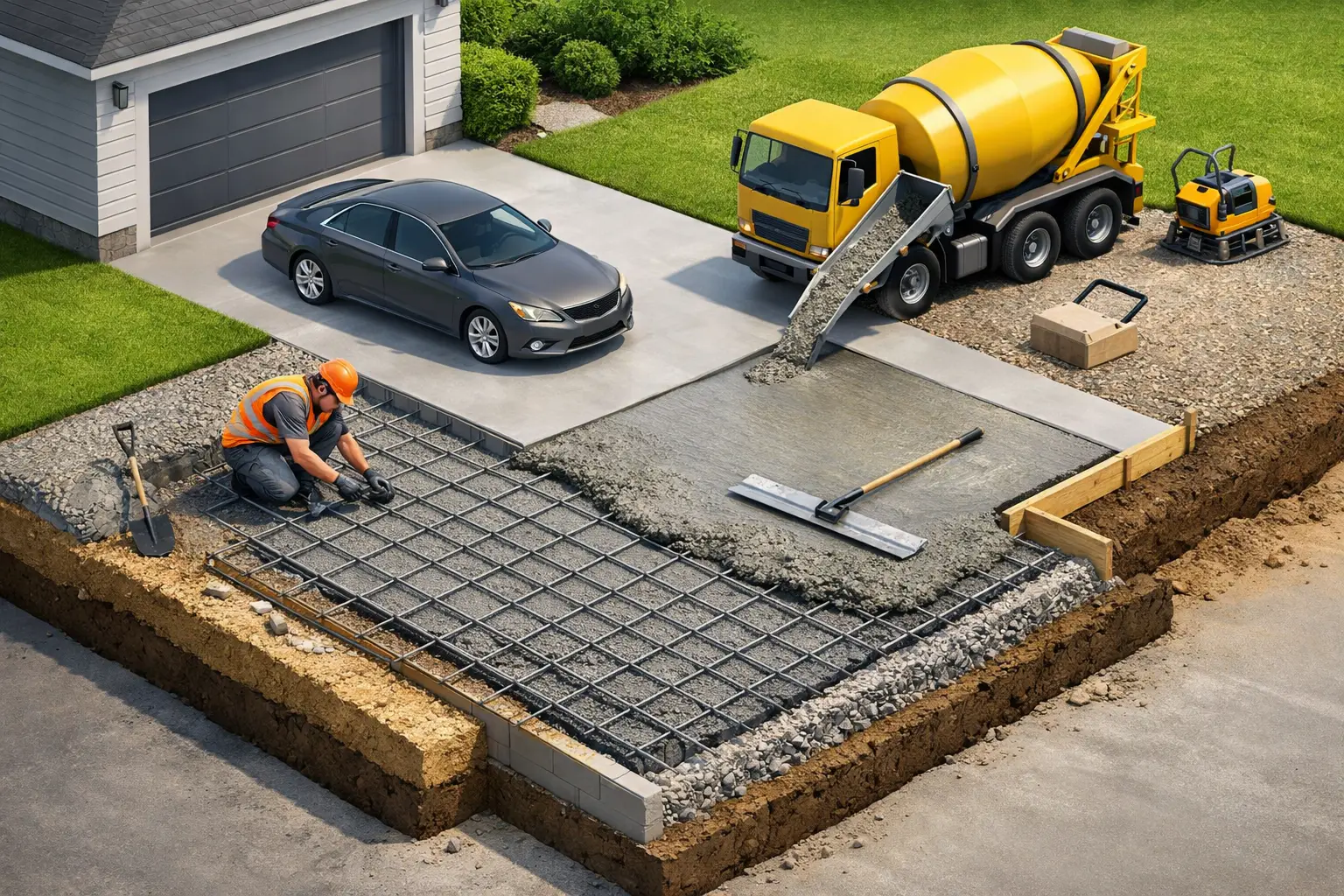
A lot of property owners hear the word reinforced and assume it just means adding rebar before the pour. Steel is part of it, but it is only one piece of the job. True reinforced concrete driveway installation starts with the ground below the slab and ends with proper curing after the finish work is complete.
First comes layout and excavation. The area has to be cut to the right depth so the driveway has room for a stable base and the concrete thickness needed for the expected traffic. If the subgrade is soft, uneven, or poorly compacted, the slab above it is already at a disadvantage.
Next comes the base. For most driveways, a compacted aggregate base helps create uniform support and improves drainage. Skipping this step or leaving the base loose is one of the fastest ways to end up with settlement, cracking, and edge failure.
Then the reinforcement is installed. Depending on the design, that may include rebar, welded wire mesh, or a combination that fits the slab thickness and load requirements. The key is placement. Reinforcement does not do much if it is sitting at the bottom of the pour or poorly tied and shifted during placement.
After that, the concrete is poured, finished, jointed, and cured. Every one of those steps affects performance. Even strong concrete can fail early if it is overwatered, finished at the wrong time, or not cured long enough.
Why reinforcement matters in a driveway
Concrete is strong in compression, but it is weaker when it comes to tension and movement. That is where reinforcement helps. A reinforced slab handles stress better, limits crack separation, and gives the driveway more structural support when soil conditions are less than perfect.
That does not mean reinforcement prevents every crack. Concrete naturally shrinks as it cures, and some cracking can still happen. What reinforcement does is help control how the slab performs when those stresses show up. In practical terms, that usually means better durability and fewer major failures.
For residential properties, reinforcement is especially useful when the driveway carries pickups, work trucks, trailers, or frequent parking in the same spots. For commercial sites, it becomes even more important because traffic loads and turning forces are often much higher.
Base prep and grading make or break the slab
If there is one part of reinforced concrete driveway installation that gets underestimated, it is the work below the concrete. Property owners tend to focus on thickness and finish, but base preparation and grading are just as important.
A driveway should be graded to move water away from the slab and away from structures when possible. If water sits under or beside the driveway, it can soften supporting soils, create erosion, and shorten the life of the concrete. In coastal and low-lying areas, drainage planning is not a bonus feature. It is part of building the driveway right.
Compaction matters too. Uneven compaction can leave one section of the slab well supported and another section vulnerable to settlement. That is how you get random cracks, rocking panels, or corners that start breaking down under vehicle traffic.
This is also where an experienced local contractor has an advantage. Soil behavior, drainage patterns, and site access vary from job to job. In places like Corpus Christi and across the Coastal Bend, those conditions can change quickly even within the same neighborhood.
Choosing the right thickness and reinforcement
There is no one-size-fits-all driveway design. A light residential driveway for standard passenger vehicles may need a different thickness and reinforcement plan than a long rural driveway used by delivery trucks, RVs, or work equipment.
For many residential applications, a 4-inch slab may be common, but that does not mean it is always the right answer. Heavier traffic, weak soils, wider spans, and higher usage can justify a thicker slab or upgraded reinforcement. Commercial drive areas often require a more engineered approach altogether.
This is where cutting costs too aggressively can backfire. Saving money on steel, thickness, or base depth may reduce the initial price, but it can raise the odds of early repair or replacement. On the other hand, not every project needs the most expensive option available. The right design depends on traffic, soil, drainage, and budget.
A dependable contractor should be willing to explain those trade-offs clearly. If a proposal is vague about thickness, reinforcement type, or base prep, that is a warning sign.
The installation process should be controlled, not rushed
Good concrete work looks efficient because the crew is prepared, not because the job is being rushed. Once the pour starts, timing matters. Forms need to be secure, reinforcement needs to stay in place, and the crew needs a clear plan for placement, screeding, finishing, and joints.
Too much water in the mix or added on site can weaken the slab. Poor finishing can trap moisture or damage the surface. Badly planned control joints can lead to uncontrolled cracking. Even traffic access matters. If vehicles get onto the slab before it has cured properly, early damage can be permanent.
That is why communication is part of quality. Property owners should know the schedule, access limitations, cure time, and what to expect after the pour. A contractor that treats those details seriously is usually more disciplined about the work itself.
Common problems caused by poor driveway installation
Most driveway failures do not happen because concrete is a bad material. They happen because the installation was incomplete, underbuilt, or poorly executed.
You see it when slabs crack wide and uneven because the base was weak. You see it when edges crumble because they were not reinforced or thick enough for traffic. You see it when water ponds in the center because the grade was wrong from the start. Surface flaking, settlement, and joint breakdown often point back to the same issue – the driveway was poured, but it was not built as a full system.
Replacement is sometimes the only real fix once those problems get far enough along. Patching can help in limited cases, but repairs will only last if the underlying cause is addressed.
What property owners should ask before hiring a contractor
Before approving a driveway project, ask what the excavation depth will be, how the base will be compacted, what reinforcement will be used, how thick the slab will be, and how drainage will be handled. Those are basic questions, and a qualified contractor should answer them without hedging.
It also makes sense to ask about cleanup, access during the job, cure time, and whether the crew handles related site work if the area needs demolition, grading, or removal of old concrete first. A contractor that can manage the full scope often helps avoid delays and coordination problems.
Licensing, insurance, and jobsite safety matter too. So does local experience. A driveway in South Texas has to be built for real field conditions, not just drawn up to look good on paper.
Reinforced concrete driveway installation is a long-term investment
A driveway is not just a place to park. It affects curb appeal, drainage, property function, and daily use. When reinforced concrete driveway installation is done right, the result is a slab that carries weight, handles weather, and keeps its shape for years with less trouble.
For homeowners, that means fewer headaches and better value. For commercial properties, it means a surface that supports operations and presents the right image to tenants, customers, and vendors. Haylo Construction approaches that work the same way any serious concrete project should be approached – with proper prep, solid reinforcement, and no shortcuts where they count.
If you are planning a new driveway or replacing one that has already failed, the best next step is to treat the slab like a structural job, not just a cosmetic one. The concrete you see matters. The work underneath it matters more.