A slab can look perfect on pour day and still fail early if the ground underneath was not handled correctly. That is why concrete slab soil preparation matters so much. Before any forms go up or concrete trucks arrive, the real work starts in the dirt – checking soil conditions, correcting grade, managing moisture, and building a base that can carry weight without shifting.
In South Texas, that step is not optional. Coastal weather, periods of heavy rain, long dry stretches, and variable site conditions can all affect how soil behaves under a slab. Whether the project is a house foundation, shop pad, driveway extension, patio, or commercial slab, the quality of the finished concrete depends heavily on what happens below it.
Why concrete slab soil preparation matters
Concrete is strong in compression, but it does not forgive movement underneath. If the subgrade settles, pumps water, or expands and contracts too much, the slab can crack, tilt, or lose support. Some cracking is common in concrete, but avoidable movement usually points back to poor site prep.
Good soil preparation does three jobs at once. It creates uniform support, improves drainage, and reduces the chance of future settlement. That matters for residential and commercial projects alike. A backyard patio may only need to support foot traffic and furniture, while a foundation or parking area may have to carry vehicles, equipment, or repeated loading. The prep strategy changes with the use of the slab, but the goal stays the same – stable support across the entire footprint.
Start with the existing soil
Every site has its own conditions. Some lots have sandy soil that drains well but can shift if it is loose. Others have clay-heavy material that holds moisture and moves as conditions change. Fill dirt from prior construction can be another issue, especially if it was placed without proper compaction.
The first step is identifying what is already there. On smaller residential jobs, that may mean evaluating visible soil conditions, probing for soft spots, and reviewing drainage patterns around the slab area. On larger or more critical projects, more formal testing may be appropriate. It depends on the size of the slab, what it will support, and whether there are signs of unstable ground.
That is one of the biggest mistakes property owners make. They assume all dirt is basically the same. It is not. A slab placed over loose fill or wet, unstable soil is already starting behind.
Organic material has to go
Topsoil, roots, grass, debris, and other organic matter cannot stay under a slab. Organic material breaks down over time, creates voids, and holds moisture where you do not want it. Even a thin layer can cause trouble later.
Proper prep usually starts with stripping that material away until competent soil is reached. If the native soil underneath is still unsuitable, more excavation may be needed. There is no shortcut here. Pouring over poor material just hides the problem until the slab begins to move.
Grading and drainage come before the base
A stable slab needs more than compacted dirt. It also needs water management. If the site is graded poorly, water can collect along the slab edge or migrate underneath. That increases erosion risk, softens supporting soils, and adds pressure where it should not.
The area should be shaped so water moves away from the slab, not toward it. For a house slab or building pad, that may involve broader site grading and elevation planning. For a patio or detached pad, it may mean setting the right slope and making sure nearby downspouts or runoff paths are not dumping water at the slab perimeter.
This is especially important in coastal markets like Corpus Christi and nearby communities, where sudden rain events can expose weak drainage planning fast. A slab may be structurally sound, but if water constantly works its way under the edges, the long-term result can still be settlement or cracking.
Compaction is where the job is won or lost
One of the most important parts of concrete slab soil preparation is compaction. Soil that looks level can still be too loose to support a slab. When weight is added later, that loose material compresses, and the slab settles with it.
Compaction reduces air voids and increases the load-bearing capacity of the soil. It also helps create more consistent support from one area of the slab to the next. The method depends on the soil type and the depth of material being compacted. Native soil may need to be moisture-conditioned and compacted in place. Imported fill should be placed in lifts and compacted layer by layer rather than dumped all at once.
That last point matters. If deep fill is needed to build up grade, placing it in thick, loose layers is asking for future settlement. Controlled fill placement takes more time, but it gives the slab a better chance of staying where it belongs.
Moisture content affects compaction
Dry soil is not always ready for compaction, and wet soil is often worse. Soil compacts best within a workable moisture range. If it is too dry, it may not bind properly. If it is too wet, it can pump, rut, or stay unstable under the compaction equipment.
This is where experienced site crews make a difference. They know when the ground needs to dry out, when moisture needs to be added, and when conditions are not right to move forward. Rushing a schedule on bad subgrade usually costs more later.
The role of the aggregate base
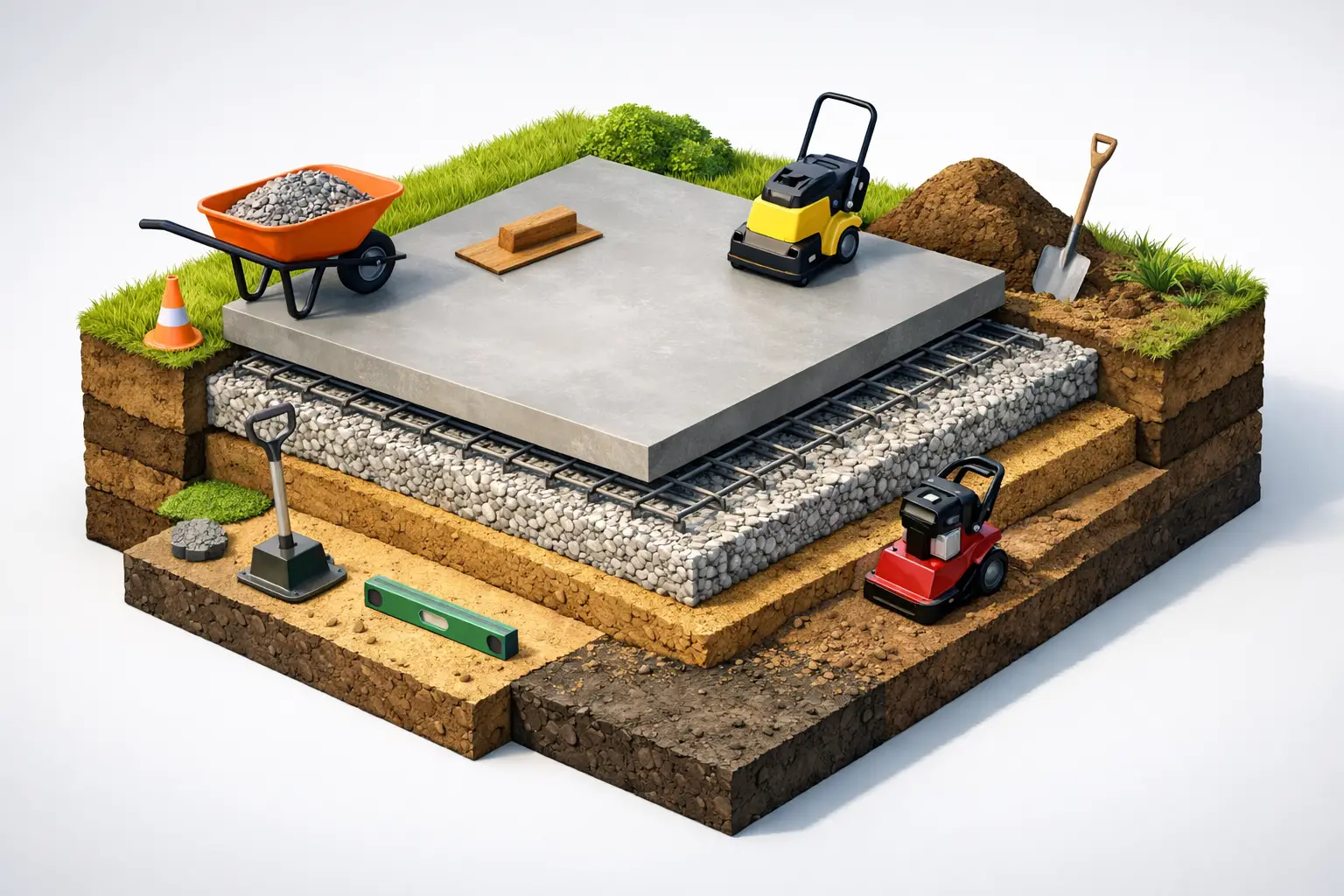
Many slabs benefit from a properly installed base layer over the prepared subgrade. Depending on the project, that might be crushed stone, road base, or another compactable aggregate. The purpose is to create a firm, uniform working platform and improve drainage under the slab.
Not every slab uses the same base thickness or material. A light-duty residential pad is different from a commercial slab or parking area. Soil conditions also influence the decision. On some sites, the native ground is strong enough that only minimal base work is required. On others, the base becomes a critical part of the system.
The key is consistency. A slab performs better when the support underneath is uniform. Hard spots beside soft spots create uneven movement, and that often shows up later as cracking.
Reinforcement does not replace good soil prep
Steel reinforcement, wire mesh, and thicker concrete all have their place, but they do not fix poor ground conditions. Reinforcement helps concrete handle stresses and control crack behavior. It does not stop a slab from settling if the soil underneath was loose, wet, or improperly graded.
That is why experienced contractors do not treat site prep as an afterthought. A well-reinforced slab over bad subgrade is still a gamble. A properly prepared site gives the concrete and reinforcement a solid chance to perform as intended.
Different slabs need different prep standards
Not every slab calls for the same approach. A backyard shed pad is not built to the same standard as a home foundation or equipment slab. The weight load, slab thickness, reinforcement plan, drainage needs, and local code requirements all affect how the soil should be prepared.
For residential flatwork like patios and walkways, the focus is often on stripping organics, establishing grade, compacting the subgrade, and placing a suitable base. For building slabs and commercial work, the process may involve stricter tolerances, engineered fill, moisture barriers, and more detailed inspection requirements.
That is why it helps to work with a contractor who understands both the slab and the site. The concrete itself is only one part of the job.
Warning signs of poor slab prep
Problems often start before the concrete is even poured. Soft spots underfoot, standing water in the work area, visible organic debris in the excavation, and loose fill that was not compacted in lifts are all red flags. So is pressure to pour immediately after major rain without giving the subgrade time to recover.
After the pour, poor preparation may show up as early cracking, corner settlement, edge erosion, uneven joints, or sections that sound hollow. Some issues can be repaired, but many are much harder and more expensive to fix once the slab is in place.
A reliable contractor should be willing to explain what the subgrade needs, what base material is being used, and how the site will handle drainage. Clear communication up front is part of doing the job right.
What property owners should expect
If you are planning a slab project, ask about excavation depth, compaction methods, base material, drainage, and whether any unstable soil needs to be removed. You do not need a lecture full of technical terms. You need a straightforward explanation of how the ground will be prepared to support the slab you are paying for.
That is especially true for projects in areas with changing soil moisture and coastal exposure. In South Texas, durable concrete starts long before the finish work. It starts with disciplined prep, proper grading, and a crew that knows when the site is ready and when it is not.
Haylo Construction approaches slab work with that mindset because long-term performance comes from the ground up. If the soil preparation is done right, the finished slab has a much better shot at staying level, draining correctly, and holding up under real use.
The concrete gets the attention, but the soil underneath decides how long that work lasts. When the prep is handled with care, the slab has something every project needs – a solid place to stand.