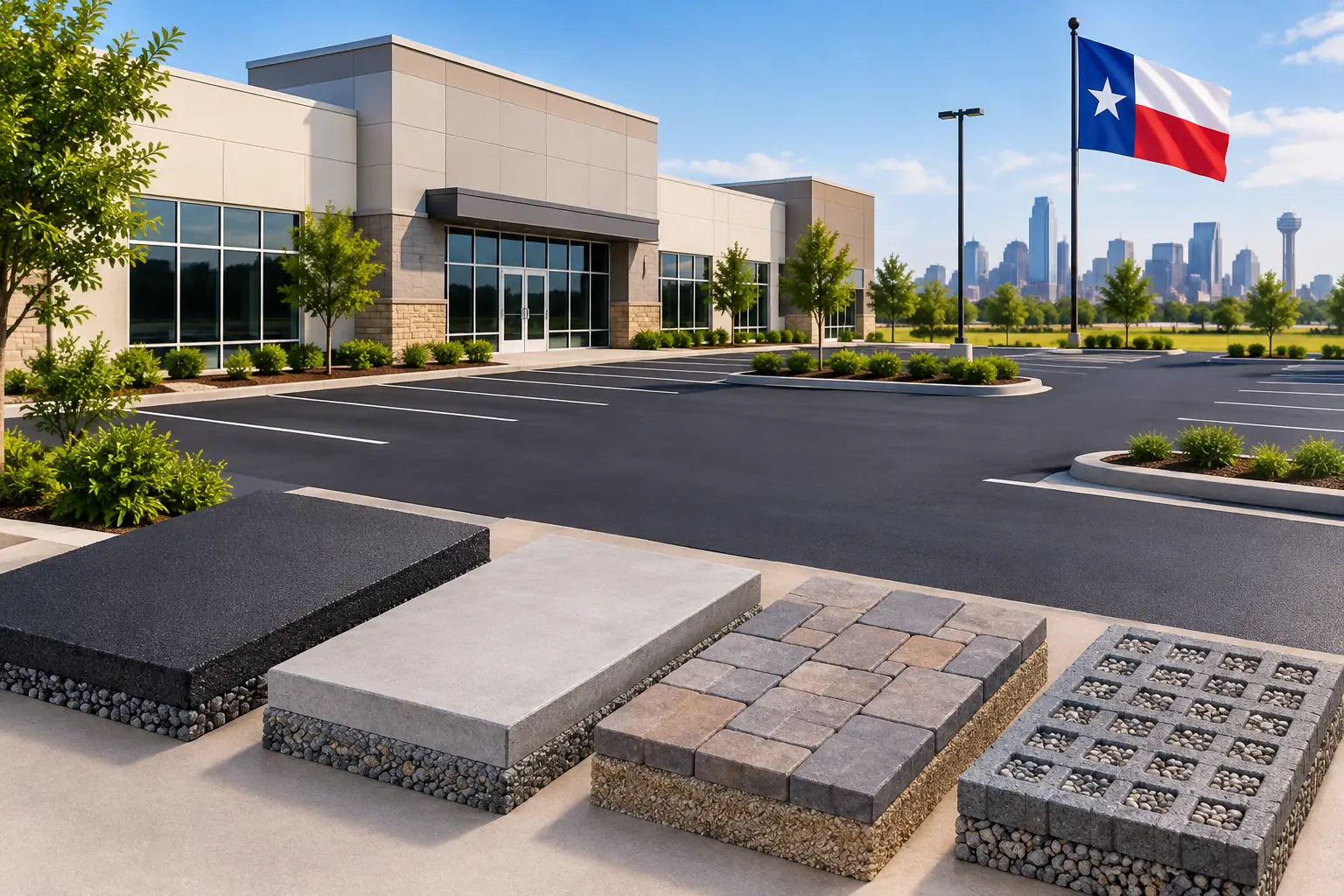
A commercial parking lot can look finished on opening day and still fail early if the material, base, and drainage do not match the property’s real demands. The best commercial paving materials depend on more than appearance or upfront price. Traffic weight, turning patterns, soil movement, drainage, maintenance capacity, and South Texas heat all affect which surface will hold up.
For a retail lot, medical office, industrial yard, multifamily property, or warehouse approach, the right choice starts with how the pavement will be used. A delivery route that carries loaded trucks needs a different design than employee parking. A coastal property with drainage concerns needs more than a smooth surface. It needs a properly prepared system that moves water where it belongs.
The Best Commercial Paving Materials by Application
Concrete, asphalt, pavers, and stabilized aggregate all have a place in commercial construction. None is automatically the right answer for every project. A dependable contractor evaluates the site first, then recommends a material and pavement section built for the expected use.
Concrete for heavy traffic and long-term durability
Concrete is often the strongest choice for high-traffic commercial areas. It performs especially well in loading zones, dumpster pads, truck entrances, fire lanes, service drives, industrial yards, sidewalks, and parking areas with frequent turning movements. Rigid concrete slabs spread vehicle loads across a wider area than flexible pavement, helping reduce rutting and surface deformation.
For Corpus Christi and the Coastal Bend, concrete also handles intense sun and heat well. It does not soften in high temperatures the way asphalt can. When installed with the correct thickness, reinforcement where required, control joints, base preparation, and drainage, a concrete surface can provide decades of service.
The trade-off is initial cost. Concrete commonly costs more to install than asphalt, and repairs require careful work to avoid mismatched panels or drainage changes. It also needs time to cure before it can carry traffic. Those costs can make sense when the area sees trucks, repeated braking, or heavy daily use. Spending less on a surface that cracks, settles, or ruts early is rarely a savings.
Asphalt for broad parking areas and budget control
Asphalt remains a practical choice for large commercial parking lots and access roads with mostly passenger vehicle traffic. It is generally faster to place than concrete and usually has a lower initial installation cost. Its dark surface also creates a clean, uniform look when freshly paved and striped.
Asphalt is flexible, which can be helpful where minor ground movement is expected. However, flexibility does not eliminate the need for a well-built base. Weak subgrade, poor compaction, standing water, and inadequate pavement thickness will shorten asphalt life quickly. In South Texas, heat can accelerate oxidation, while water entering cracks can weaken the base below.
An asphalt lot needs a maintenance plan. Crack sealing, sealcoating when appropriate, patching, and timely drainage repairs protect the investment. Asphalt can serve a commercial property well, but it is not the best fit for every high-load area. Many successful sites use asphalt in standard parking bays and concrete at entrances, dumpster areas, loading zones, and sharp-turn locations.
Interlocking pavers for high-visibility spaces
Concrete pavers are a strong option for plazas, pedestrian walkways, courtyards, storefront entries, outdoor dining areas, and other spaces where appearance matters as much as function. They are available in different shapes, patterns, and colors, giving owners more design control than plain pavement.
A properly installed paver system can also be repaired in sections. If utility work is needed beneath the surface or an isolated area settles, individual units can be lifted and reset rather than cutting out a large slab. That can be valuable for properties that expect future underground work.
Pavers are not a shortcut around site preparation. Their performance depends on excavation depth, edge restraints, bedding material, compaction, and drainage. They also may not be the most cost-effective choice for a large employee parking lot or truck yard. Use them where they improve the customer experience, guide pedestrian traffic, or add a durable finished look to a visible area.
Permeable pavement where drainage drives the decision
Permeable pavers and certain permeable concrete or asphalt systems allow water to pass through the surface and into a prepared stone base below. These systems can reduce surface runoff and help manage water in locations where traditional drainage is limited or stormwater control is a major design concern.
They require careful planning. The base must be designed to store and release water correctly, and the underlying soil must be evaluated for drainage conditions. Maintenance matters as well. Fine sediment, leaves, and debris can clog surface openings if the property does not keep up with cleaning.
For the right site, permeable paving can be useful in overflow parking, low-speed parking stalls, walkways, and landscaped commercial areas. It is usually not the first recommendation for heavy truck lanes, unless an engineered design specifically supports that use.
Stabilized aggregate for low-traffic and service areas
Crushed limestone, caliche, recycled concrete, and other aggregate surfaces can work for temporary access, equipment yards, rural commercial sites, and low-traffic service areas. Stabilized aggregate is often less expensive than full-depth paving and can be installed relatively quickly.
The limitation is dust, tracking, erosion, and ongoing grading. Aggregate does not deliver the same clean, finished appearance or predictable maintenance profile as concrete or asphalt. Heavy rain can expose weak areas, and repeated traffic can create potholes or washboarding. It is best used when the site’s function supports a more utilitarian surface.
Material Choice Is Only Part of the Job
A quality paving surface begins below grade. The best material will not perform as intended over unstable soil, poor compaction, or inadequate drainage. This is where commercial projects often go wrong: owners compare surface prices without comparing excavation, base depth, reinforcement, grading, or water management.
Coastal Texas properties can face expansive soils, high water tables, heavy rain events, salt exposure, and long periods of extreme heat. These conditions make site preparation critical. A contractor should assess existing grades, identify low spots, plan runoff routes, and determine whether damaged pavement is caused by a surface problem or a failing base.
For concrete, that may mean removing unsuitable material, placing and compacting a stable base, setting correct elevations, installing joints in the right locations, and using the appropriate slab thickness. For asphalt, it means building a base that can support the pavement and keep water from undermining it. For pavers, it means installing a compacted foundation and secure edge restraints that prevent movement.
Drainage deserves special attention. Water should not pond near building entrances, collect in drive aisles, or flow toward foundations. It should move intentionally toward drains, swales, curbs, or designated collection points. Correct slopes may seem minor during construction, but they often determine whether a paved area lasts or becomes a recurring repair issue.
How to Choose the Right Material for Your Property
Start with traffic, not just square footage. Ask what vehicles use the area, how often they use it, and where they turn, stop, or idle. Delivery trucks, garbage trucks, forklifts, buses, and trailers place far more stress on pavement than regular passenger vehicles.
Next, consider the property’s priorities. If long-term durability and low disruption are the goal, concrete may justify the higher initial investment. If the project is a large lot for light vehicles and the budget is tight, asphalt may be the practical route. If curb appeal and pedestrian use lead the decision, pavers may be worth the added installation cost. If drainage is the main concern, evaluate permeable options as part of a complete site plan.
Finally, consider maintenance honestly. Every material needs some level of attention. Concrete needs joint and crack monitoring. Asphalt needs regular preventive maintenance. Pavers need cleaning and occasional resetting. Aggregate needs grading and replenishment. The right material is one the owner can maintain properly after construction is complete.
Build the Surface for the Work It Must Do
Commercial pavement should not be selected from a photo or a per-square-foot price alone. The better decision comes from matching the surface to the site, building the base correctly, and planning for drainage before the first truck arrives.
Haylo Construction helps commercial property owners across the Coastal Bend evaluate concrete paving, demolition, grading, repairs, and site-related needs with long-term performance in mind. A clear site assessment and a detailed estimate give you a better path forward than a quick patch or a one-size-fits-all recommendation. Choose the material that fits the work, then make sure the preparation underneath is built to support it.