A waterfront bulkhead is not a cosmetic border. It is a structural barrier holding back soil, protecting usable ground, and managing the constant pressure created by water, tides, rainfall, and changing soil conditions. Choosing the right bulkhead materials for waterfront property can determine whether a shoreline remains stable for decades or begins showing movement, washout, and costly damage far sooner than expected.
For property owners in the Coastal Bend, material selection needs to account for salt exposure, wind-driven waves, high water events, soft or shifting soils, drainage, and the intended use of the property. A backyard canal, marina edge, commercial shoreline, and waterfront development do not all need the same wall. The right answer comes from the site conditions and the load the bulkhead must carry.
What a Bulkhead Must Handle
A properly designed bulkhead resists more than visible water pressure. Soil behind the wall becomes heavier when saturated, especially after a hard rain. Water can move through or around poorly detailed walls, carrying fine soil particles with it. Boat wakes, tides, and storm surge can create repeated impact along the water-facing side. If a driveway, building, parking area, pool, or heavy equipment sits near the top of the bank, the wall must also account for that added surcharge load.
That is why bulkhead work starts with the shoreline, not a material catalog. The contractor needs to evaluate bank height, soil type, water movement, access for equipment, existing damage, drainage paths, and whether the wall will support improvements behind it. Local permitting and waterfront regulations may also affect the wall location, height, and construction method.
Common Bulkhead Materials for Waterfront Projects
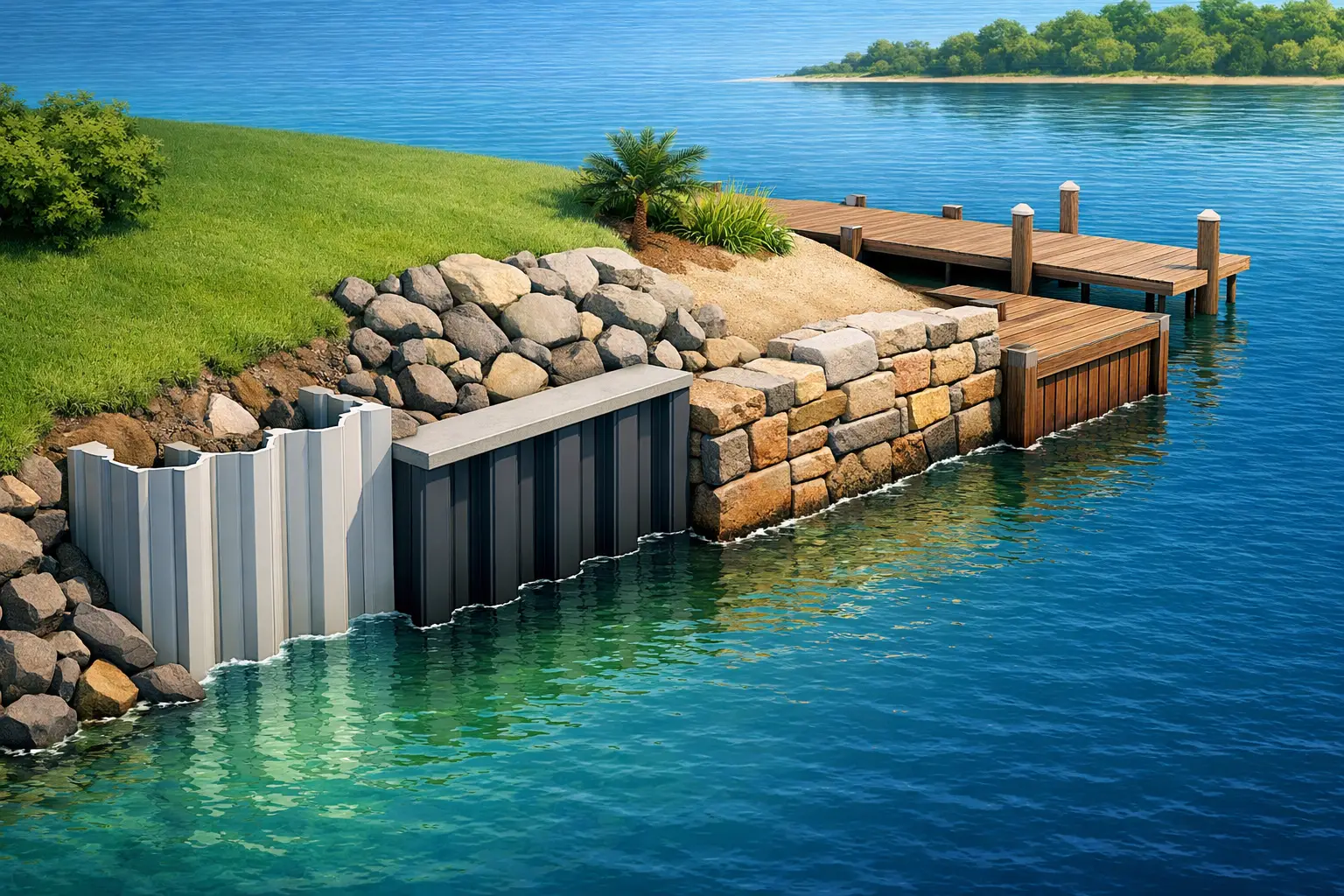
The most common materials are treated timber, vinyl sheet piling, steel sheet piling, and reinforced concrete. Each has legitimate uses. The best choice depends on the required service life, exposure, budget, appearance, structural demand, and maintenance expectations.
Treated Timber Bulkheads
Treated timber has long been used for residential waterfront walls. It is familiar, can be cost-effective for smaller projects, and has a traditional appearance that fits many coastal properties. When designed correctly, timber systems use treated pilings, walers, tie rods, deadmen or anchor systems, and drainage details to hold the wall in place.
The trade-off is longevity in a wet, salt-influenced environment. Even properly treated wood can eventually deteriorate, split, become damaged by marine organisms, or weaken around fasteners and connections. Timber may make sense for lower-load applications where future maintenance or replacement is expected. It is generally less appealing where a wall must support major improvements or where owners want the longest possible service life.
Vinyl Sheet Piling
Vinyl sheet piling is a popular option for waterfront residential work because it does not rot, does not rust, and performs well in wet conditions. Its clean, uniform appearance can also be a benefit for canal-front properties, docks, and neighborhoods where presentation matters.
Vinyl is not automatically the right choice for every site. It has limits on structural capacity and can require closer pile spacing, stronger framing, or deeper embedment depending on wall height and soil pressure. It can also be vulnerable to damage from severe impact or installation errors. A properly engineered vinyl bulkhead can be an excellent long-term fit, but it should not be selected based on appearance alone.
Steel Sheet Piling
Steel sheet piling offers high strength and is often used where conditions demand serious holding power. It can be a practical choice for commercial waterfronts, marinas, industrial sites, deeper walls, and locations with significant surcharge loads. Steel can be driven to substantial depths and is well suited to demanding soil and water conditions.
Its main concern in coastal Texas is corrosion. Protective coatings, proper material selection, and allowances for corrosion over the expected life of the wall are essential. Steel can be more expensive upfront, and installation may require specialized equipment and careful planning around neighboring structures and utilities. For high-load work, however, its strength can justify the investment.
Reinforced Concrete Bulkheads
Reinforced concrete bulkheads provide durability, mass, and a clean finished appearance. They are often a strong option when the project needs a permanent wall that can support nearby hardscapes, drives, patios, structures, or commercial use. Concrete can be formed and reinforced to suit specific heights, grades, and loading conditions.
Concrete quality matters. In a coastal environment, reinforcement, mix design, placement, curing, drainage, and joint details all affect long-term performance. Poor drainage behind a concrete wall can build hydrostatic pressure. Poorly placed concrete can crack or allow water intrusion that reaches reinforcing steel. A concrete bulkhead should be designed as a complete system, not just a poured wall at the waterline.
Material Choice Is Only Part of the Job
The most durable material can still fail when the rest of the system is undersized or poorly installed. Bulkhead performance depends heavily on pile depth, anchor layout, tie rod capacity, wall alignment, drainage, backfill, and protection against erosion at the toe of the wall.
Drainage deserves particular attention. Water trapped behind a bulkhead creates pressure that the wall was never meant to carry. Filter fabric, properly graded backfill, drainage stone where appropriate, and relief points or weep details can help manage water movement while preventing soil loss. The goal is to drain the retained area without allowing the wall to wash out from behind.
The transition areas also matter. A sound bulkhead can still be undermined at its ends if the adjoining bank is not protected. In areas exposed to stronger wave action, riprap, concrete protection, or another engineered erosion-control detail may be needed at the base and returns of the wall.
How to Match the Material to the Property
For a modest residential shoreline with manageable bank height, treated timber or vinyl may provide the right balance of cost and performance. For homeowners planning a new patio, pool deck, driveway extension, or structure close to the water, reinforced concrete or a higher-capacity system may be more appropriate.
Commercial sites and properties with heavy vehicle traffic, larger elevation changes, or repeated wave impact often call for steel or engineered reinforced concrete. These projects should be planned around the full site layout, including drainage, access, utilities, paving, and future construction. Installing a bulkhead without considering the work that will sit behind it can create avoidable limitations later.
Budget should be evaluated over the expected life of the wall. A lower initial price may be reasonable for a short wall with limited exposure. But if replacement would require removing a deck, disrupting a business, or working around a completed landscape, paying for a longer-lasting system can be the more economical decision.
Questions to Settle Before Construction
Before selecting a bulkhead material, establish how high the retained bank will be, what is located behind the wall, whether vehicles or structures will add load, and how water moves across the property during heavy rain. Determine whether the shoreline sees open-water wave action, boat wakes, or mostly calm canal conditions. It is also wise to identify permitting requirements before material is ordered or equipment is mobilized.
A contractor should be able to explain the proposed wall system in clear terms: the selected material, piling or foundation approach, anchoring method, drainage plan, expected access needs, and how the work connects to existing grades and improvements. Straight answers early in the process help prevent change orders and weak spots later.
Haylo Construction approaches waterfront work with the same practical standard used on retaining walls, concrete, and site preparation: build for the actual conditions, control drainage, and do not cut corners on structural details. A bulkhead is too important to treat as a quick shoreline cleanup project.
A good next step is to walk the waterfront after rainfall or at a higher tide and look for erosion, settled soil, standing water, leaning walls, cracked caps, or gaps around existing improvements. Those signs give a contractor useful information before the shoreline damage becomes a larger repair.