A driveway slab that drops an inch at the garage, a patio pulling away from the house, or a parking lot panel that holds water after every storm is more than a cosmetic problem. Knowing how to repair concrete settlement starts with identifying why the slab moved. Covering the gap or adding a patch may improve the appearance for a short time, but it will not correct unstable soil, poor drainage, or a failed base.
For property owners in the Coastal Bend, settlement often comes back to water and soil movement. Heavy rain, sandy or expansive soils, underground leaks, and inadequate grading can all remove support beneath concrete. A lasting repair addresses both the concrete surface and the conditions below it.
What Concrete Settlement Looks Like
Concrete settlement happens when the soil or fill beneath a slab compresses, washes out, dries and shrinks, or was never properly compacted. The concrete itself may still be sound, but it no longer has uniform support. Since concrete is strong in compression and weak when it bends, unsupported areas eventually crack, tilt, or break at joints.
Common signs include a section of concrete sitting lower than the surrounding slab, cracks that widen over time, standing water, a trip edge, or a visible gap along a building, curb, or retaining wall. Doors, gates, and garage thresholds can also reveal movement when the slab near them settles.
Not every crack means settlement. Hairline surface cracking can occur as concrete cures. Settlement is more likely when cracks are paired with a change in elevation, separated joints, drainage problems, or soft ground near the affected area.
Find the Cause Before You Repair the Slab
The repair method should fit the reason the concrete moved. This is where a contractor’s site assessment matters. A slab that settled because downspouts dump water beside it needs a different solution than a slab installed over loose fill.
Start by checking drainage. Water should move away from buildings, slabs, and paved areas rather than ponding along edges. Look for clogged drains, low spots, leaking irrigation lines, broken gutters, and areas where runoff cuts channels under the concrete. On coastal properties, intense rain and changing soil moisture can expose weak grading quickly.
Next, consider the slab’s use and condition. A lightly used patio with a small, stable drop may be a candidate for lifting. A commercial loading area, heavily cracked driveway, foundation-adjacent slab, or parking lot with broad subgrade failure may need removal and replacement. The goal is not simply to make the surface look level. It is to restore safe support for the load the concrete will carry.
If the settlement involves a foundation, structural wall, bulkhead, or major building movement, bring in a qualified structural professional before work begins. Those conditions require a more detailed evaluation than a typical flatwork repair.
How to Repair Concrete Settlement: Choose the Right Method
There is no one-size-fits-all answer. The best approach depends on the amount of settlement, the concrete’s remaining condition, access beneath the slab, and whether drainage or soil issues have been corrected.
Concrete leveling with slab lifting
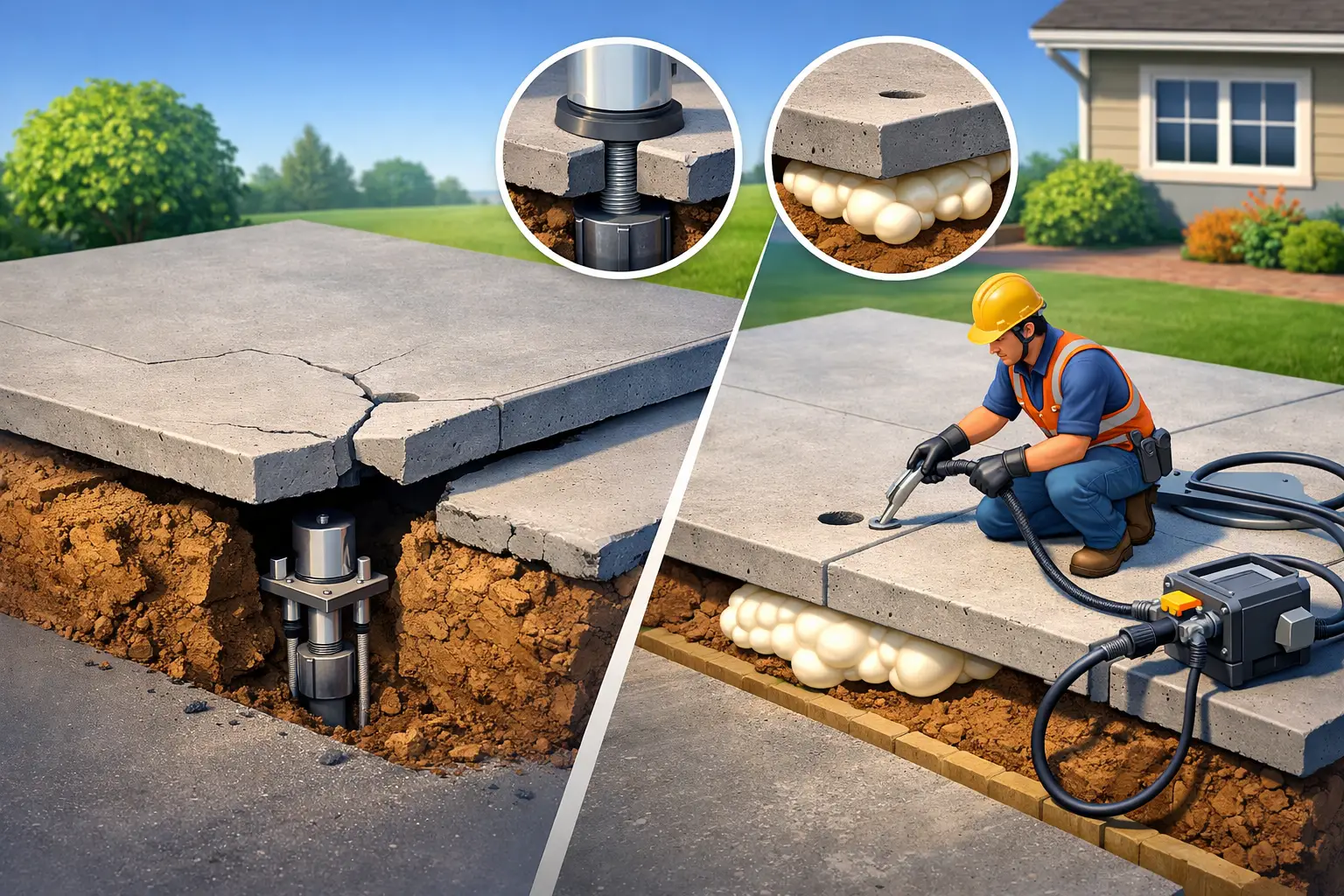
Slab lifting raises an existing concrete panel by filling voids beneath it. Depending on the application, a contractor may use cement-based grout or expanding polyurethane foam. Small access holes are drilled through the slab, material is injected beneath the concrete, and the panel is raised carefully toward its original elevation.
This can be an efficient solution for sidewalks, patios, driveways, pool decks, and certain parking lot areas when the slab is largely intact. It avoids demolition, keeps usable concrete in place, and can reduce downtime. Polyurethane foam is lightweight and cures quickly, while cementitious grout can be useful where a heavier fill is appropriate.
The trade-off is that lifting does not repair severely broken concrete or solve an active drainage problem. If the base continues to wash out, the slab can settle again. Cracks may also remain visible after leveling, even when the surface is safe and properly supported.
Remove and replace damaged concrete
Replacement is often the better investment when concrete has widespread cracking, significant spalling, broken edges, poor thickness, or extensive settlement. The damaged slab is removed, the exposed subgrade is evaluated, unsuitable material is excavated as needed, and a properly prepared base is compacted before new concrete is installed.
This method provides the best opportunity to correct underlying issues. A new driveway or slab can be built with proper slope, reinforcement, joint placement, and thickness for its intended use. For vehicle traffic, commercial operations, or areas where appearance matters, replacement often produces the most dependable long-term result.
Replacement does cost more upfront and takes longer than lifting because it includes demolition, hauling, base preparation, forming, pouring, finishing, and curing. But pouring new concrete over an unstable or poorly compacted base is not a repair. It simply restarts the problem.
Repair localized voids and drainage failures
Sometimes the concrete has not moved much, but water is clearly undermining an edge or joint. In that case, the first work may be drainage correction, leak repair, joint sealing, or backfilling and compacting eroded soil. A localized void may then be filled before it becomes a larger settlement issue.
This approach works only when the slab is still well supported overall. It is not a substitute for lifting or replacement when the panel has already dropped, cracked through, or become unsafe.
Why Surface Patches Usually Fail
Mortar patches, caulk, and asphalt-style fillers have a place for small cosmetic defects and joint maintenance. They do not restore support beneath settled concrete. A patch over a low area can crack loose as the slab continues to move, and filling a gap at a building edge can trap water where it does not belong.
Avoid adding a thin layer of concrete over a settled slab to make it appear level. Thin overlays are prone to debonding, cracking, and chipping when the original slab moves. The repair should start below the concrete, not just on top of it.
What a Durable Concrete Repair Should Include
A professional repair plan should account for the site, not just the visible crack. That means verifying the source of water, evaluating the condition of the existing concrete, and determining whether the base can be stabilized or needs to be rebuilt.
For replacement work, proper preparation is the difference between a short-term fix and a durable installation. The subgrade should be shaped and compacted, the base material should be installed to suit the site, and the finished concrete should drain correctly. Reinforcement, control joints, and slab thickness should match the intended load. A residential walkway and a commercial vehicle area should not be built to the same standard.
Timing also matters. Concrete needs adequate curing before it carries normal traffic, and fresh repairs should be protected from premature loading. Rushing that process can damage a new surface before it has gained strength.
When to Call a Concrete Contractor
Call for an evaluation when a trip hazard has developed, water is collecting against a building, cracks are widening, or a driveway and sidewalk no longer meet safely. Commercial property owners should move quickly when settlement affects accessible routes, parking lot drainage, loading areas, or customer entrances. Liability and operational disruption can grow when damaged concrete is left in service.
It is also worth getting a professional opinion before attempting DIY slab lifting. Concrete panels are heavy, and uncontrolled lifting can create new cracks, damage adjacent structures, or leave voids beneath the slab. Work near utilities, foundations, or retaining structures requires added care.
Haylo Construction evaluates concrete conditions with the full site in mind, including demolition, grading, base preparation, drainage, and replacement when needed. That practical approach helps property owners avoid paying twice for a repair that only treats the surface.
A settled slab rarely improves on its own. Address the water, support the concrete correctly, and choose a repair method that matches the condition of the slab. A clear assessment now can protect your property, improve safety, and prevent a small low spot from becoming a larger concrete failure.