A driveway can look solid on day one and still fail early if the thickness is wrong. That is why one of the most common questions property owners ask is how thick should a concrete driveway be. The short answer is that most residential driveways should be 4 inches thick, but that is not the whole story. Vehicle weight, soil conditions, base preparation, drainage, and reinforcement all affect whether 4 inches is enough or whether the slab needs to be thicker.
How thick should a concrete driveway be for most homes?
For a standard residential driveway that will carry passenger cars, SUVs, and light pickup trucks, 4 inches of concrete is the accepted minimum. When the subgrade is properly compacted and the base is built correctly, a 4-inch driveway performs well for typical daily use.
That said, minimum and best practice are not always the same thing. Many contractors recommend 5 inches when the budget allows, especially if the driveway will see frequent truck traffic, larger SUVs, work vehicles, or heavier delivery vehicles. That extra inch adds strength and helps reduce the risk of cracking and settlement over time.
If the driveway will carry RVs, trailers, heavy-duty pickups, or commercial vehicles, 6 inches or more may be the better choice. A thin slab under heavy loads usually shows problems fast – cracking, edge failure, surface separation, and low spots where water starts to collect.
Thickness depends on more than the concrete itself
Property owners often focus on slab thickness because it is easy to measure. The problem is that thickness alone does not make a driveway durable. A 6-inch driveway poured over weak, wet, or poorly compacted ground can fail sooner than a 4-inch driveway built on a stable base.
The base matters
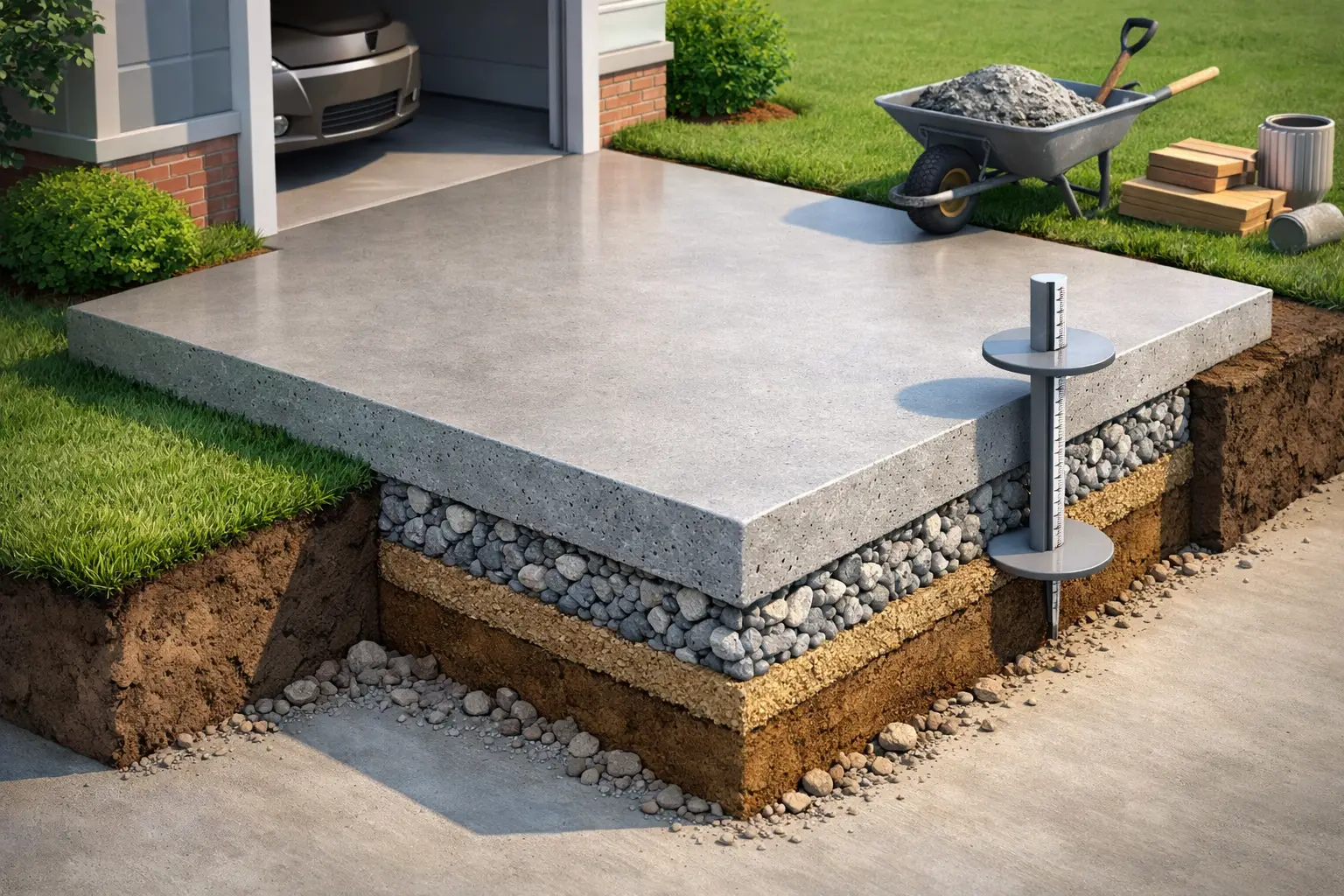
A concrete driveway needs support underneath it. In many cases, that means a compacted base of crushed stone or similar material. The exact base depth depends on soil conditions and site requirements, but if the base is soft, uneven, or not compacted well, the slab can crack from movement below.
In coastal South Texas, this matters even more. Soil movement, moisture changes, and drainage issues can put extra stress on a driveway. If the site holds water or the subgrade shifts, the slab thickness will only do part of the job. Proper grading and base prep are what keep the concrete supported.
Reinforcement helps, but it does not replace thickness
Rebar or wire mesh can improve the slab’s performance by helping control cracking and keeping the concrete working together under load. Fiber reinforcement may also be used depending on the mix and application.
But reinforcement is not a shortcut for making a driveway too thin. If a driveway needs 5 or 6 inches based on expected traffic, adding rebar to a 4-inch slab does not make it the same thing. Reinforcement and thickness work together. One does not cancel out the need for the other.
Drainage protects the slab
Water is one of the biggest reasons driveways wear out early. When water sits on the surface, runs under the slab, or softens the soil below, cracking and settlement become more likely. A properly graded driveway with good runoff is just as important as concrete thickness.
This is one reason experienced contractors pay attention to the whole system – excavation, grading, formwork, reinforcement, and concrete placement – not just the final pour.
When 4 inches is enough and when it is not
A 4-inch driveway is usually enough when the driveway serves a single-family home, supports normal passenger vehicles, and sits on stable, properly prepared ground. If the design is straightforward and the traffic is light to moderate, that thickness is standard.
A thicker slab makes more sense when any of the following apply: the driveway is long and heavily used, the owner parks large trucks or trailers on it, delivery traffic is frequent, the soil is weak, or the apron near the street takes repeated heavy wheel loads. In those situations, moving up to 5 or 6 inches can be a smart long-term investment.
The edges of the driveway also deserve attention. Concrete is more vulnerable at unsupported edges, where cracking and breaking are more likely. Thickened edges or stronger edge support can improve durability, especially near ditches, landscaping transitions, or areas with turning traffic.
How thick should a concrete driveway be for heavy vehicles?
If you are asking how thick should a concrete driveway be for heavy vehicles, the answer is usually 6 inches minimum, and sometimes more depending on the load. That includes RV parking, commercial vans, work trucks carrying equipment, trailers, dumpsters, and repeated delivery access.
Heavy loads create stress that standard residential slabs are not built to handle every day. A homeowner may only occasionally park a large moving truck on a 4-inch driveway without obvious damage, but repeated heavy use is different. Over time, that traffic can break down a slab that was designed only for lighter vehicles.
For commercial properties or mixed-use sites, thickness should be evaluated alongside concrete strength, reinforcement layout, joint spacing, and subgrade design. This is where a one-size-fits-all answer stops being useful.
Concrete strength and joints also matter
Thickness gets most of the attention, but a durable driveway also depends on the right concrete mix and proper control joints. Concrete is going to crack. The goal is to control where it cracks and limit how severe those cracks become.
A stronger mix helps the slab handle wear and vehicle loads, while correctly spaced joints help manage shrinkage and movement. If joints are poorly placed or skipped, random cracking becomes more likely even if the slab is thick enough.
Finishing and curing also matter. Concrete that dries too fast, is overworked during finishing, or is not cured properly can lose durability at the surface. That is when scaling, dusting, and premature wear start to show up.
Common mistakes that lead to driveway failure
One common mistake is pouring to the minimum thickness everywhere without looking at how the driveway will actually be used. Another is inconsistent thickness, where some sections end up thinner than planned because the grade was not set correctly.
Poor compaction is another major issue. If the base settles after the pour, the slab can crack regardless of reinforcement. Weak edges, bad drainage, and skipping expansion details near garages or other structures can also shorten the life of the driveway.
Sometimes property owners ask for the cheapest option and get a driveway that looks fine at first but is not built for the traffic it will see. Concrete replacement costs a lot more than getting the thickness and prep right the first time.
What homeowners and property managers should ask before a pour
Before approving a driveway project, ask what thickness is planned and why. The answer should reflect the actual use of the driveway, not just a generic number. Ask about the base material, how the subgrade will be compacted, whether reinforcement is included, how drainage will be handled, and what concrete strength is being used.
If trucks, trailers, or service vehicles will use the driveway, say that upfront. If part of the slab near the street or garage sees concentrated loading, that should be discussed too. Good contractors do not guess their way through these details.
For property owners in areas with challenging soil and weather conditions, local experience matters. A contractor who understands regional drainage patterns, moisture movement, and site prep will usually give better recommendations than someone quoting by square footage alone. That is part of building a driveway for long-term performance, not just quick installation.
The right thickness is the one that fits the job
So, how thick should a concrete driveway be? For most homes, 4 inches is the standard minimum. For better durability under heavier residential use, 5 inches is often a stronger choice. For RVs, trailers, work trucks, or commercial traffic, 6 inches or more may be necessary.
The real answer depends on load, soil, drainage, reinforcement, and workmanship. A driveway is only as good as the prep under it and the installation behind it. If you want concrete that holds up, do not choose thickness by guesswork or by the lowest bid. Build it for the way the property is actually used, and it will serve you a lot longer.
If you are planning a new driveway or replacing a failing one, get the thickness, base, and grading evaluated together. That is how you avoid preventable repairs and end up with concrete that does its job year after year.