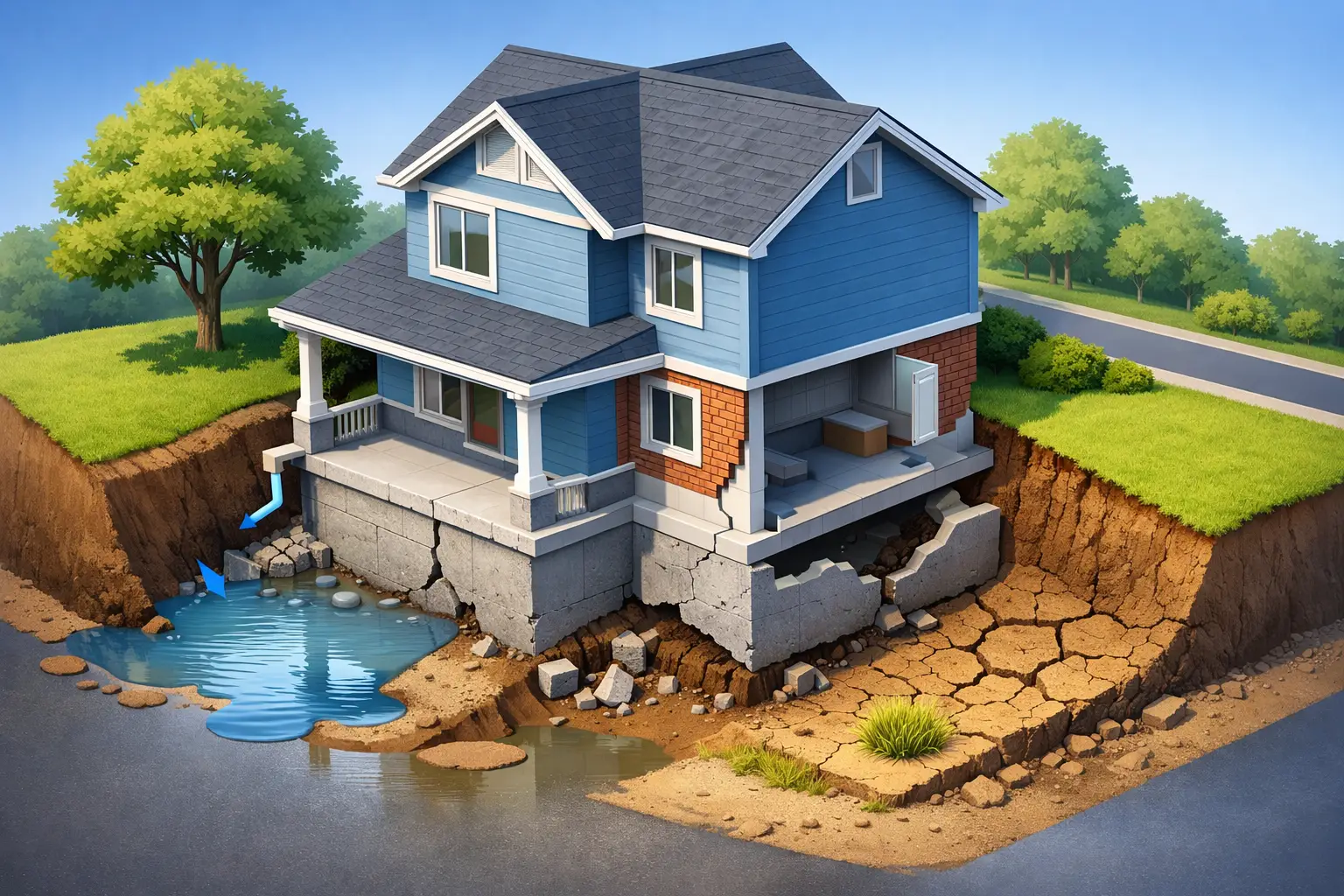
A slab rarely fails all at once. More often, it starts with water collecting where it should not, soaking the soil around the structure, and quietly shifting the support under your building. That is how foundation issues from poor grading begin – not with one dramatic event, but with a site that was never sloped correctly to move water away.
For property owners in South Texas, this matters more than many realize. Heavy rain, flat lots, coastal weather, and changing soil moisture can put constant pressure on a foundation when drainage is poorly planned. If the grade around a home, office, warehouse, or retail building sends water toward the slab instead of away from it, the problem usually spreads beyond the foundation. You may also see erosion, standing water, cracked concrete, fence movement, and drainage trouble across the entire site.
Why poor grading causes foundation problems
Grading is the shape and slope of the ground around a structure. When it is done right, water drains away from the building in a controlled direction. When it is done wrong, water ponds near the perimeter, runs back toward the slab, or saturates one side of the property more than the other.
That uneven moisture is where trouble starts. Soil expands when it holds water and contracts when it dries out. If one section of soil under or beside the foundation stays wetter than another, the slab may not move evenly. One edge can heave while another settles. Over time, that movement can lead to cracks in the slab, brick, drywall, and exterior flatwork.
There is no single pattern every time. Some buildings show corner cracks first. Others develop sticking doors, uneven floors, or widening gaps around windows. The common thread is moisture imbalance, and poor grading is one of the most common causes.
Common signs of foundation issues from poor grading
Some warning signs show up outside before anything becomes obvious indoors. If water stands near the structure after a storm, if mulch and soil wash toward the foundation, or if the ground has sunken along the perimeter, the grade may already be working against the building.
Inside, the signs can be subtle at first. Doors start rubbing. Windows become harder to open. Floor tiles crack for no clear reason. A hairline wall crack that seemed harmless gets longer over one season of wet weather and another season of dry heat.
Outside, you may notice cracks in nearby driveways, sidewalks, patios, or curbs. That does not always mean the main foundation is failing, but it often points to the same site condition. If drainage is poor, concrete surfaces across the property can all be affected by shifting soil and washout.
What poor grading looks like on a property
A lot does not need to look dramatic to have a grading problem. In fact, some of the most expensive drainage and foundation repairs start on properties that seem mostly flat and usable.
One common issue is negative grading, where the ground slopes toward the structure. That can happen because the site was graded incorrectly during construction, because soil settled over time, or because landscaping changed the original drainage path. Adding flower beds, edging, or too much topsoil against the house can also trap water where it should be moving away.
Another issue is low spots near corners, downspout discharge points, or along long walls. Water follows the path of least resistance. If the lot has dips, shallow swales in the wrong places, or compacted areas that hold water, the foundation perimeter may stay wet long after the rest of the site dries out.
Commercial properties have their own version of the same problem. Parking lots, loading areas, and sidewalks can redirect runoff toward the building if the slope is off. A site can have a solid-looking slab and still suffer from drainage failure if surface water is being funneled back to the structure every time it rains.
South Texas conditions make grading more important
In coastal and near-coastal areas, drainage problems do not stay small for long. Flat terrain can limit natural runoff. Sudden heavy storms can dump large volumes of water in a short time. Wind-driven rain adds even more exposure around walls, entrances, and slab edges.
Soil conditions also matter. Some soils are more reactive than others, meaning they expand and shrink as moisture levels change. That cycle puts stress on foundations, driveways, and retaining structures. If grading is inconsistent, the soil moisture around the building becomes inconsistent too, which increases the risk of movement.
This is why a foundation should never be looked at in isolation. The slab, the surrounding grade, the drainage path, and nearby concrete surfaces all affect one another. If one part is wrong, the rest eventually feels it.
Why cosmetic repairs do not solve the real problem
It is common for owners to patch cracks, repaint walls, or replace damaged flooring before addressing drainage. Those repairs may improve appearance for a while, but they do not remove the cause. If water is still collecting around the foundation, movement can continue.
The same goes for isolated concrete patching outside. A repaired sidewalk or driveway section may crack again if the supporting soil is still washing out or expanding from poor drainage. The visible damage is the symptom. The grade and drainage pattern are often the source.
That does not mean every crack points to major structural failure. Concrete cracks for different reasons, and some are minor. But if cracks are growing, repeating, or showing up alongside drainage issues, the smarter move is to evaluate the site conditions before spending money on surface-level fixes.
How grading problems are typically corrected
The right fix depends on the property, the slope available, the amount of runoff, and the condition of the existing concrete and soil. There is no one-size-fits-all answer, and anyone promising a universal solution is skipping the hard part.
In some cases, regrading the soil around the structure is enough. That means reshaping the ground so water moves away from the foundation instead of sitting against it. The work has to be done carefully. Too little slope will not drain properly, and too much can create erosion or redirect water toward another problem area.
In other cases, drainage improvements need to be paired with grading. That may include swales, surface drains, catch basins, or adjusting where downspouts discharge. On sites with concrete hardscapes, the condition and slope of the flatwork may also need to be addressed. A badly pitched patio or driveway can keep sending water back toward the slab even if the soil is reshaped nearby.
When settlement or erosion has already damaged surrounding surfaces, repairs may need to extend beyond the foundation perimeter. This is where experienced site and concrete work matters. Fixing the grade without considering the rest of the property can leave you with half a solution.
When to act on foundation issues from poor grading
If you only see one small crack and no drainage problems, monitoring may be reasonable. But if you see standing water, repeated cracking, gaps around doors or windows, or soil pulling away in some areas and staying soaked in others, it is time to stop guessing.
The longer poor grading is left alone, the more expensive the job can become. Water damage near the slab can affect landscaping, fencing, walkways, and paved areas before the owner decides to deal with the source. On commercial properties, drainage problems can also create safety issues for customers, tenants, or staff.
A proper site review should look at more than the foundation itself. It should account for runoff patterns, low areas, drainage discharge, nearby concrete performance, and how the property behaves during and after storms. That practical approach usually tells the truth faster than waiting to see if another crack appears.
What property owners should look for before hiring help
The contractor should understand grading, concrete, and site drainage as connected systems, not separate trades that ignore one another. That matters because many foundation-related drainage problems are not solved by a simple patch or a rushed dirt move.
Ask whether the plan addresses where water is coming from, where it will go after the repair, and how nearby surfaces will be protected. Ask whether the work will hold up to local weather and soil conditions. A dependable contractor should be able to explain the correction in plain terms, without overcomplicating the problem or minimizing it.
For homeowners and commercial owners alike, the goal is straightforward. You want water moving away from the structure, soil staying more consistent around the slab, and concrete work that is built for long-term performance. That takes proper grading, sound execution, and a crew that knows how site conditions affect the life of the structure.
Haylo Construction works with property owners who need that kind of practical fix – not a sales pitch, but a clear plan to correct drainage and protect the concrete and foundation below it.
If your property keeps holding water or showing signs of movement, do not wait for the damage to become obvious from every room. The ground around a building tells the story early, and acting on it early is usually the cheaper, smarter move.