A parking lot does more than hold vehicles. It directs traffic, manages stormwater, affects curb appeal, and gives customers their first impression of your property. The question, “when should parking lots be replaced,” usually comes up after cracks, potholes, and standing water have become too visible to ignore. Waiting too long can turn a manageable project into a larger safety, drainage, and business-access problem.
For property owners and managers, the right answer is not based on age alone. A lot with isolated surface damage may still be a good candidate for repair. A lot with failing subgrade, repeated potholes, widespread cracking, or poor drainage often needs full replacement. The condition below the surface matters just as much as what drivers see from above.
When Should Parking Lots Be Replaced?
Full parking lot replacement is usually the better investment when the underlying concrete or base has failed. Patching the surface may improve appearance for a short time, but it will not correct movement, washout, or drainage issues beneath the pavement.
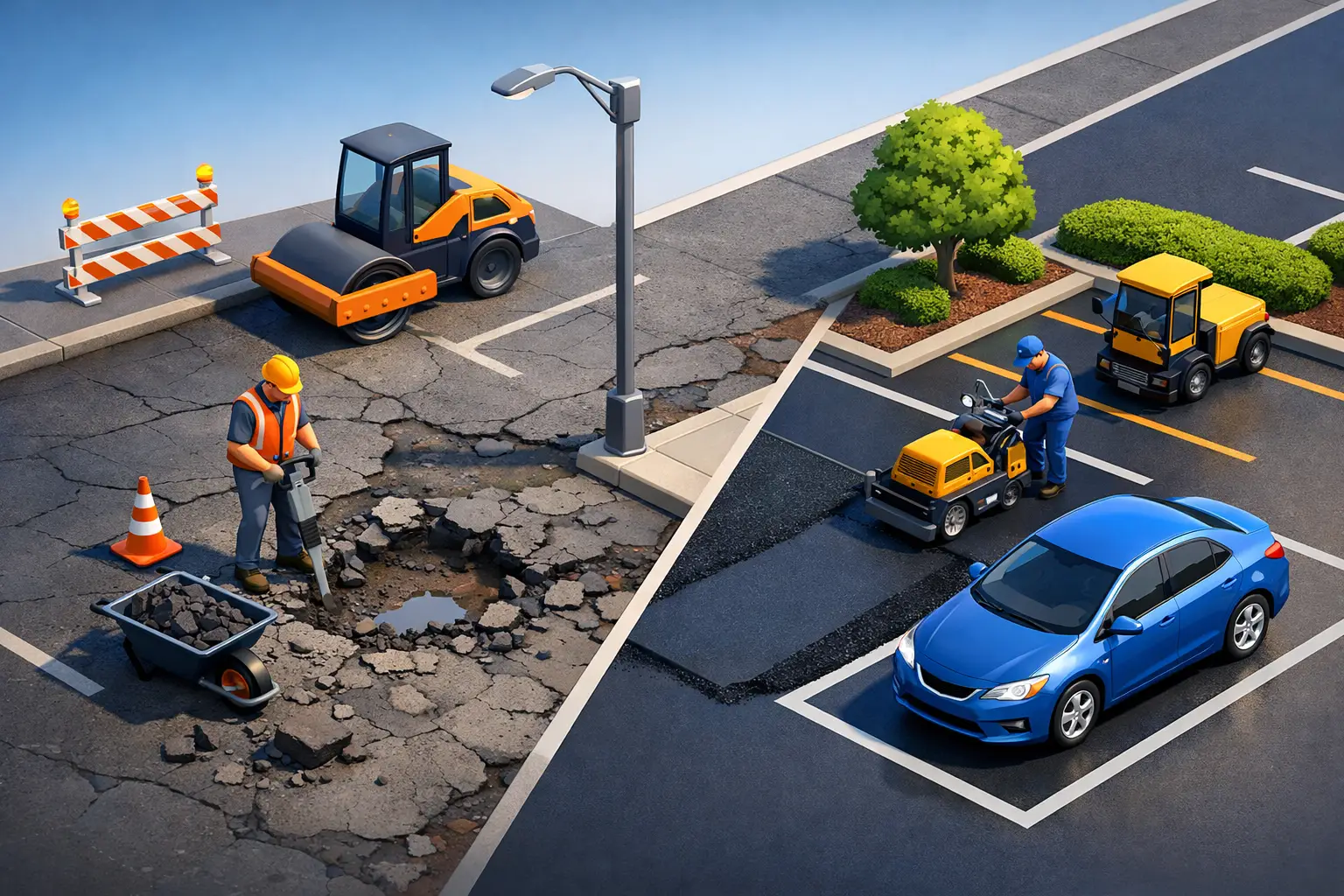
Replacement should be seriously considered when damage is widespread across the driving lanes, parking stalls, entrances, or high-traffic areas. One or two cracks do not necessarily justify removing an entire lot. But when repairs are scattered throughout the property and new damage keeps appearing, the lot may be past the point where spot repairs deliver lasting value.
These conditions commonly point to replacement rather than another round of patches:
- Large areas of interconnected cracking, especially cracks that are widening, uneven, or breaking into smaller sections
- Repeated potholes or surface failures in the same locations after previous repairs
- Settlement that creates low spots, trip hazards, broken curbs, or poor transitions at sidewalks and entrances
- Standing water after normal rainfall, particularly when it sits near buildings, drive lanes, or accessible parking areas
- Exposed aggregate, crumbling edges, major spalling, and surface deterioration across a significant portion of the lot
A replacement project provides the opportunity to remove failed material, evaluate the base, correct grading, and install properly reinforced concrete designed for the traffic the lot will carry. That is a different level of work than filling a crack or patching a pothole.
Repair or Replacement: What Is the Better Call?
The decision comes down to the scope and source of the damage. Repair is often the right call when the slab remains stable, drainage is working, and damage is limited to a few localized areas. Replacing a small broken panel, repairing a joint, sealing cracks early, or correcting minor edge damage can extend the useful life of a parking lot without disrupting the entire property.
When Repairs Still Make Sense
Repairs are practical when the concrete is generally sound and the damage is not growing from a deeper problem. For example, a small area damaged by a delivery vehicle, a few isolated cracks, or localized joint deterioration may be corrected without rebuilding the lot.
The repair must match the cause. Simply placing new material over weak concrete or a washed-out base will not hold. A proper repair may require saw cutting, removing the failed section, rebuilding the base, installing reinforcement where needed, and placing new concrete at the correct elevation.
When Replacement Saves More Money Over Time
If repairs have become routine maintenance rather than isolated fixes, replacement may cost less over the long run. Frequent patching creates an uneven appearance, adds operational headaches, and can leave property owners paying for the same problem more than once.
Replacement is also the better choice when the parking lot no longer supports how the property is used. A lot designed for light passenger vehicles may deteriorate quickly if it now receives delivery trucks, service vehicles, dumpsters, or heavier commercial traffic. Increasing concrete thickness, improving reinforcement, and strengthening the base can prevent the new lot from repeating the same failure pattern.
Drainage Can Decide Whether a Parking Lot Needs Replacement
Along the Coastal Bend, heavy rain, flat sites, shifting soils, and coastal weather can be hard on concrete parking areas. Water that does not drain correctly is one of the most common reasons lots deteriorate before their time.
Standing water seeps into cracks and joints. It can soften or wash away supporting material beneath the slab, creating voids that lead to settlement and cracking. Water near building entrances can also create slip hazards, accessibility concerns, and potential foundation drainage issues.
A parking lot replacement project is the right time to correct grades instead of working around them. That may involve adjusting slopes, rebuilding low areas, improving drainage paths, and making sure water moves away from structures and traffic areas. The goal is not simply a new-looking surface. The goal is a parking lot that performs during the next hard rain.
Look Beyond the Concrete Surface
A contractor should inspect more than cracks and potholes before recommending replacement. The evaluation should consider where traffic enters and exits, the weight of vehicles using the lot, drainage patterns, curb and sidewalk conditions, and the condition of the surrounding site.
Pay close attention to damage near dumpster pads, loading areas, drive-through lanes, fire lanes, and entry points. These sections take more stress than standard parking stalls. If only those high-load areas are failing, a targeted replacement may be possible. If damage extends through the lot, the base or overall design may be inadequate.
Property owners should also consider safety and liability. Uneven slabs, deep holes, loose concrete, ponding water, and faded or poorly planned parking areas can create risks for customers, tenants, employees, and visitors. Addressing these issues early protects the property and makes the site easier to use.
Plan Replacement Around Business Operations
Replacing a commercial parking lot requires more planning than a residential driveway. Access for customers, employees, deliveries, emergency vehicles, and tenants has to be maintained as much as possible. A good contractor will help identify workable phases so the entire property does not have to shut down at once.
Before work begins, confirm the project scope. That includes demolition and disposal of failed concrete, subgrade preparation, base work, grading, reinforcement, concrete placement, joints, curbs, drainage adjustments, and striping coordination if needed. A low price that leaves out base repair or proper drainage can create a more expensive problem later.
Concrete also needs time to cure before it carries regular vehicle traffic. The exact schedule depends on the scope, weather, mix design, and site conditions. Planning ahead helps avoid rushing vehicles onto new concrete before it is ready.
For older lots, it is smart to discuss whether replacement should include upgrades to accessible parking spaces, curb ramps, pedestrian routes, or drainage features. Requirements can vary by property and project scope, but addressing known issues during a full replacement is usually more efficient than tearing out new work later.
Choose Workmanship That Holds Up
A durable parking lot starts below grade. Proper excavation, stable base preparation, correct slope, reinforcement, joint placement, and concrete thickness all affect performance. Good finish work matters, but a smooth surface cannot compensate for poor support underneath.
Haylo Construction approaches parking lot work with the full site in mind, from demolition and removal through grading, concrete placement, and final cleanup. For commercial properties in Corpus Christi and surrounding South Texas communities, local experience matters because drainage, soil movement, heat, and coastal weather all influence the right construction approach.
Do not wait for a parking lot to become a daily complaint from tenants or customers. If the damage is spreading, water is standing, or repairs are no longer holding, have the lot evaluated before the next failure affects safety and operations. The right replacement plan gives your property a clean, durable surface built for the traffic it actually carries.