
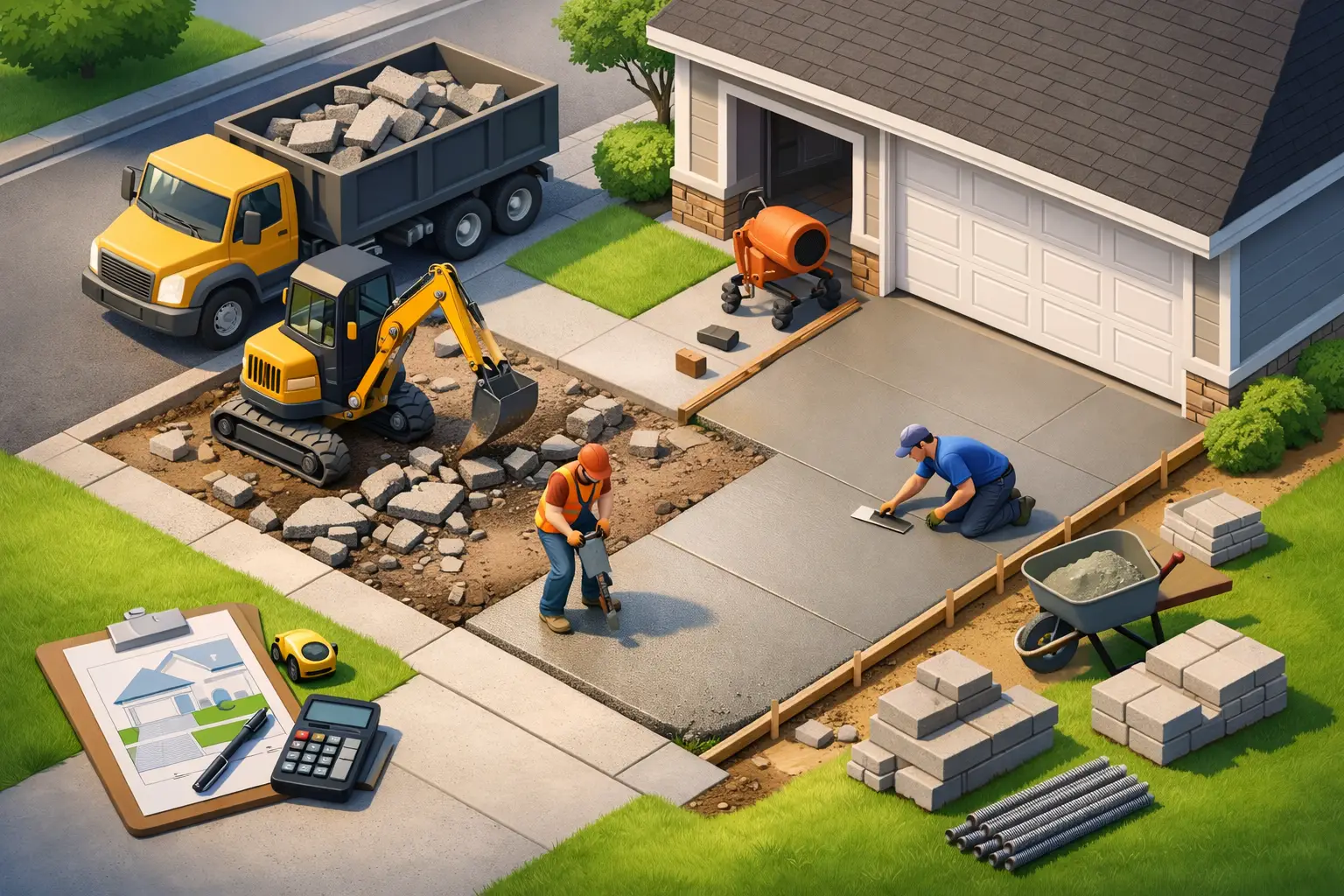
A driveway can look like a simple slab from the street. Underneath it, though, are decisions that determine whether the replacement lasts for decades or starts cracking and settling early. Knowing how to estimate driveway replacement cost helps you compare proposals fairly and budget for the work that actually protects your property.
For homes and businesses in the Coastal Bend, the concrete itself is only one part of the number. Demolition, soil conditions, drainage, reinforcement, access, and the driveway’s intended use can all change the scope. A dependable estimate should account for the full system, not just quote a low price per square foot.
Start With the Driveway’s Square Footage
The first calculation is straightforward: multiply the driveway length by its width. A 20-foot-wide driveway that runs 50 feet from the street to the garage contains 1,000 square feet. Measure each distinct section separately if the shape includes parking pads, turnarounds, curved entries, or side extensions.
For an irregular driveway, divide the area into rectangles and add them together. Curves, angled sections, and flared entrances are harder to form and finish than a basic rectangle, so square footage alone will not tell the whole story. Still, it gives you a reliable starting point for planning.
Do not forget sections that may need to be replaced with the main drive, such as the approach at the curb, a walkway tied into the slab, or a garage apron. Leaving those items out of the initial measurement often creates a budget surprise later.
How to Estimate Driveway Replacement Cost by Scope
A useful way to estimate a replacement is to think of it as a series of work phases. Your starting budget should account for demolition and disposal, site preparation, the new concrete installation, and any needed finishing or restoration work.
A simple planning formula looks like this:
Total estimated cost = removal and hauling + base and grading + concrete installation + reinforcement + drainage or site repairs + finish and access costs
Each category deserves attention because skipping one does not make it disappear. It usually means the contractor has excluded it, assumed conditions are favorable, or plans to address it as an added cost if it becomes necessary.
Removal, Breaking, and Disposal
Replacing an existing driveway means taking out the failed concrete first. The cost depends on slab thickness, the amount of reinforcement inside it, equipment access, and where debris can be loaded and hauled.
A thin residential slab with open access is generally more efficient to remove than a heavily reinforced drive behind a narrow gate. Tree roots, buried utilities, adjacent structures, and tight neighborhoods can also slow demolition. If old concrete has settled badly, removal may expose deeper base problems that need correction before new work begins.
Ask whether the proposal includes breaking the concrete, loading it, hauling it away, and legally disposing of the material. Those are separate operational costs, and they should be clear in writing.
Base Preparation and Grading
Concrete is only as dependable as the material beneath it. After demolition, a contractor may need to remove soft soil, install and compact base material, reshape the grade, or correct areas that hold water. This is where a low-cost estimate can become expensive if the site was not properly evaluated.
In Corpus Christi and nearby coastal communities, moisture, shifting soils, and heavy rain events can expose weak subgrade quickly. A driveway that drains toward the garage, home foundation, or neighboring property needs to be addressed before concrete is poured. Proper slope is not a cosmetic detail. It is part of the driveway’s long-term performance.
If a quote simply says “pour concrete” without describing grading or base preparation, ask what is included and what conditions would trigger an additional charge.
Concrete Thickness, Strength, and Reinforcement
The next major factor is the new slab design. Many standard residential driveways are built for passenger vehicles, while commercial traffic, work trucks, RVs, trailers, and frequent deliveries may require a thicker, more heavily reinforced section.
A driveway also needs properly placed control joints to help manage normal concrete shrinkage and reduce random cracking. Reinforcement can include rebar or wire mesh, depending on the slab design and project conditions. Neither material can compensate for poor grading or an unstable base, but both can be part of a properly specified installation.
When comparing estimates, confirm the proposed thickness, concrete strength, reinforcement type, joint layout, and edge treatment. “Concrete driveway” is too broad to compare on price alone. Two proposals can cover the same square footage while delivering very different finished products.
Account for Features That Change the Price
Basic gray broom-finish concrete is usually the most direct option. Costs increase when the driveway includes additional design work, difficult forming, or specialty finishes. That does not mean those upgrades are a bad investment. It means they should be budgeted separately from the core replacement.
Common cost drivers include:
- A widened drive, parking extension, turnaround, or vehicle pad
- Decorative borders, stamped patterns, stain, or exposed aggregate finishes
- Curves, circular drives, tight access, gates, and restricted equipment entry
- Drainage channels, culverts, catch basins, or regrading around the slab
- Removal and replacement of fencing, landscaping, sidewalks, or irrigation affected by the work
- Permit requirements, utility coordination, or work within a city right-of-way
The same applies to concrete at the street. Some driveway approaches and curb-related work may fall under local requirements or require coordination with the municipality. A professional contractor should identify those issues before work starts instead of treating them as an afterthought.
Consider the Real Use of the Driveway
The right driveway is not always the cheapest one to install. A homeowner with two sedans has different needs than a property owner who parks a boat trailer, service truck, or RV at home. A commercial property may need to withstand delivery vehicles, dumpsters, forklifts, or consistent traffic that would quickly damage a light-duty residential slab.
Be direct about how the driveway will be used. Tell the estimator about heavy vehicles, planned additions, drainage issues, and previous cracking or settlement. That information helps determine whether a thicker slab, stronger base, reinforced edges, or drainage improvements make sense.
It also prevents a common mistake: replacing a failed driveway with the same design without fixing the reason it failed. If the original slab cracked because water undermined the base, simply pouring new concrete in the same conditions is not a long-term solution.
Compare Proposals Line by Line
The lowest number is not automatically the best value. A clear proposal should make it possible to see what the contractor intends to remove, install, protect, and restore. If one estimate is substantially lower than the others, look for missing scope before assuming you found a bargain.
Compare the slab size and thickness, demolition and hauling, base preparation, reinforcement, concrete finish, control joints, drainage work, cleanup, and warranty terms. Also confirm whether the estimate addresses access limitations and whether landscaping, gates, or adjacent surfaces could be affected.
Good communication matters here. Contractors cannot see every hidden soil condition before demolition, but they can explain likely risks, identify allowances, and provide a process for handling legitimate change orders. Clear expectations before the crew arrives protect both the customer and the project.
Build a Sensible Contingency Into Your Budget
For a straightforward driveway with visible conditions and easy access, the contractor’s written scope may be close to the final project cost. For older properties or sites with drainage and soil concerns, leave room in your budget for hidden conditions. Soft subgrade, unexpected slab thickness, buried debris, damaged drainage components, and utility conflicts can require additional work.
The goal is not to expect the worst. It is to avoid making a major property decision based on an unrealistically narrow number. A well-prepared estimate gives you a range for planning, then a site visit turns that range into a scope built around your actual driveway.
A new driveway should improve access, drainage, curb appeal, and daily use of your property – not create another repair problem in a few years. Before choosing a contractor, request a detailed on-site estimate that explains the preparation beneath the concrete as clearly as the finish you will see on top.