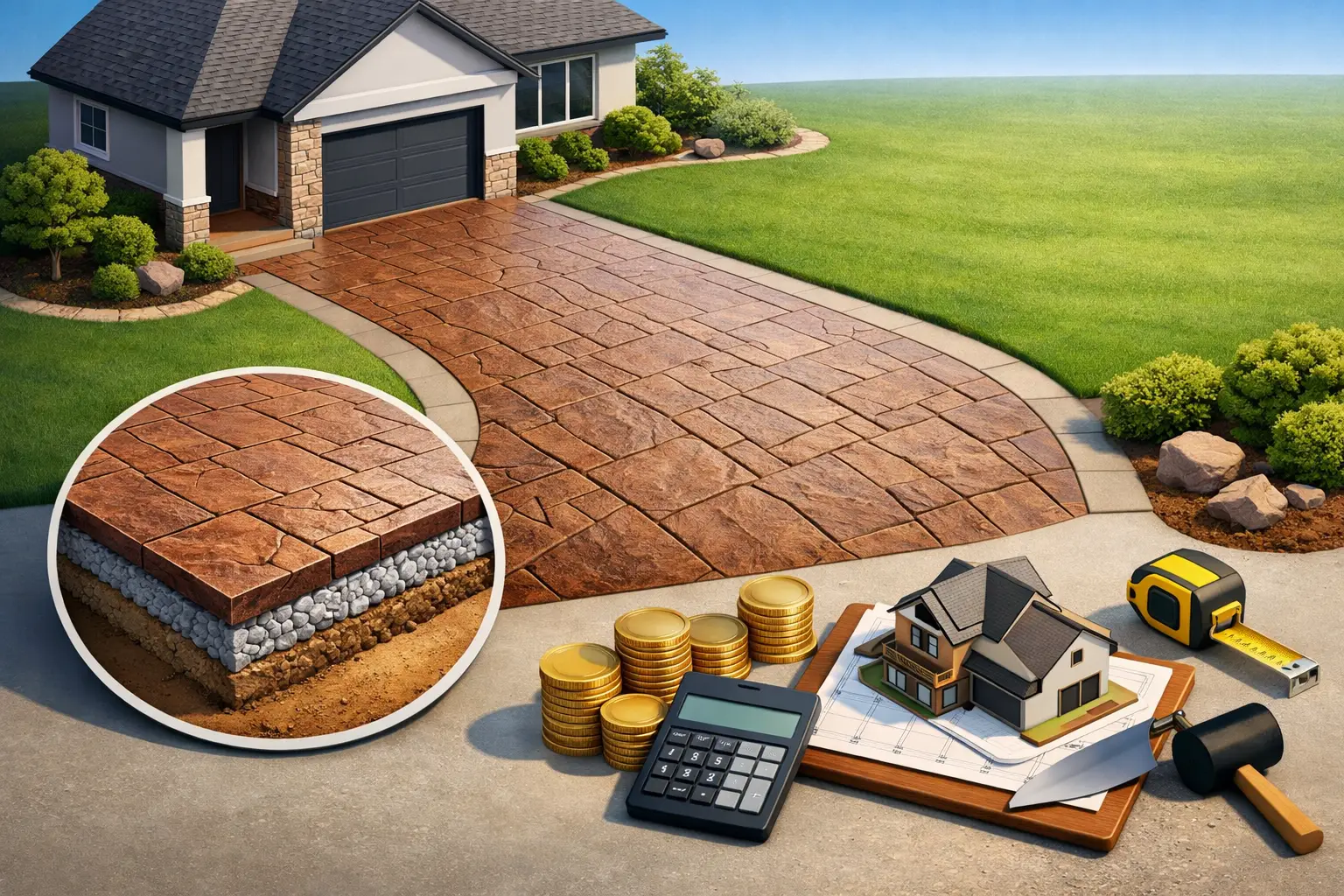
A stamped driveway can make a plain front entry look finished, but the real question is what that upgrade costs once the forms are set and the concrete truck arrives. Stamped concrete driveway cost usually falls well above basic broom-finish concrete, and for good reason. You are paying for added labor, decorative work, stronger planning, and a finish that needs to hold up under vehicle traffic, weather, and daily use.
For property owners, the mistake is focusing on price per square foot alone. That number matters, but it does not tell the whole story. The final cost depends on the driveway size, thickness, reinforcement, site access, grading, drainage, base condition, stamp pattern, color choices, edge detail, and sealing requirements. On coastal properties and in areas with shifting soils or drainage concerns, those jobsite conditions can move pricing fast.
What affects stamped concrete driveway cost
The biggest factor is square footage, but large driveways do not always mean a simple job. A straight, open driveway with easy truck access is different from a narrow approach with curves, borders, and limited room for equipment. Decorative concrete takes timing and manpower. Once the pour starts, the crew has to place, finish, color, and stamp the slab on schedule. More complexity means more labor.
Thickness and reinforcement matter too. A driveway has to support cars, trucks, trailers, and regular turning movement. If the slab is undersized or poorly reinforced, the decorative finish will not save it. A good stamped driveway starts with sound construction under the surface, including proper subgrade prep, compaction, and reinforcement selected for the load and soil conditions.
Design choices also push cost up or down. A single stamp pattern with one integral color is more affordable than a layout with multiple colors, borders, saw cuts, or custom texture changes. Homeowners often like the look of stone or brick patterns, but some patterns take more labor to line up and stamp consistently across a large area.
Sealing is another cost item that should not be treated as optional. Stamped concrete needs a quality sealer to protect the color, help resist moisture intrusion, and improve long-term appearance. In hot, humid, and coastal environments, maintenance planning is part of the real project cost.
Typical stamped concrete driveway cost ranges
In many markets, stamped concrete driveway cost often lands around $12 to $20 per square foot for a standard residential project, with more basic decorative work coming in near the low end and custom designs moving well above that. Higher-end jobs can exceed that range when site prep is extensive, access is difficult, or the design includes borders, multi-tone coloring, or specialty sealing systems.
That means a 600 square foot driveway may cost roughly $7,200 to $12,000 or more, while an 800 square foot driveway can run from about $9,600 to $16,000 and up. Those are rough planning numbers, not fixed quotes. They can shift based on demolition needs, haul-off, grading correction, drainage work, permit requirements, and local material and labor rates.
A smaller driveway is not always cheaper on a per-square-foot basis. Mobilization, forming, finishing, and decorative labor still carry fixed costs. On the other hand, very large projects may gain some efficiency if layout and access are straightforward.
Why stamped concrete costs more than plain concrete
Plain concrete is faster to place and finish. Stamped concrete adds a decorative process that has to happen during a tight working window. The crew applies color, release agents when needed, stamp mats, detail tools, and finishing techniques that require experience and coordination.
That extra labor is the main reason the price climbs. There is also more risk in the work. Decorative mistakes are harder to hide than on a standard slab. If alignment is off, color variation is poor, or the surface sets too quickly in hot weather, the finished product can suffer. Skilled crews charge more because good decorative concrete leaves less room for error.
For many owners, the added cost is worth it because stamped concrete delivers a stronger visual impact than standard gray concrete without the higher movement and weed issues that come with individual pavers. It gives you a decorative look on a monolithic slab, but it still needs proper installation and maintenance to perform well.
Site conditions can change the price quickly
One reason estimates vary so much is that the ground rarely tells the same story from one property to the next. If an old driveway has to be broken out and hauled away, expect the total price to rise. If the base underneath is unstable, the contractor may need to excavate deeper, import compacted fill, and correct grade issues before new concrete is poured.
Drainage is especially important. A driveway that holds water or sends runoff toward the garage can become a long-term problem no matter how attractive the stamp pattern looks. In South Texas, heat, heavy rain, coastal moisture, and soil movement all put pressure on concrete performance. That is why the prep work matters just as much as the decorative finish.
Access can also affect labor. If crews cannot get trucks or equipment close to the pour area, placement becomes more time-consuming. Tight side yards, fences, landscaping, and existing structures can slow down demolition and installation.
Design upgrades that add to stamped concrete driveway cost
If you are pricing options, ask where the upgrades start. Most stamped driveway estimates increase when you add custom borders, contrasting accent colors, tighter grout lines, heavy antiquing, curved layouts, widened aprons, or transitions into walkways and patios.
Some owners want the driveway to match nearby stone, pool decking, or the home’s exterior finishes. That can produce a strong final look, but it usually takes more mockups, more hand detail, and more finish control. Decorative scoring or saw cuts can add definition, though those details should be planned carefully to help control cracking and preserve appearance.
The right design is usually the one that balances appearance with maintainability. A clean, consistent pattern often ages better than an overly complicated layout. For driveways, durability should stay ahead of decoration.
Budgeting the right way
If you are comparing bids, make sure each estimate includes the same scope. Ask about demolition, haul-off, subgrade prep, base material, thickness, reinforcement, coloring method, stamping process, control joints, sealing, cleanup, and curing time. One lower bid can look attractive until you realize it excludes site prep or uses a thinner slab.
It also helps to ask how the contractor handles drainage and whether the grade will be adjusted as part of the work. A stamped driveway is not just a finish product. It is a structural exterior surface that has to manage water, carry vehicle loads, and hold up over time.
Financing may make sense for some owners, especially if the project also includes walkway replacement, patio work, or related site improvements. The key is to budget for the full job rather than the decorative layer alone.
How to protect the investment
Stamped concrete is not maintenance-free. It should be cleaned regularly and resealed on a schedule that fits traffic, weather exposure, and surface wear. If the driveway sees full sun, salt air, frequent washing, or heavy vehicle use, the sealer may need attention sooner.
Avoid the mindset that decorative concrete can be installed and ignored for years. Sealer breakdown, surface wear, and small cracks are easier to manage when caught early. A well-built stamped driveway can last a long time, but long-term performance depends on the original installation and the care that follows.
This is where experience matters. A contractor who understands concrete installation, replacement, grading, and repair as one scope is better positioned to price the work accurately and build it for local conditions. That matters even more when the property has drainage issues, older flatwork, or signs of soil movement.
If you are considering a new stamped driveway, get a detailed quote based on the actual site, not a generic online number. Haylo Construction works with property owners who want concrete that looks good, drains right, and holds up under real use. The best project is not the cheapest one on paper. It is the one built correctly the first time, with a design you will still be satisfied with years from now.