If you are weighing slab foundation vs pier for a home, shop, office, or light commercial build, the wrong choice can follow the property for decades. Foundation problems are expensive, disruptive, and hard to hide. In South Texas, where soil movement, drainage, heat, and coastal conditions all come into play, this decision needs to be made with the site in mind – not by default.
Some owners assume a slab is always cheaper and faster, while others think pier systems are automatically better because they reach deeper support. Neither is true in every case. The right answer depends on soil behavior, building use, water management, access for future repairs, and how the structure will perform over time.
Slab foundation vs pier: the basic difference
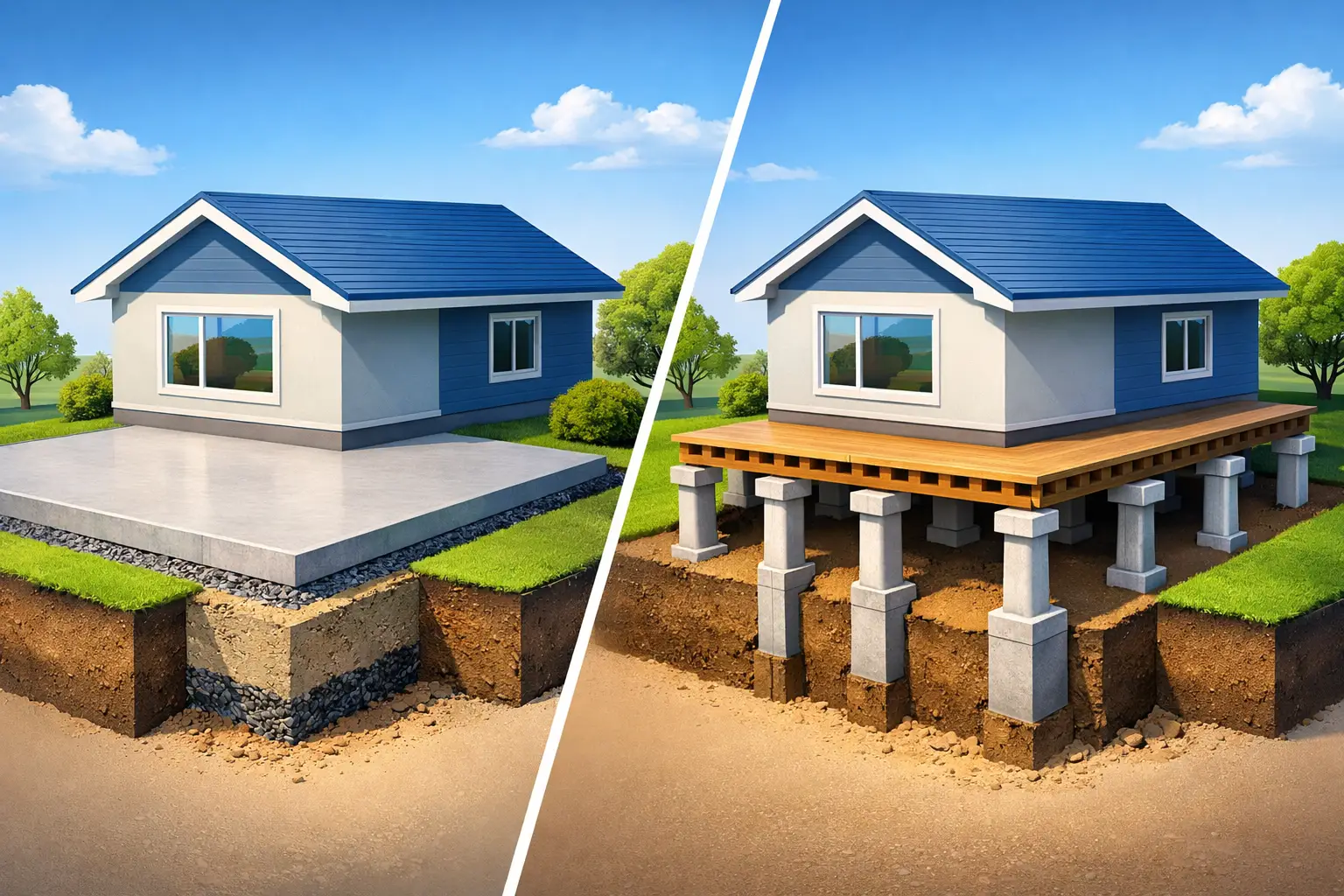
A slab foundation is a continuous concrete base poured directly on properly prepared ground. It usually includes reinforcement, a moisture barrier, thickened edges or grade beams, and subgrade compaction designed to support the structure above. It creates a low-profile foundation and is common for homes, additions, garages, and many commercial buildings.
A pier foundation uses a series of vertical supports that transfer loads to deeper, more stable soil layers. Depending on the project, that may include concrete piers, drilled shafts, or other engineered support elements tied into beams or a structural floor system. In everyday conversation, people also use the term pier and beam for raised floors supported by piers.
The biggest practical difference is simple. A slab spreads the load across the prepared surface. A pier system concentrates the load into deeper bearing points. That affects cost, installation, drainage planning, accessibility, and long-term maintenance.
When a slab foundation makes more sense
A properly built slab can be a strong, efficient solution when site conditions are favorable and grading is handled correctly. For many property owners, it is the most straightforward option because it supports the building and finished floor in one system.
Slabs often work well on sites with manageable soil conditions, good drainage design, and a building layout that does not require under-floor access. They are also common when speed matters. Once site prep, forms, reinforcement, and inspections are complete, a slab can move a project forward quickly.
There are cost advantages too, especially on simpler footprints. A slab generally uses less under-structure framing and fewer access components than a raised foundation system. For residential and light commercial projects, that can make budgeting more predictable.
That said, slab performance depends heavily on preparation. If the subgrade is poorly compacted, drainage is ignored, or reinforcement is undersized, the slab may crack, settle unevenly, or allow moisture-related problems to develop. The slab itself is not the problem in those cases. The issue is usually what happened before the concrete was poured.
When a pier foundation makes more sense
Pier systems are often selected when surface soils are less reliable or when the structure needs to be elevated. They can also be a good fit where access below the building adds long-term value, especially for utility work, inspections, or repairs.
On sites with expansive or unstable upper soils, piers may offer a more dependable load path because they transfer weight below the most active layer. In some cases, that can reduce movement compared with a slab resting near the surface. Raised systems can also help when flood considerations, ventilation, or finished-floor height are part of the design.
Pier foundations can be especially useful on sloped sites or properties with drainage challenges that make a low, slab-on-grade profile less practical. For some owners, the biggest benefit is future access. Plumbing, electrical, and mechanical work can be easier to reach in a raised structure than in a slab where utilities may be embedded below concrete.
The trade-off is complexity. Pier systems usually involve more structural coordination, more components, and in many cases a higher upfront cost. They also require proper engineering and installation. If spacing, depth, or beam support is wrong, the system can still experience movement and floor issues.
Soil and drainage matter more than the debate
When people ask which foundation is better, the real question is usually which foundation fits the site. Soil and water are often the deciding factors.
In the Coastal Bend and surrounding South Texas areas, contractors have to account for shifting moisture levels, drainage flow, and soil behavior that can change from one lot to the next. A slab that performs well on one property may not be the best answer a few miles away. The same goes for piers.
Poor drainage is one of the most common reasons foundations start having trouble. Water pooling near the perimeter can soften supporting soils, increase movement, and create differential settlement. On the other side, overly dry conditions can also affect soils that shrink and pull away. That is why grading, runoff control, and moisture management are not extras. They are part of foundation performance.
A good contractor does not start by pushing one option. They start by reading the site, reviewing the intended structure, and making sure the foundation system works with the soil report, drainage plan, and building demands.
Cost, repairs, and long-term ownership
For many owners, cost drives the first conversation. That is reasonable, but initial price should not be the only filter.
A slab is often less expensive upfront on a straightforward project. Fewer moving parts, faster schedules, and simpler floor systems can keep costs down. But if future plumbing repairs require cutting through concrete, repair costs can rise quickly. Interior disruption can also be greater when utilities are buried under the slab.
Pier foundations often cost more to build, but they can offer easier access for certain repairs and modifications later. That does not mean they are maintenance-free. Raised floors can develop issues like unevenness, moisture concerns under the structure, or support adjustments if conditions change over time.
The better way to look at cost is total ownership. What does the site require now, and what type of repairs are more likely later? If a property has conditions that make slab movement a serious risk, the cheaper upfront option may not be the cheaper long-term option.
Slab foundation vs pier for homes and commercial properties
For homes, the decision often comes down to lot conditions, elevation needs, and budget. A slab can be a dependable choice for subdivisions and custom builds where the pad is properly prepared and drainage is controlled. A pier system may be more attractive for older neighborhoods, flood-prone areas, or sites where access under the floor matters.
For commercial properties, the answer depends even more on use. Storage loads, equipment, traffic, utility routing, and the scale of the structure can all influence foundation design. Some commercial buildings benefit from the simplicity and strength of a well-engineered slab. Others need deeper support or elevation strategies that make piers a better fit.
This is where experience matters. Foundation selection should match the building type, not just the habit of the builder. A retail pad, office shell, detached garage, and workshop do not all carry the same loads or face the same site demands.
What to ask before choosing a foundation
Before you move forward, ask how the soil has been evaluated, how drainage will move water away from the structure, and what reinforcement or pier design is being specified. Ask where utilities will run and how repairs would be handled later. Ask whether the finished floor elevation is appropriate for the site.
You should also ask who is responsible for site prep. A strong foundation starts before concrete arrives. Excavation, grading, moisture conditioning, compaction, forms, and base preparation all affect the final result.
If the answers are vague, that is a problem. A dependable contractor should be able to explain why a slab or pier system fits the project and what steps will be taken to reduce risk.
The right choice is the one built for your site
There is no universal winner in slab foundation vs pier. A slab can be efficient, durable, and cost-effective when the site is prepared correctly. A pier system can be the smarter option when soils are less stable, elevation is needed, or future access matters more.
What property owners need is not a generic preference. They need a foundation plan that reflects the ground conditions, drainage demands, building use, and long-term maintenance reality of the job. That is where local experience makes a real difference. A contractor who understands coastal soil behavior, grading, and reinforced concrete work can help you avoid expensive guesswork.
If you are planning a new build, addition, or structural concrete project, slow down long enough to get the foundation decision right. It is one of the few parts of a project that everything else depends on.