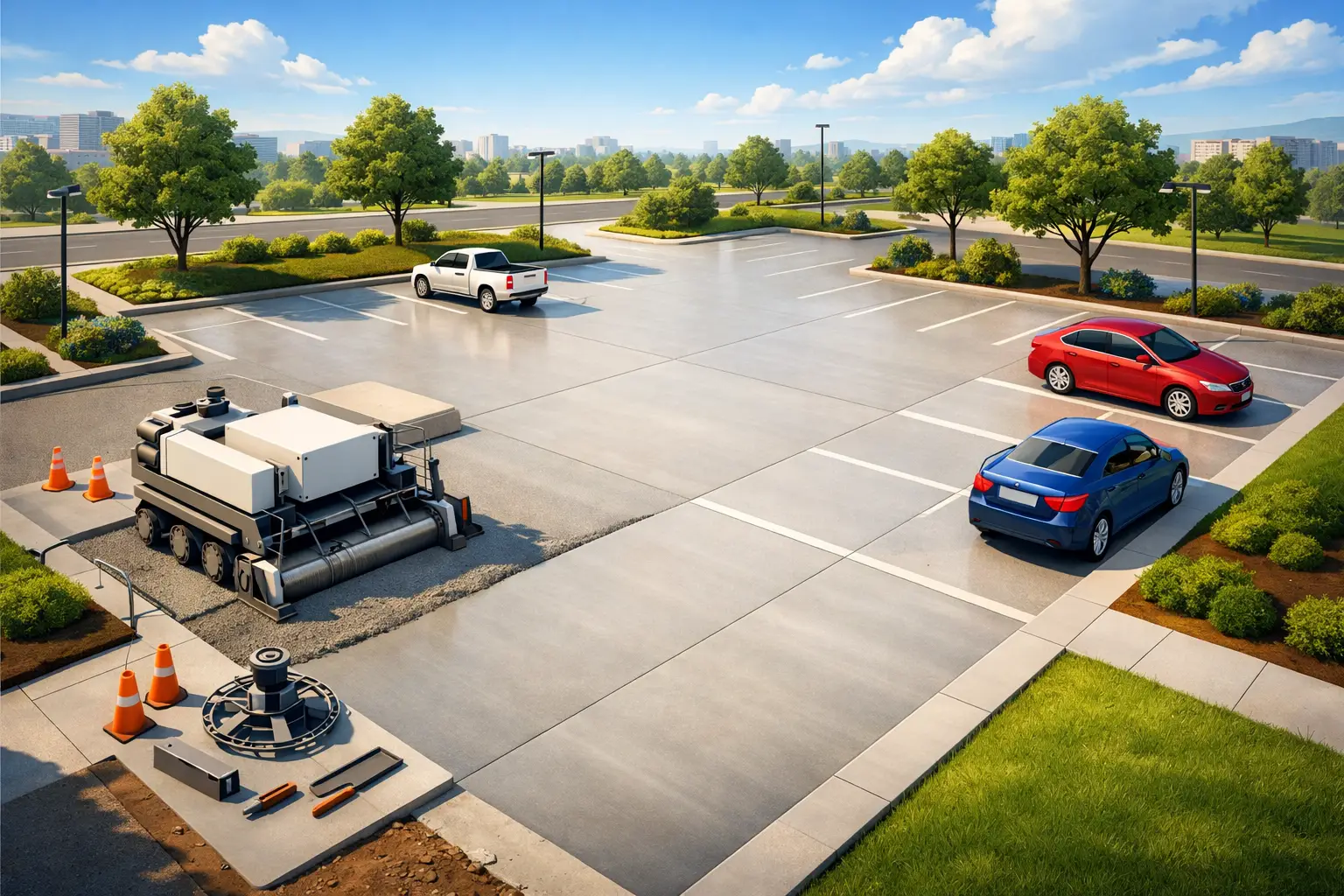
A parking lot starts making an impression before anyone reaches your front door. If the surface is cracked, ponding water, or breaking apart under traffic, customers notice it, tenants notice it, and your maintenance budget notices it. Concrete parking lot paving gives property owners a hard-wearing surface built for heavy use, cleaner appearance, and long-term performance when the work is done right.
For many commercial properties, the lot is not just a place to park. It is part of site access, drainage, safety, and day-to-day operations. That is why material choice matters. Concrete is often the better fit for owners who want a longer service life, stronger load capacity, and less frequent replacement than asphalt, especially on sites that see delivery trucks, steady traffic, or hot South Texas conditions.
Why concrete parking lot paving makes sense
Concrete costs more up front than asphalt in many cases, and that should be said plainly. But initial price is only one part of the decision. The real question is what the lot will cost over time, how it will hold up under use, and how often you want to deal with patching, resurfacing, or disruption to your business.
Concrete handles compressive loads well, which makes it a strong option for retail centers, office properties, churches, industrial yards, apartment complexes, and mixed-use sites. It also reflects more light than darker paving materials, which can improve visibility and reduce heat buildup at the surface. In coastal and high-moisture environments, proper grading and drainage are just as important as the slab itself, because standing water will shorten the life of any parking lot.
A well-built concrete lot is not just a slab poured over dirt. It depends on excavation, stable subgrade preparation, base compaction, reinforcement, joint layout, thickness matched to traffic demands, and careful finishing. Miss any one of those steps, and the lot may look good for a short time but fail early.
What separates a durable parking lot from a short-lived one
Most parking lot failures start below the surface. Soft spots in the subgrade, poor compaction, or weak drainage lead to cracking, settling, and edge failure. On the Gulf Coast, where soil movement and heavy rain can both be factors, site prep is not optional. It is the foundation of the whole project.
That means removing unstable material where needed, establishing the right base, and grading the site so water moves away from the pavement instead of collecting on it. Reinforcement also matters. Depending on the project, that may include rebar or wire mesh designed to help the slab resist movement and carry loads more evenly.
Thickness is another big factor. A lot built for passenger vehicles has different structural needs than one that sees trash trucks, delivery vehicles, or commercial traffic every day. Going too thin to save money at the start usually costs more later in repairs and replacement.
Joint placement is another detail that gets overlooked by owners until problems show up. Concrete will crack. The goal is to control where that happens. Properly planned control joints help direct movement and reduce random cracking across the lot. Expansion joints in the right places also help protect surrounding pavement and adjacent structures.
Concrete parking lot paving vs. asphalt
This decision comes down to budget, traffic, maintenance expectations, and timeline. Asphalt can be less expensive to install and faster to open in some cases. For certain properties, that makes it a practical choice. But it generally requires more ongoing maintenance, including sealing and more frequent surface repairs.
Concrete usually has a higher upfront cost, but it tends to last longer and hold shape better under heavier loads. It also performs well in heat, where asphalt can soften and deform over time. For owners focused on lifecycle value instead of lowest initial bid, concrete often comes out ahead.
There is also the appearance factor. Concrete has a cleaner, brighter look that works well for commercial entrances and properties where curb appeal matters. That does not mean it is the right answer for every lot. If a site needs a lower initial investment and traffic is lighter, asphalt may still be worth discussing. Good contractors will explain the trade-offs instead of forcing one material into every job.
Planning the project the right way
Every parking lot project starts with questions that affect the final result. How much traffic will the lot carry? What kinds of vehicles use it? Does the site have drainage problems now? Is there existing pavement that can be removed cleanly, or is the base failing underneath? Are there utility conflicts, access needs, ADA requirements, or phasing concerns that could affect the schedule?
For active commercial properties, staging matters almost as much as construction. Businesses still need customer access, delivery routes, and safe pedestrian movement. A contractor who understands site work will plan around those needs instead of treating them like an afterthought.
Permitting and code requirements also need attention early. Striping layout, accessible parking, slopes, curb transitions, and drainage compliance all affect how the finished lot performs and whether it passes inspection. It is cheaper to plan for those items upfront than to fix them after the pour.
The installation process and where quality shows up
A solid parking lot build usually follows a straightforward path, but execution is where the job is won or lost. Demolition or removal comes first if an old lot is being replaced. From there, the crew prepares the subgrade, installs and compacts base material, sets forms, places reinforcement, and verifies elevations for proper drainage.
Then comes the concrete placement itself. This stage moves fast, and it has to be coordinated well. Mix design, weather conditions, placement timing, finishing, and curing all affect the strength and surface quality of the final lot. Rushing a pour or cutting corners during curing can lead to scaling, dusting, weak surfaces, or early cracking.
After the slab reaches the required strength, final work may include striping, signage, wheel stops, and tie-ins to surrounding pavement or sidewalks. The lot should not just look finished. It should function cleanly for traffic flow, drainage, and safe use.
Maintenance is lower, not zero
Concrete is known for lower maintenance, but that does not mean no maintenance. Joint sealing, crack monitoring, occasional cleaning, and prompt repair of isolated damage all help extend service life. The good news is that owners are typically dealing with fewer recurring surface issues than they would with asphalt.
If damage does appear, the right fix depends on the cause. Small surface cracks may be mostly cosmetic. Settlement, broken corners, spalling, or drainage-related issues usually point to a deeper problem that should be addressed before it spreads. A proper evaluation matters more than a quick patch.
Why local site knowledge matters
In South Texas, heat, rainfall, coastal exposure, and shifting ground conditions all influence pavement performance. A parking lot that is overbuilt in the wrong places and underbuilt in the critical ones is still a problem. Local experience helps contractors make better decisions about grading, reinforcement, base prep, and water management.
That is especially important for commercial properties where downtime costs money. You need a contractor who can handle demolition, site prep, concrete work, and coordination without making the job harder than it needs to be. Haylo Construction approaches parking lot work with that mindset – clear communication, proper preparation, and a finished product built for the real use the site will see.
Choosing a contractor for concrete parking lot paving
The lowest number on a bid does not tell you much by itself. Owners should be asking what is included in subgrade prep, how drainage will be handled, what slab thickness is planned, what reinforcement is specified, and how traffic loads were considered. Insurance, safety practices, schedule control, and cleanup also matter, especially on active properties.
A dependable contractor should be able to explain the scope in plain language and tell you where the risks are. Sometimes the right answer is a full replacement. Other times, selective removal and new paving in key sections may make more sense. The best recommendation is the one that fits the condition of the site and the long-term goals of the property.
If your lot is becoming a liability instead of an asset, it is probably time to look at the whole picture, not just the surface. A well-planned concrete parking lot gives your property a stronger first impression, better durability, and fewer headaches over time. The smart next step is to get a professional estimate and make sure the work is designed for the traffic, drainage, and conditions your site actually has.