A driveway usually tells you when it is done. Not with one big failure, but with a pattern – widening cracks, standing water, rough sections at the garage, and edges that keep breaking off. If you are looking into driveway replacement Portland TX property owners can count on, the real question is not just how to pour new concrete. It is how to replace it in a way that holds up to traffic, drainage demands, and South Texas conditions.
For many homes and commercial properties, patching only buys time. A few repairs can make sense when damage is isolated, but widespread cracking, sinking, or drainage problems usually point to a deeper issue under the slab. In those cases, replacement is often the smarter investment because it addresses the base, the grading, and the structural performance of the driveway as a whole.
When driveway replacement makes more sense than repair
Concrete is durable, but it is not permanent. Once a driveway starts failing across multiple sections, surface fixes stop being cost-effective. If you see long structural cracks, uneven panels, broken corners in several areas, or repeated ponding after rain, replacement deserves serious consideration.
The biggest sign is movement. When one section settles and another does not, vehicles start putting uneven pressure on the slab. That can lead to faster cracking, trip hazards, and drainage that pushes water back toward the garage or foundation. Repair can cover the symptoms for a while, but it does not always solve what caused the slab to move in the first place.
Age also matters, but not by itself. An older driveway that still drains well and has limited cosmetic wear may not need full replacement. On the other hand, a newer slab built on poor preparation can fail early. What matters most is the condition of the concrete and the condition of the base underneath it.
What affects driveway replacement in Portland TX
Driveway replacement Portland TX projects are shaped by more than square footage. Coastal weather, soil behavior, drainage, and daily use all affect how the new concrete should be built.
Soil and base preparation
A driveway is only as good as the ground supporting it. If the subgrade is weak, poorly compacted, or uneven, the slab above it will eventually show the problem. That is why demolition and removal are only part of the job. Proper site prep matters just as much.
A dependable contractor will evaluate the base after the old driveway is removed, not assume it is ready for new concrete. In some cases, the existing material can be reworked and compacted. In others, unstable sections need to be cut out and replaced. Skipping that step may lower the upfront price, but it raises the odds of early failure.
Drainage and grading
This is one of the most overlooked parts of driveway work. If water sits on the surface or runs toward structures, concrete deterioration speeds up and surrounding property can be affected. Good replacement work includes grading that moves water where it should go without creating runoff problems elsewhere on the site.
That is especially important when the old driveway already had ponding issues. Pouring a new slab at the same elevations without correcting slope is not a real fix. It is just a cleaner version of the same problem.
Reinforcement and thickness
Not every driveway should be built the same way. A residential driveway used by standard passenger vehicles has different demands than one handling heavy trucks, trailers, or business traffic. Thickness, reinforcement, joint layout, and concrete mix all need to match the use.
This is where experience matters. A low price can mean a thinner slab, weak reinforcement, or shortcuts in finishing and curing. Those choices may not show up on day one, but they show up later in the form of cracks, edge breakdown, and shortened service life.
What the replacement process usually looks like
A professional driveway replacement should feel organized from the first visit. That starts with a clear estimate and a real site assessment, not a guess based on photos alone.
Demo and removal
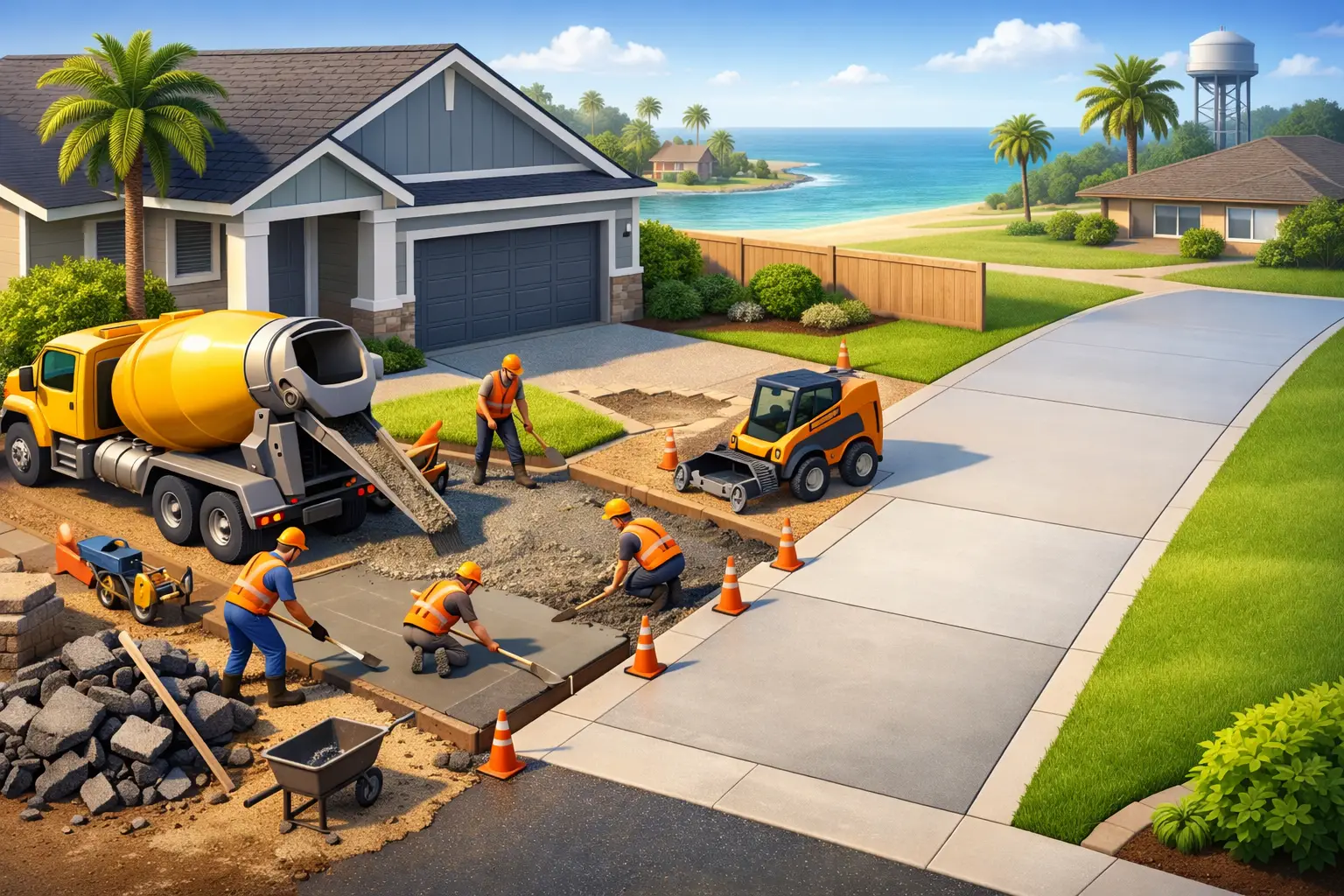
The first stage is breaking out and removing the old driveway. Clean demolition matters because it exposes the full condition of the site and prevents loose material from being left under the new work. If the project ties into sidewalks, curbs, garage slabs, or adjacent flatwork, those transitions should be evaluated carefully.
Subgrade correction and form setup
Once the old concrete is out, the site is graded and compacted. Weak areas are addressed, forms are installed, and the layout is checked for proper slope and fit. This is the stage where quality control pays off. If the forms are wrong, the finished driveway will be wrong.
Reinforcement and concrete placement
After prep is complete, reinforcement is placed and concrete is poured, finished, and jointed. The finish should match the use of the driveway. Most owners want a clean, durable surface with enough texture for traction without making it hard to maintain.
Curing and return to service
Concrete needs time to gain strength. That means a responsible contractor will give clear guidance on when foot traffic and vehicle traffic can return. Rushing this part can damage a brand-new driveway before it ever gets a fair start.
Cost factors property owners should expect
There is no honest one-size-fits-all price for driveway replacement. The final cost depends on the amount of concrete being removed, site access, thickness requirements, drainage corrections, reinforcement, and whether any adjoining features need to be adjusted.
Decorative options can also change the total. Some property owners want a standard broom finish because it is practical and cost-efficient. Others prefer a more customized look with border work, stamped finishes, or stained concrete. Those upgrades can improve curb appeal, but they should not come before structural basics like base prep and drainage.
If you are comparing estimates, make sure you are comparing the same scope. A lower number may leave out hauling, base correction, thicker sections, or proper reinforcement. The cheapest bid is not always the most affordable once callbacks and premature failure are factored in.
How to choose the right contractor for driveway replacement Portland TX
The best contractor is not just the one who can pour concrete. It is the one who can manage demolition, site prep, grading, placement, and cleanup with discipline.
Look for clear communication, detailed scope of work, and local experience with coastal conditions. Ask how base preparation is handled. Ask what reinforcement is included. Ask how drainage will be improved if the current driveway holds water. Good contractors will answer directly.
Insurance, licensing where required, and safe work practices matter too. So does reliability. Property owners should not have to chase updates or wonder if the crew will show up prepared. A driveway replacement affects access to the home or business, so scheduling and execution need to be handled professionally.
For owners who want one contractor to handle concrete, removal, and site-related work without passing blame between trades, a full-service company can make the project smoother. That is part of why many South Texas property owners work with crews like Haylo Construction that understand both the slab and everything under it.
Getting the longest life from a new driveway
A well-built driveway still benefits from practical care. Keep heavy loads within what the slab was designed to handle. Avoid letting drainage issues from gutters or landscaping dump water onto the concrete edge. Clean oil and chemical spills when they happen, and pay attention to early signs of movement near joints or transitions.
That said, maintenance only goes so far. Longevity starts with the installation itself. Proper grading, compaction, reinforcement, and curing do more for long-term performance than any after-the-fact product or patch.
A new driveway should not just look better from the street. It should function better every day, carry the load it was built for, and direct water away from the areas you need to protect. If your current slab is past the point of repeated fixes, replacement is a chance to solve the real problem and put solid concrete back under your property.