A basketball court should play consistently on day one and still hold up after years of South Texas sun, rain, and regular use. The best basketball court surfaces are not chosen by color or price alone. They depend on who will use the court, whether it is indoors or outdoors, how the site drains, and how much maintenance the owner is willing to handle.
For most outdoor residential and commercial courts in the Coastal Bend, a properly prepared concrete slab with a quality sports coating is the dependable choice. It provides a stable playing surface, handles heavy use, and gives property owners a court that can be maintained instead of replaced when the finish eventually wears.
Best Basketball Court Surfaces for Outdoor Use
Outdoor courts need more than a flat-looking slab. They need a base that resists movement, a controlled slope that moves water away, and a surface that performs in heat without becoming a constant repair project.
Concrete with an acrylic sports coating
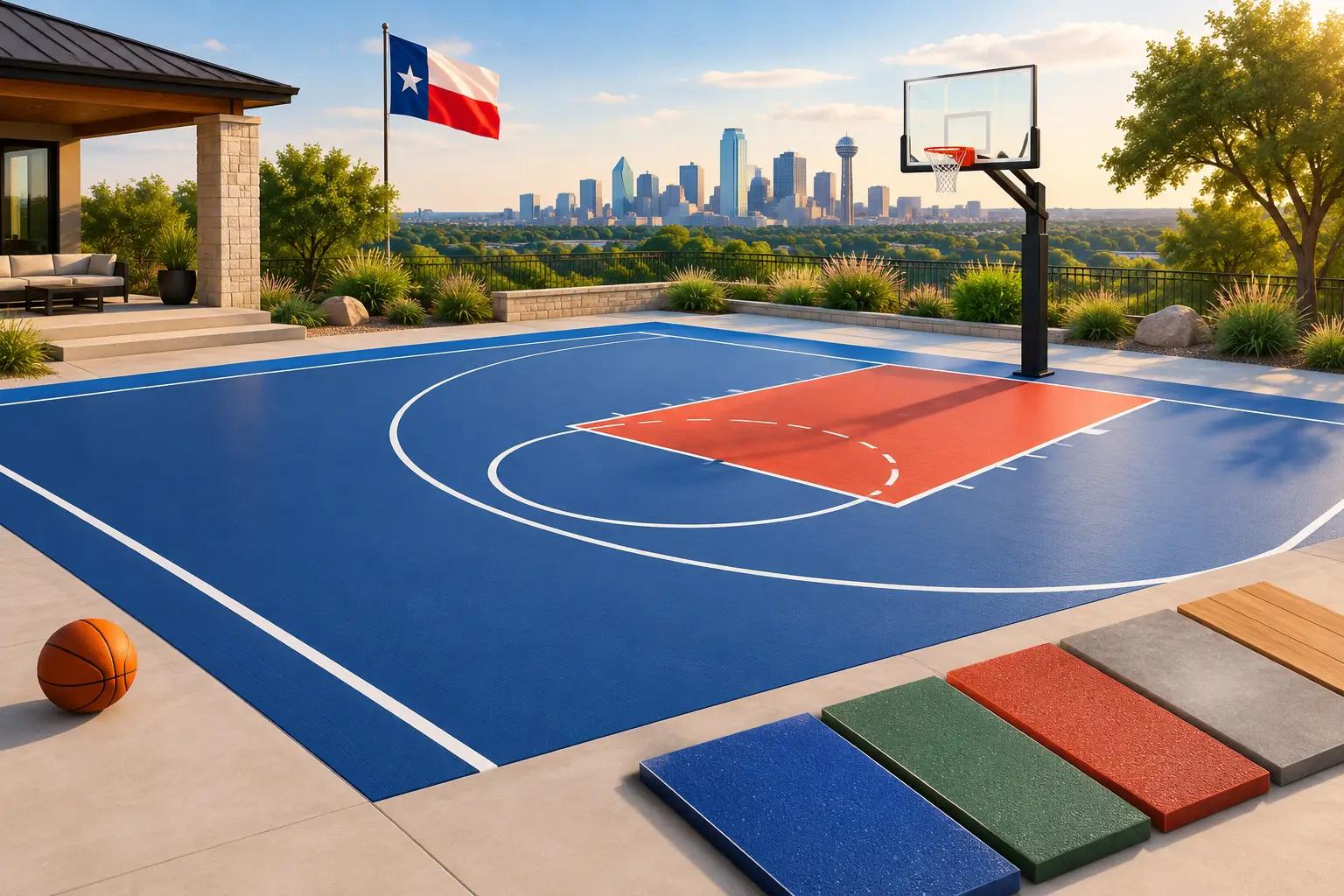
Concrete with an acrylic sports coating is usually the best all-around option for outdoor basketball courts. The concrete provides the structural strength, while the coating improves traction, reduces glare, adds color, and creates clean game lines. It also gives the court a more comfortable feel than bare concrete.
This system works well for home courts, apartment communities, schools, churches, parks, and commercial properties. A coating can be selected with texture appropriate for basketball, which helps players keep their footing without creating an overly rough surface that tears up shoes and skin.
The concrete work matters most. The slab must be built on properly compacted ground, reinforced as needed, placed at the correct thickness, and graded for drainage. In Corpus Christi and surrounding areas, poor site preparation can lead to settlement, cracking, standing water, and premature coating failure. A good finish cannot correct a weak base underneath it.
Acrylic coatings do require upkeep. Dirt, salt residue, mildew, and leaf stains should be cleaned regularly, and the surface will eventually need recoating. That is normal maintenance, not a failure of the court. The advantage is that a court can be refreshed without demolishing sound concrete.
Bare concrete
Bare concrete is a practical choice when budget and durability are the main priorities. It is strong, easy to clean, and able to handle heavy foot traffic, rolling equipment, and general outdoor use. For a multipurpose slab where basketball is one of several uses, bare concrete can make sense.
The trade-off is playability. Bare concrete is harder underfoot, can be slippery when dust or moisture is present, and creates more glare in direct sun. It is also more abrasive during falls. A broom finish can improve traction, but too much texture can make ball bounce less predictable and make the court uncomfortable for players.
For a basic backyard half court or a utility-focused recreational area, bare concrete is a solid foundation. For a dedicated basketball court, adding a sports coating is generally worth the additional investment.
Modular sport tiles
Modular sport tiles are interlocking panels installed over a stable concrete base. They are popular for homeowners who want a finished court quickly, want color options, or prefer more cushioning than a coated slab provides. Many tile systems include drainage openings, allowing water to move through the surface rather than puddling on top.
These tiles can improve comfort and reduce impact compared with bare concrete. They also offer a clean, finished look and can be replaced in sections if individual panels are damaged.
However, modular tiles do not eliminate the need for quality concrete and drainage. If the slab settles, cracks badly, or holds water, the tile system will follow those problems. In high heat, lower-quality tiles may expand, shift, fade, or become noisy underfoot. Property owners should choose a system rated for outdoor UV exposure and install it over a properly built slab, not as a shortcut around site work.
Asphalt
Asphalt is common for larger recreational courts because it can be less expensive upfront than concrete. It offers a smoother feel than rough concrete and can be coated with an acrylic sports surface. For large parks or facilities with ample space, it may be a workable option.
In South Texas, asphalt requires realistic expectations. Intense heat can soften the surface, and regular expansion, oxidation, and moisture exposure can create cracks over time. It may need sealcoating, crack repair, and resurfacing more often than a well-built concrete court. Heavy loads and weak subgrade conditions can also leave depressions that collect water.
Asphalt is not automatically a bad choice. It can be appropriate when budget, court size, and local site conditions support it. But for many residential and light-commercial properties, concrete delivers better long-term stability and lower structural maintenance.
Indoor Court Surface Options
Indoor basketball courts are a different decision because weather and drainage are no longer the main concerns. The focus shifts to ball response, player comfort, appearance, and the type of building.
Hardwood remains the standard for dedicated gymnasiums. It provides the familiar bounce, traction, and visual appearance expected in competitive basketball. It also requires climate control, routine cleaning, refinishing, and protection from moisture. Hardwood is an investment best suited to enclosed, properly managed facilities.
Synthetic gym flooring and rubberized systems can be practical alternatives for multipurpose spaces. They can offer added impact absorption and are often easier to maintain than hardwood. Still, not every resilient floor provides the same ball response as wood, so the system should match the level of play expected at the facility.
For covered but open-sided courts, outdoor concrete with an acrylic sports coating is often more practical than an indoor-style surface. Humidity, wind-driven rain, and exposure at the court edges can be hard on materials designed for a conditioned gym.
What Matters More Than the Top Layer
The surface players see is only part of the project. The concrete slab, base material, drainage plan, and joint layout determine whether the court stays level and usable.
A court should have a deliberate slope that directs water away without noticeably affecting play. Water that sits on a court creates slip hazards, stains, algae growth, and coating damage. Drainage must account for nearby buildings, fences, landscaping, and neighboring property, not just the court itself.
Soil conditions matter as well. Coastal soils can vary significantly from one property to the next. Soft areas, poorly compacted fill, and inadequate excavation can allow a slab to move. Reinforcement helps manage cracking, but it does not replace proper subgrade preparation. Control joints should also be planned so natural concrete movement is managed without creating random cracks across the playing area.
The court layout deserves the same attention. A full court, half court, shooting lane, or multi-sport pad should be sized around actual use and available space. Hoop placement, fence clearance, lighting, gates, and runoff all affect how the finished court functions day to day.
Choosing the Right Surface for Your Property
A homeowner building a backyard half court usually gets the best value from reinforced concrete with an acrylic coating. It is durable, professional-looking, and easier to renew than a system that depends on replacing an entire surface.
A property manager may prefer coated concrete or modular tiles, depending on the expected traffic and maintenance budget. Coated concrete is often better for long-term durability, while tiles can provide more cushioning and a distinct visual upgrade when the base is already sound.
For a school, church, apartment complex, or commercial recreation area, the decision should consider supervision, daily use, accessibility, drainage, and repair planning. A court that sees constant activity needs a stronger base and a surface that can be cleaned, repaired, and recoated without extended downtime.
Haylo Construction approaches sports court projects from the ground up, because dependable concrete, grading, and drainage work are what protect the finished playing surface. Before selecting a color or coating system, make sure the site can support the court you expect to use for years. That is where a good basketball court starts.