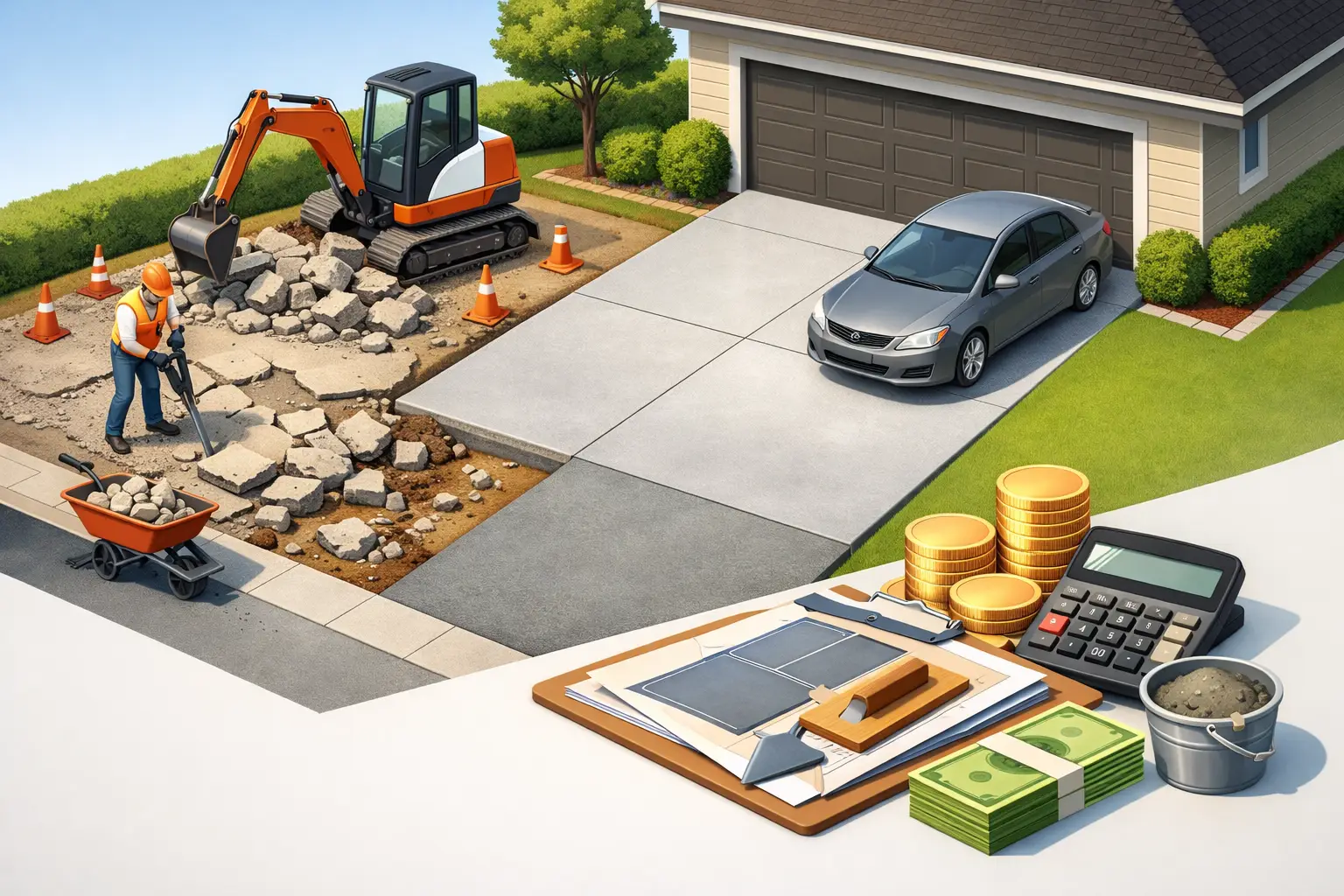
A driveway can look simple from the street, but replacement pricing usually comes down to what is happening underneath it. If you are trying to pin down concrete driveway replacement cost, the biggest mistake is assuming every square foot costs the same. In real jobs, demolition, subgrade condition, drainage, reinforcement, access, and finish all affect the final number.
For homeowners and property managers, that matters because the cheapest quote is not always the best value. A driveway that is poured over weak base material or without proper slope may cost less up front, but it can crack, settle, and hold water long before it should. A solid replacement is about more than new concrete. It is about removing the failed surface, preparing the site correctly, and building for long-term performance.
What affects concrete driveway replacement cost
Most replacement projects are priced by square footage, but that is only the starting point. A contractor has to account for the full scope of work, not just the new slab.
Size is the obvious factor. A longer or wider driveway requires more demolition, more base work, more concrete, and more labor. Thickness matters too. Standard residential driveways often use 4 inches of concrete, but some applications call for 5 or 6 inches, especially where heavier vehicles, RV parking, or repeated traffic loads are involved.
Demolition is another major cost driver. If the old driveway is badly cracked, heaved, or tied into other concrete near the garage, sidewalk, or curb, removal may take more time and equipment. Haul-off and disposal also add cost, especially on larger projects.
Then there is the base. If the soil under the driveway is unstable, soft, washed out, or improperly compacted, the crew may need to regrade and install new base material before any concrete is poured. This is where many price differences come from. One quote may include real prep work, while another may skip what you cannot see.
Access can also change the number. If equipment can reach the site easily, the work moves faster. If crews have to work around tight gates, landscaping, utilities, or occupied commercial traffic areas, labor time goes up.
Finish options matter as well. A basic broom finish is usually the most budget-friendly. Decorative borders, stamped concrete, colored concrete, exposed aggregate, or custom saw cuts will increase the overall cost.
Typical price range for concrete driveway replacement cost
In many residential markets, concrete driveway replacement cost often falls somewhere around $8 to $18 per square foot for a standard replacement. On more complex projects, pricing can go higher. That means a straightforward two-car driveway replacement may land in the mid-thousands, while a larger driveway with extensive prep, thicker concrete, decorative finish, or drainage corrections can move well beyond that.
That range is broad for a reason. A 600-square-foot driveway is not just a 600-square-foot pour. If one property has solid ground, clean access, and a standard finish, the cost will look very different from a driveway with broken edges, tree root issues, poor drainage, and a need for extra base repair.
In coastal and South Texas areas, site conditions can push costs around more than many property owners expect. Soil movement, drainage demands, and weather exposure all affect how a driveway should be built. If a contractor is pricing for durability, not just speed, the estimate may reflect reinforcement, grading, and proper site prep that help the slab last.
Demolition and removal are not small line items
When people budget for replacement, they often focus on the new concrete and overlook removal. But tearing out the old driveway is a real part of the job.
Concrete has to be broken up, loaded, hauled away, and disposed of. If the slab is reinforced, extra labor and heavier equipment may be needed. If sections are close to the garage foundation, walkways, curbs, or utilities, crews may need to work more carefully to avoid damage.
This is one reason replacement costs more than a brand-new slab on an empty site. With replacement, you are paying for controlled demolition first, then rebuilding the driveway the right way.
Base prep, grading, and drainage can make or break the job
If there is one place not to cut corners, it is below the concrete. A driveway needs a stable, compacted base and proper slope so water moves away instead of pooling.
Poor drainage is one of the fastest ways to shorten the life of a driveway. Standing water can weaken the base, stain the surface, and increase cracking over time. If the old driveway failed because of settlement or drainage issues, simply pouring new concrete over the same conditions is not a real fix.
That is why estimates can vary. One contractor may quote basic removal and replacement. Another may include excavation, imported base material, compaction, and regrading. The second number may be higher, but it may also be the one that addresses the actual problem.
Reinforcement, thickness, and jointing
A properly built driveway is not only about concrete volume. Reinforcement and control joints matter too.
Depending on the project, reinforcement may include rebar, wire mesh, or fiber additives. The right choice depends on slab design, soil conditions, traffic load, and contractor methods. More reinforcement usually means a higher initial cost, but it can improve durability and crack control.
Thickness has a similar trade-off. A basic residential driveway may perform well at standard thickness, but heavier use may justify a thicker slab. If delivery trucks, trailers, boats, or work vehicles are common, that should be discussed before the pour, not after the concrete starts cracking.
Joint placement is another detail that affects long-term results. Concrete will crack. The goal is to manage where it cracks. Good joint layout helps direct movement and reduce random surface cracking.
Finish options and curb appeal
For many property owners, appearance matters almost as much as strength. A plain broom finish is the standard choice because it is clean, durable, and slip-resistant. It also keeps the budget more controlled.
Decorative finishes increase the cost, but they can make sense if the driveway is a visible part of the property. Stamped concrete, stained concrete, borders, exposed aggregate, and custom textures can all raise the price because they require added materials, labor, and finishing time.
The right question is not whether decorative work costs more. It does. The better question is whether the added look matches the property and your long-term goals.
How to compare estimates without getting fooled
When reviewing bids, look beyond the bottom-line number. Ask what is included in demolition, haul-off, base prep, reinforcement, thickness, finish, and cleanup. If drainage problems exist, ask exactly how they will be handled.
A lower quote may leave out excavation depth, compaction, stronger reinforcement, or proper forming. It may also assume easier site conditions than what the property really has. That can lead to change orders later or a driveway that fails early.
A reliable estimate should clearly explain scope. It should tell you what is being removed, what is being rebuilt, and what standards are being used for the new slab. That level of detail is usually a better sign than a fast number with no explanation.
When replacement makes more sense than repair
Not every damaged driveway needs full replacement, but patching only works when the underlying slab is still structurally sound. If large sections are cracked, sunken, spalling, or draining poorly, repair can become money spent on a short-term fix.
Replacement is often the better move when the driveway has widespread failure, repeated settling, or a base problem that cannot be solved from the surface. Yes, the upfront cost is higher, but so is the chance of getting a cleaner result that lasts.
For some owners, that decision also comes down to liability and appearance. Uneven concrete can create trip hazards, poor drainage near buildings, and a worn-down first impression. In those cases, replacement is not just cosmetic. It is a practical property improvement.
What to expect during the project
A typical driveway replacement starts with demolition and removal, followed by grading, base preparation, forming, reinforcement, pouring, finishing, and curing. The exact timeline depends on size, weather, access, and whether extra site corrections are needed.
Good communication matters here. Property owners should know when access will be limited, how long curing will take, and when vehicles can return to the driveway. Rushing that last step can damage a brand-new slab before it has reached proper strength.
In South Texas, weather timing can also affect scheduling and curing conditions. Heat, moisture, and rain windows all play a role in getting a good finish and a durable result.
If you are comparing concrete driveway replacement cost, do not stop at square-foot pricing. Ask what the contractor is doing to solve the reason the old driveway failed in the first place. That is usually where the real value is, and it is the difference between paying for new concrete and paying for a driveway built to hold up.