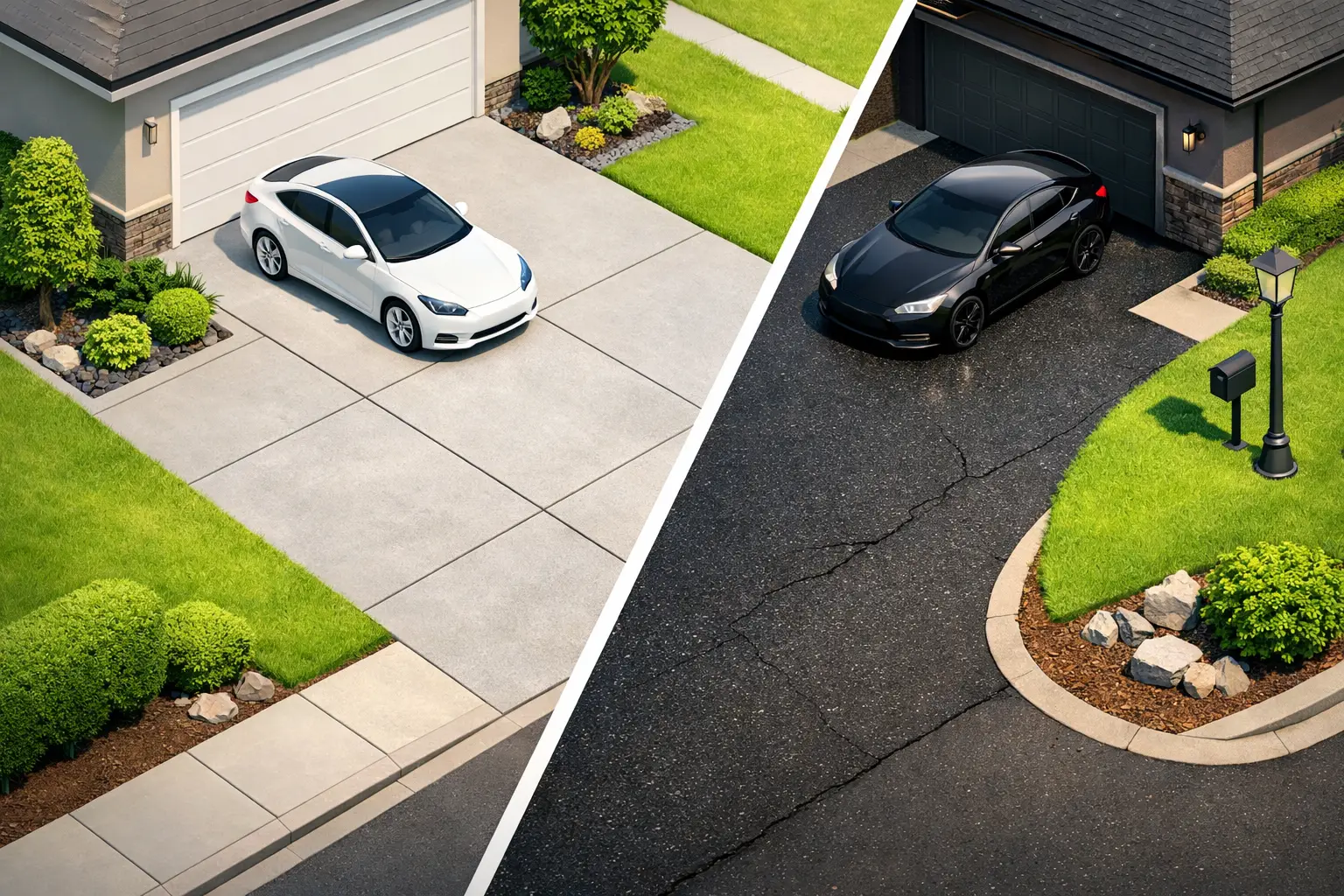
If you are pricing a new driveway, the real question is not just what looks better on day one. It is what will hold up under South Texas heat, heavy vehicles, drainage issues, and years of daily use. When property owners compare concrete driveway vs asphalt, the best choice usually comes down to lifespan, maintenance tolerance, appearance, and site conditions.
For many homes and commercial properties, both materials can work. But they do not perform the same way, and they do not ask the same thing from your budget over time. A cheaper install can turn into more frequent repairs. A higher upfront cost can make more sense if you want a longer service life and fewer maintenance cycles.
Concrete driveway vs asphalt: the biggest differences
The first major difference is durability. Concrete is a rigid surface. When it is properly reinforced, placed, and cured, it handles vehicle traffic well and typically lasts longer than asphalt. Asphalt is more flexible, which can help in some climates, but it generally needs more regular maintenance to stay in good condition.
The second difference is heat. In Texas, this matters. Asphalt absorbs more heat and softens more in high temperatures. On very hot days, it can become more vulnerable to surface wear, tire marks, and deformation, especially if the base work was not done correctly. Concrete reflects more heat and stays more stable under intense sun.
The third difference is appearance. Asphalt has a clean, dark finish, but it is more limited from a design standpoint. Concrete gives property owners more options, from a standard broom finish to decorative textures, borders, stamped patterns, and color treatments. If curb appeal matters, concrete usually gives you more flexibility.
Upfront cost vs long-term cost
Asphalt usually wins on initial price. If you need a quick, lower-cost surface and are focused on short-term budget, asphalt can be attractive. That is one reason it is common in some parking areas and lower-cost paving projects.
But the lower install price does not tell the whole story. Asphalt often needs sealcoating, patching, crack filling, and resurfacing sooner than concrete. Those costs add up. Concrete usually costs more upfront, but if it is built right, it can deliver a longer life with less frequent maintenance.
That does not mean concrete is maintenance-free. It can crack, stain, or scale if the installation is poor or if drainage is ignored. But in many cases, owners who plan to stay on the property for years find that concrete makes better financial sense over the long run.
How climate affects the choice
Climate is where national advice often misses the mark. What works in a cooler region does not always translate well to the Coastal Bend. In hot, humid, and storm-prone areas, surface performance is tied closely to subgrade prep, drainage, and material behavior under heat.
Asphalt can perform well, but high temperatures are harder on it. It tends to oxidize over time, become brittle, and show wear faster when exposed to constant sun and heat. Water intrusion also creates problems if cracks are not maintained. Once water gets below the surface, the base can weaken and failure can spread.
Concrete is not immune to weather problems, but it generally handles South Texas heat better. It also performs well when the slab is reinforced properly and the site is graded to move water away from the surface. On coastal properties or sites with drainage challenges, the workmanship under the surface matters just as much as the finish on top.
Installation quality matters more than the material alone
A good asphalt driveway will outlast a poorly installed concrete driveway. A good concrete driveway will outperform a rushed asphalt job. That is why the contractor and the prep work are not side issues. They are the job.
Base preparation, grading, compaction, thickness, reinforcement, and joint placement all affect the final result. If the soil is unstable, if drainage is poor, or if the driveway is too thin for the traffic it carries, either material can fail early.
For residential properties, that usually means planning for personal vehicles, delivery traffic, and occasional service trucks. For commercial sites, the stakes are higher. Heavier use demands a more disciplined approach to thickness, base structure, and traffic flow. That is where experienced site and concrete contractors bring real value.
Maintenance expectations for each surface
Asphalt needs more regular attention. Sealcoating helps protect the surface, preserve appearance, and slow down weather-related wear. Cracks should be repaired early before water gets in and causes deeper damage. If you ignore asphalt maintenance, its condition can decline quickly.
Concrete typically requires less ongoing work, but it still benefits from periodic cleaning and sealing in the right applications. Small cracks should be monitored. Oil stains and tire marks can affect appearance, especially on decorative finishes. Expansion joints and control joints should also be watched so water does not create problems around the slab.
For property owners who want the lowest possible upkeep, concrete often has the advantage. For those who are comfortable with scheduled maintenance and want a lower initial investment, asphalt may still make sense.
Appearance, property value, and use case
Driveways do more than carry traffic. They shape how a property looks and how it functions. On a home, the driveway can affect curb appeal immediately. On a commercial property, it can influence how customers, tenants, and visitors judge the site.
Concrete usually gives a cleaner, more finished appearance over time. It also pairs better with decorative options if the goal is to upgrade the front of a home, improve a courtyard, or create a more polished entry. If the surface is part of the property’s presentation, concrete has the edge.
Asphalt works well when appearance is less of a priority and function is the main concern. It can be a practical fit for large paved areas where budget is tight and aesthetics are secondary. Still, for many business owners, surface appearance matters more than they first assume. A worn parking or driveway surface does not send a strong message.
When asphalt makes sense
Asphalt is not the wrong choice. It can be a reasonable option if you need lower upfront cost, want a faster installation in some cases, and are prepared for ongoing maintenance. It also has a softer visual look that some owners prefer for certain site types.
If the project is temporary, if the budget is tight, or if the owner expects future redevelopment, asphalt may be the more practical route. The key is going in with realistic expectations. It is usually not a set-it-and-forget-it surface.
When concrete makes sense
Concrete is often the better fit for owners who want long-term durability, stronger heat performance, lower routine maintenance, and a more finished appearance. It is especially well suited for properties where drainage, reinforcement, and structural reliability need to be handled correctly from the start.
For homeowners planning to stay put, concrete often provides better long-term value. For commercial properties that need dependable access and a professional look, it can also be the stronger investment. In coastal Texas, where heat and weather are hard on exterior surfaces, a properly built concrete driveway or paved area is often the more dependable choice.
Which should you choose?
If you are deciding between concrete driveway vs asphalt, start with the real conditions on your property. Look at your budget, but also look at how long you plan to keep the property, how much maintenance you are willing to manage, what kind of traffic the surface will carry, and how important appearance is to you.
If your priority is lower upfront cost and you accept more maintenance, asphalt can work. If your priority is durability, stability in heat, and better long-term value, concrete is often the stronger choice. The right answer depends on the site, the use, and the quality of the installation.
That is why it pays to get a professional assessment before making the call. A good contractor will not just quote material. They will look at grading, drainage, soil, traffic load, and the condition of the surrounding site. That is how you avoid paying twice for the same driveway.
If you want a surface that is built for the way your property actually gets used, start with the conditions on the ground and choose the material that will still make sense years from now.