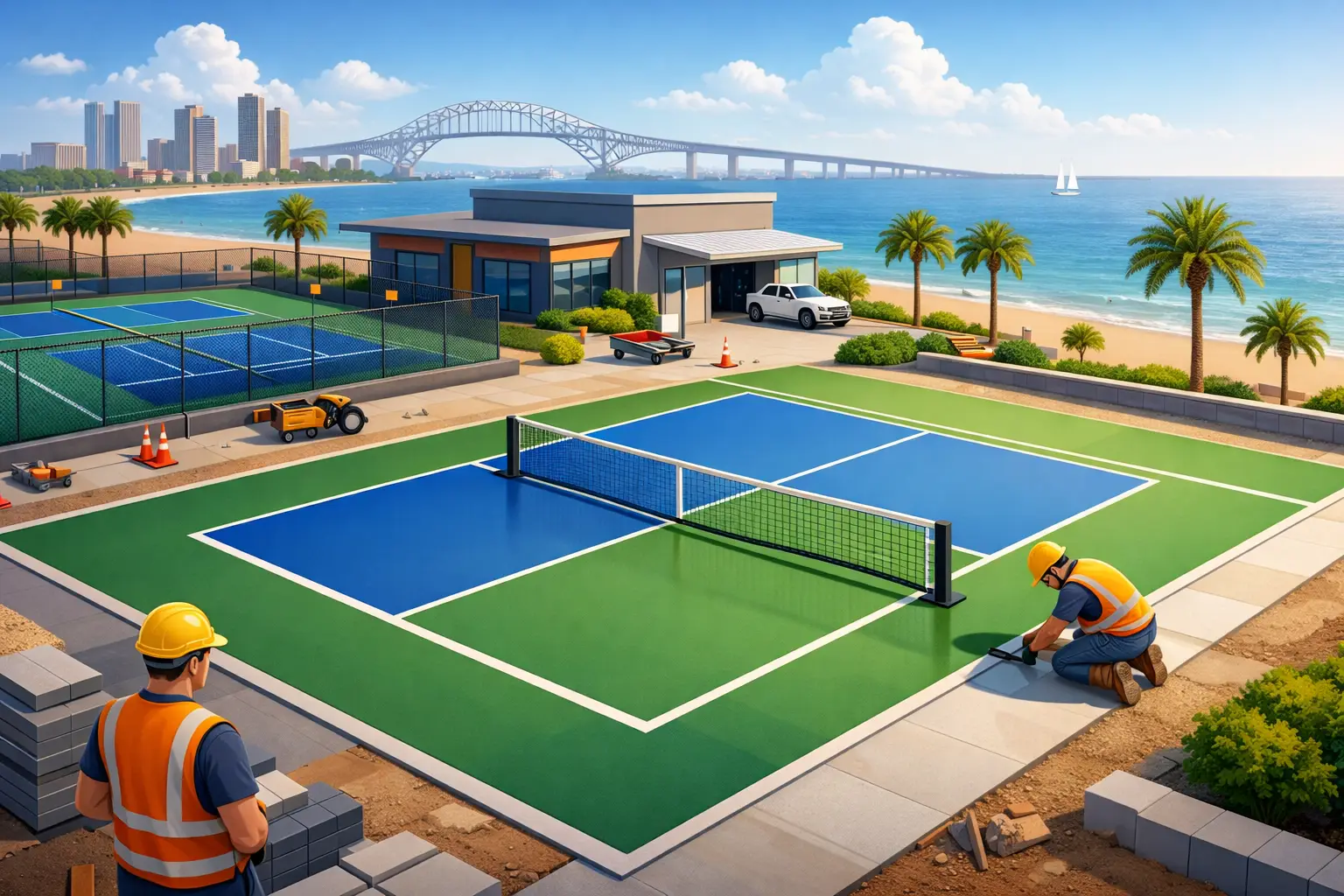
A pickleball court that looks good on day one but starts holding water, cracking, or fading after one South Texas season was not built right. If you are searching for a pickleball court contractor Corpus Christi property owners can count on, the real question is not just who can pour concrete. It is who can build a court that stays playable, drains properly, and holds up under heat, salt air, and steady use.
What a pickleball court contractor in Corpus Christi should actually handle
A court project is more than surface paint and striping. The foundation work underneath determines whether the court performs the way it should. That starts with site preparation, grading, sub-base work, reinforced concrete, drainage planning, and clean finishing. If any of those steps get rushed, the finished court may look acceptable at first and still become a problem later.
For homeowners, that usually means standing water after rain, uneven bounce, or cracks that spread across the playing area. For commercial properties, HOAs, schools, and recreational facilities, the stakes are higher. A bad court affects safety, appearance, maintenance costs, and long-term value.
That is why the right contractor needs to think like both a builder and a site-work professional. In Corpus Christi and the surrounding Coastal Bend, conditions are hard on exterior surfaces. Heat expansion, sudden heavy rain, shifting soils, and exposure to coastal moisture all matter. A court is only as strong as the slab and drainage plan below it.
Why local conditions matter on a pickleball court in South Texas
Pickleball courts are precision playing surfaces. Even minor issues in slope, finish, or base preparation can change how the game feels. In this region, local experience matters because the environment is not forgiving.
The first challenge is drainage. Courts need controlled slope so water moves off the surface without affecting play. Too flat, and water sits. Too much pitch, and the court feels off during use. Getting that balance right takes real field experience, not guesswork.
The second issue is soil movement. Some sites are stable. Others need more attention before concrete work begins. If the subgrade is not properly prepared and compacted, the slab can settle unevenly. That leads to cracks, low spots, and premature repairs.
Then there is the weather. High temperatures and sun exposure wear on coatings and stress concrete over time. Coastal air can also speed up surface wear on the wrong materials. A contractor who understands local construction conditions is more likely to choose the right approach from the start.
Choosing a pickleball court contractor Corpus Christi owners can trust
A lot of contractors will say they can build a court. Not all of them should. The right contractor should be able to explain the process clearly, walk the site, identify drainage concerns, and talk through realistic expectations for budget, finish, and maintenance.
Ask how they handle excavation and grading. Ask what kind of reinforcement is used in the slab. Ask how they determine slope and runoff. Ask whether they manage both the concrete work and the site-related prep, or if key parts are being passed to multiple subcontractors.
That matters because gaps in responsibility usually create problems. If one company handles excavation, another pours concrete, and another stripes the surface, it gets harder to pinpoint responsibility when something fails. Property owners usually do better with a contractor that can manage the job from the ground up.
Clear communication matters too. A dependable contractor should give you a straightforward scope of work, realistic scheduling, and honest answers about site limitations. Not every property is ready for a court without additional prep. A good contractor will tell you that early instead of pretending every site is simple.
The build process that makes the difference
Every site is different, but durable court construction usually follows the same basic path. First comes layout and planning. The contractor should confirm available space, orientation, access, drainage paths, and how the court fits the rest of the property.
Next is site preparation. This may involve demolition of existing surfaces, clearing, excavation, and grading. If the base is not stable, no finish on top will fix that problem. This is one of the biggest reasons sports court projects fail.
Then comes the slab. For a pickleball court, the concrete needs to be properly reinforced, poured to the right thickness, and finished with playability in mind. The goal is a clean, consistent surface that supports coating systems and reliable ball bounce. It is not just about getting concrete down. It is about getting the slab right.
After curing, the court surface can be coated and striped. Surface systems vary depending on the intended use, appearance goals, and budget. Some owners want a private residential court with a straightforward finish. Others want a more polished recreational or commercial installation. The right choice depends on traffic, exposure, maintenance expectations, and how the court will be used over time.
Residential and commercial pickleball court projects are not the same
A backyard court and a commercial-use court may look similar when finished, but they are not always built for the same demands. Residential projects often focus on making the best use of available space while balancing budget and appearance. Homeowners may also want fencing, adjacent flatwork, or integration with a patio, driveway, or outdoor living area.
Commercial and community projects usually involve more planning around access, safety, traffic, and long-term wear. A property manager or business owner may need the court to work with existing parking, walkways, drainage systems, or larger site improvements. In those cases, it helps to work with a contractor that already understands concrete, site prep, and exterior project coordination at a broader level.
That is where a full-service contractor can bring real value. If fencing, gates, drainage corrections, demolition, or surrounding flatwork are part of the job, it is more efficient when one team can manage the full scope.
Common mistakes that cost more later
The biggest mistake is choosing based on the lowest price without understanding what is included. A lower quote may leave out excavation depth, reinforcement, drainage work, or surface prep. Those missing details are usually the same details that affect how long the court lasts.
Another mistake is treating the court like a standard patio slab. A pickleball court is a recreational surface with performance requirements. If the grade is off or the finish is inconsistent, players will notice it immediately.
Some owners also underestimate the value of drainage planning around the court, not just on it. Water that flows onto the slab from nearby landscaping, roofs, or hard surfaces can create repeated problems. The contractor should be looking beyond the court lines and evaluating the full site.
Finally, poor communication can drag out the project. If the contractor is vague about schedule, materials, or who is handling what, that usually does not improve once work starts.
What to expect when planning your court
Budget depends on more than court size. Site access, demolition needs, grading complexity, drainage requirements, fencing, and finish options all affect the final cost. A flat, open site is usually more straightforward than a tight lot with drainage issues or existing concrete that has to be removed.
Timing also depends on weather, curing conditions, and scope. A contractor should give you a realistic timeline, not just an optimistic one. If permits or approvals are required, that should be part of the discussion early.
If you are planning a court for a home, community space, or commercial property, it helps to start with a site visit and a direct conversation about how the court will actually be used. That allows the contractor to recommend the right approach instead of forcing a one-size-fits-all build.
For property owners who want a court that looks clean, plays right, and holds up, the best move is simple. Work with a contractor that understands concrete, drainage, grading, and long-term exterior performance in South Texas conditions. That is the difference between a court that becomes a feature and one that becomes a repair project.
Haylo Construction approaches sports court work the same way it approaches every exterior build – with solid prep, dependable execution, and a focus on long-term durability. If you are considering a new pickleball court, a direct site evaluation is the right place to start. A good court should give you years of use, not years of fixes.