A retaining wall that looks fine on day one can start leaning, cracking, or washing out fast in South Texas if the site work underneath it is wrong. That is why retaining wall construction property owners invest in has to be built around drainage, soil movement, and long-term structural performance – not just appearance.
In this market, retaining walls are rarely just decorative. They solve grade changes, protect foundations and paved areas, manage runoff, and help keep usable space on a property that would otherwise erode or shift. For homeowners, that might mean holding a backyard slope in place and keeping water away from a patio or fence line. For commercial sites, it often means protecting access areas, controlling elevation changes, and creating stable, functional ground around buildings, parking lots, and hardscapes.
Why retaining walls matter in Corpus Christi
Coastal bend properties deal with conditions that put extra stress on exterior construction. Heavy rain can move water quickly across a site. Coastal exposure can wear on materials over time. Expansive and shifting soils can create pressure behind a wall that was never properly designed for the load. A wall that is undersized or poorly drained may still get built quickly, but that does not make it a lasting solution.
That is the difference between a wall built to fill a visual gap and one built to perform. A proper retaining wall has to account for grade, water flow, base preparation, reinforcement, and the weight of the retained soil. If any of those pieces are ignored, the wall may become the weak point on the property.
What good retaining wall construction in Corpus Christi should include
The wall itself is only part of the job. Good retaining wall construction in Corpus Christi starts with understanding what the site is doing now and what it will do during a hard rain. That means looking at slope, soil conditions, existing drainage, nearby structures, and how the wall ties into the rest of the property.
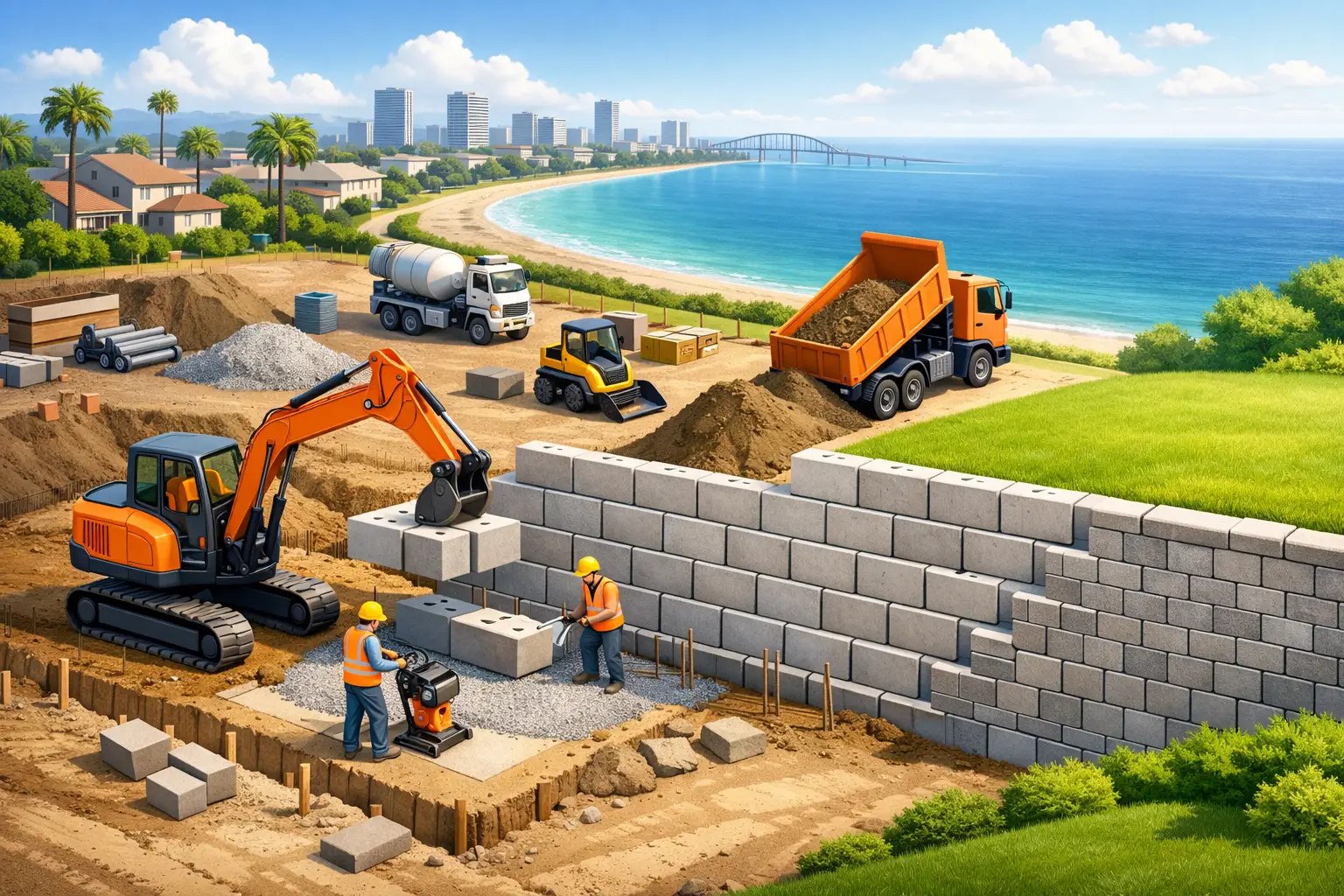
Base prep matters first. If the footing area is not excavated and compacted correctly, the wall can settle unevenly. That is where many failures begin. The next issue is drainage. Water building up behind a retaining wall adds pressure that can push even a strong wall out of line. Gravel backfill, drainage provisions, and proper grading are not optional details. They are part of the structure doing its job.
Material choice also depends on the application. Concrete retaining walls are a strong fit for many residential and commercial properties because they provide durability, clean lines, and reliable structural performance when properly reinforced. In some cases, segmental block systems may be appropriate. In others, especially where the wall supports heavier loads or works near slabs, drive lanes, or foundations, a reinforced concrete wall may make more sense.
There is no one-size-fits-all answer. The right wall depends on height, load, drainage demand, soil pressure, and how the finished area will be used.
Residential retaining walls: more than curb appeal
For homeowners, retaining walls are often tied to drainage and yard usability. A sloped lot can leave standing water near the house, make fencing difficult, or turn part of the yard into wasted space. A properly built wall can create a level area for a patio, control erosion, and help direct water away from the home.
That said, residential work still needs structural discipline. A small backyard wall may look simple, but if it is holding back saturated soil near a foundation or hardscape, failure can become expensive fast. It can affect nearby concrete, landscaping, and even adjacent property lines. Good workmanship upfront is usually cheaper than tearing out a failed wall and repairing the damage around it.
Appearance still matters, especially on visible residential projects. The best result is a wall that performs first and also fits the property cleanly. Straight lines, proper elevation, smooth transitions, and a finished look all make a difference, but only after the wall is built on a solid system.
Commercial retaining walls need a different level of planning
Commercial and multi-use properties usually bring heavier demands. The wall may support a grade transition next to a parking lot, loading area, sidewalk, building pad, or site entrance. In those cases, the wall is not just controlling soil. It is helping protect access, drainage flow, and long-term site function.
This is where planning and execution matter even more. The contractor has to think beyond the wall face and account for traffic loads, nearby pavement performance, water movement across larger hard surfaces, and how construction sequencing affects operations. On an active site, safety and efficiency also become a bigger part of the project.
Property managers and business owners typically want the same thing homeowners do – a clean finished product that lasts. The difference is that commercial wall failure can create liability, access issues, and disruption to daily use. That raises the value of working with a contractor who understands site-related construction as a whole, not just one isolated trade.
Common reasons retaining walls fail
Most retaining wall problems come from a short list of avoidable mistakes. Poor drainage is one of the biggest. Water pressure builds up behind the wall, the soil gets heavier, and movement starts. Inadequate base prep is another common issue, especially on walls installed too fast or without proper compaction.
Undersized construction is also a problem. A wall may be built for appearance when it really needs to act as a structural element. If reinforcement, footing design, or wall thickness do not match the actual load, the wall can bow, lean, or crack. Bad grading around the wall adds to the issue by sending more runoff toward the structure instead of away from it.
Sometimes the failure is not dramatic at first. It starts as minor cracking, separation, or uneven movement. But those early signs usually mean the wall is under stress and the surrounding site conditions are working against it.
What to expect from the construction process
A dependable retaining wall project starts with a site review and a direct conversation about what the wall needs to accomplish. In some cases, the main goal is erosion control. In others, it is creating level usable space, protecting nearby concrete, or supporting a larger site improvement plan.
From there, the work should move through layout, excavation, base preparation, wall construction, drainage integration, backfill, grading, and cleanup in an organized way. If the site also needs demolition, concrete work, or grading adjustments, it helps to have one contractor managing those scopes together. That reduces delays and helps keep the finished work aligned.
Communication matters during this process. Property owners should know what is being built, why certain steps are necessary, and what conditions on the site could affect schedule or cost. Straight answers and clear expectations go a long way on projects like this.
Choosing the right contractor for retaining wall construction Corpus Christi
Not every contractor who offers walls is equipped to handle structural site work in coastal South Texas. When you are comparing options for retaining wall construction Corpus Christi, look at more than photos. Ask whether the contractor understands drainage, reinforcement, concrete performance, grading, and the local conditions that affect durability.
Experience with related services matters too. Retaining walls often connect to driveways, slabs, foundations, fencing, demolition, and broader site preparation. A contractor who already works across those scopes can usually spot issues earlier and build a better overall solution.
You also want professionalism on the job. Licensed and insured crews, safety-focused practices, dependable scheduling, and clear communication are not extras. They are part of a well-run project. Haylo Construction approaches retaining wall work the same way it approaches every site job – with a focus on preparation, execution, and results that hold up.
When it makes sense to act now
If you already see soil washing out, standing water collecting where it should not, or a slope starting to shift toward a fence, slab, or structure, waiting usually does not make the repair cheaper. The longer drainage and erosion problems continue, the more likely they are to affect surrounding improvements.
The same goes for walls that are already showing warning signs. Leaning, separation, cracking, and movement near the base are all worth addressing early. Sometimes the solution is repair. Sometimes replacement is the smarter long-term move. That depends on the cause of the problem, the condition of the existing wall, and whether the original construction was adequate in the first place.
A retaining wall should give you control over your site, not another maintenance problem to manage. If your property in Corpus Christi needs grade support, erosion control, or a stronger long-term drainage solution, the right next step is a professional site review and a clear estimate built around how the wall actually needs to perform.