
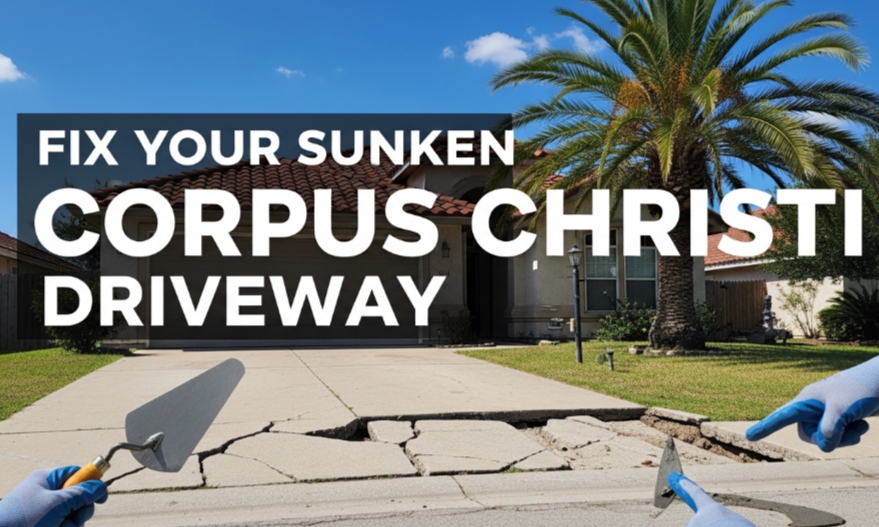
Why Is My Driveway Sinking? What Corpus Christi Homeowners Need to Know
You pull into your driveway after work, and something feels off. That spot near the garage looks lower than it did last month. Or there’s a crack running across the middle that keeps getting wider. Or after it rains, there’s always a puddle sitting in the same place where water never used to collect.
I’ve had this conversation with a hundred homeowners around Corpus Christi. They notice their driveway is sinking, and they’re not sure if it’s normal or if they should be worried.
Here’s the thing. Concrete doesn’t just sink for no reason. Something’s going on underneath. And no, it won’t fix itself.
Let me walk you through what’s probably happening, how to know if you need to do something about it, and what driveway sinking repair costs actually look like.
Four Things That Make Driveways Sink Around Here
Water Washes the Dirt Out From Underneath
This is the main one. When rain gets under your concrete driveway, it carries away the dirt that’s supposed to be holding it up. Over time, that leaves empty spaces underneath. The concrete has nowhere to go but down. That’s one of the most common causes of driveway sinking around here.
We get a lot of rain in Corpus Christi. About 32 inches a year on average. That’s plenty of water to find its way under your slab. And when we get those big storms during hurricane season? Even worse.
The Ground Wasn’t Packed Right When They Poured It
Most people never think about this. When your driveway was poured, the dirt underneath should have been compacted tightly before any concrete went in.
If the crew skipped that step or rushed through it, that soil has been slowly settling for years. It might take a long time to show up, but eventually, your concrete driveway sinking starts happening. The whole thing drops into those soft spots.
That Sticky Clay Soil We’ve Got Here
This one’s specific to the Coastal Bend. The soil around here does something weird. When it rains, it soaks up water and swells up. When it’s dry like our brutal Texas summers, it shrinks and cracks.
That constant moving back and forth puts stress on your driveway and creates gaps underneath. One season, your slab might be fine. Next season, you’ve got sinking in cement that wasn’t there before.
Tree Roots and Critters Digging Around
Sometimes big tree roots grow under driveways and push things around. Or they die and rot, leaving voids. And yeah, sometimes rats and gophers dig tunnels under there. Those tunnels collapse, and your driveway drops. It’s not the most common cause, but we’ve seen it.
Five Signs Your Driveway Needs Help
1. You Can See It Drooping
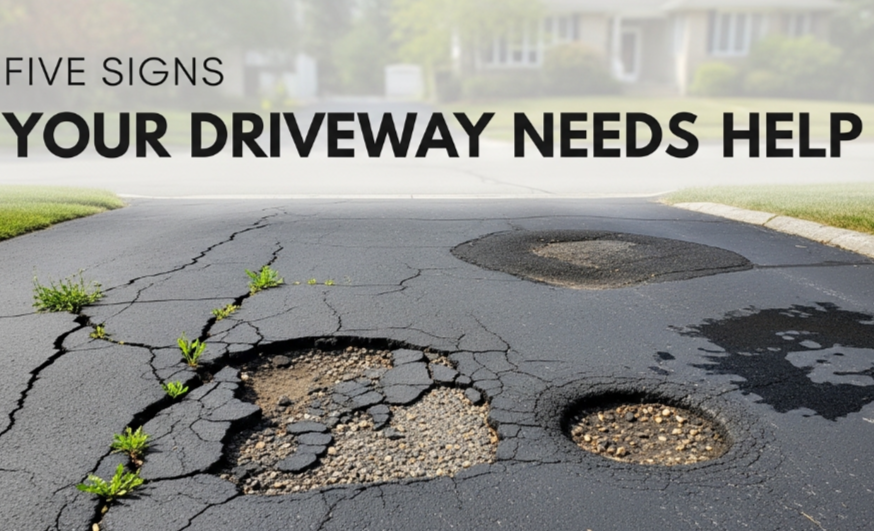
Walk to the street and look back at your house. Suppose one section is visibly lower than the rest by more than an inch; that’s not normal. That’s a driveway cracked and sinking situation waiting to get worse.
2. Cracks That Keep Getting Bigger
Little hairline cracks aren’t a big deal. Concrete does that. But if you’ve got driveway cracking and sinking where the cracks are getting wider, or one side is higher than the other, something’s moving underneath.
3. Water Sits There After Rain
Next time it storms, look at your driveway after the rain stops. If water is sitting in spots instead of running off, those areas have sunk. Standing water is bad for the concrete and bad for your foundation if it’s draining toward the house.
4. Gaps Next to the Garage or Sidewalk
Look where your driveway meets your garage floor or the sidewalk. If you’re seeing a gap open up, or one side is higher than the other, your driveway is pulling away. That’s a tripping hazard waiting to happen.
5. You’ve Stubbed Your Toe
If you’ve caught your heel or tripped on an uneven spot, that’s a problem. Anything over a quarter-inch difference is enough to catch someone. For older folks or kids running around, that’s dangerous. Time to look into sunken driveway repair.
Your Options to Fix a Sinking Driveway
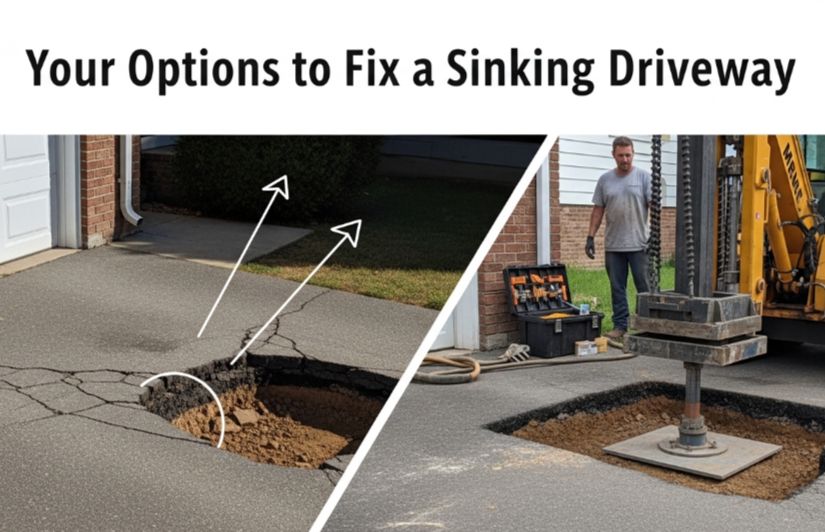
Let me walk you through what actually works, what it costs, and when each option makes sense. I’m not going to sugarcoat it. Every method has tradeoffs.
Option 1: Tear It All Out and Start Fresh
This is exactly what it sounds like. Demo crew comes in, hauls away your old concrete, fixes whatever’s wrong with the dirt underneath, and pours a brand-new driveway.
What it costs. About 9 to 16 dollars per square foot. For a typical two-car driveway around 400 square feet, you’re looking at 3,600 to 6,400 dollars. That’s the high end of driveway sinking repair cost because you’re starting over.
How long does it take? The demo and pour is 2 to 3 days. Then you wait 5 to 7 days before you can park on it. Two weeks before, life was back to normal.
When you need this. If your concrete is cracked all to hell, if it’s sunk more than 8 inches, or if the dirt underneath is so bad it needs excavation. If the slab itself is damaged, lifting it won’t help.
Option 2: Mudjacking
They drill holes about an inch and a half to two inches wide and pump a cement mixture underneath. The pressure lifts the slab back up. This is one way to fix a sinking driveway.
What it costs. About 3 to 6 dollars per square foot. That same 400 square foot driveway costs 1,200 to 2,400 dollars. Cheaper upfront, but there are tradeoffs.
How long does it take? The pumping takes a few hours. Then you wait 24 to 48 hours before using it.
The downsides. That cement slurry is heavy. You’re adding 100 plus pounds per cubic foot to soil that’s already sinking. If the problem was weak dirt, you just made it worse. The holes stay visible unless they are patched well. And the mix quality varies. Sometimes it holds, sometimes it doesn’t. Not always the best way to fix a sunken driveway.
Option 3: Polyurethane Foam Injection
This is what we use at Haylo. We drill tiny holes about 5/8 inch smaller than a dime. Then we inject expanding foam. It fills every gap, lifts the slab exactly where needed, and hardens in minutes. This is a modern concrete driveway sinking repair.
What it costs. About 5 to 7 dollars per square foot. For 400 square feet, that’s 2,000 to 2,800 dollars right in the middle for sunken driveway repair cost.
How long does it take? Here’s the big difference. You can walk on it immediately. Park on it in 15 minutes. Fully hard in 2 hours. You’re not waiting days.
Why does it work better? The foam is lightweight. It doesn’t push down on weak soil. It’s waterproof so that it won’t wash away. It expands to fill every void, not just lift. And we control it precisely, so the slab ends up perfectly level. This is genuinely the best way to fix a sunken driveway method we’ve found.
For sinking concrete driveway problems in our humid coastal climate, this is the smart play. The foam handles moisture, won’t erode, and lasts.
Ready to Fix That Sinking Driveway in Corpus Christi, TX?
You’ve got the facts now. You know what causes driveway sinking, what fixing sunken driveways options exist, and what it costs.
If your driveway is cracked, sinking, or just looking rough, let’s talk. We’ll come out, take a look, and give you an honest assessment. No obligation, just straight answers from people who’ve been doing this here for years.
Get a quote from Haylo Construction, and let’s get your driveway back to level.
One comment
[…] the new work will solve the problem for the long term. A driveway may be cracked, uneven, or holding water. A patio may have settled. A slab for a shed, workshop, or outdoor structure may need to support […]