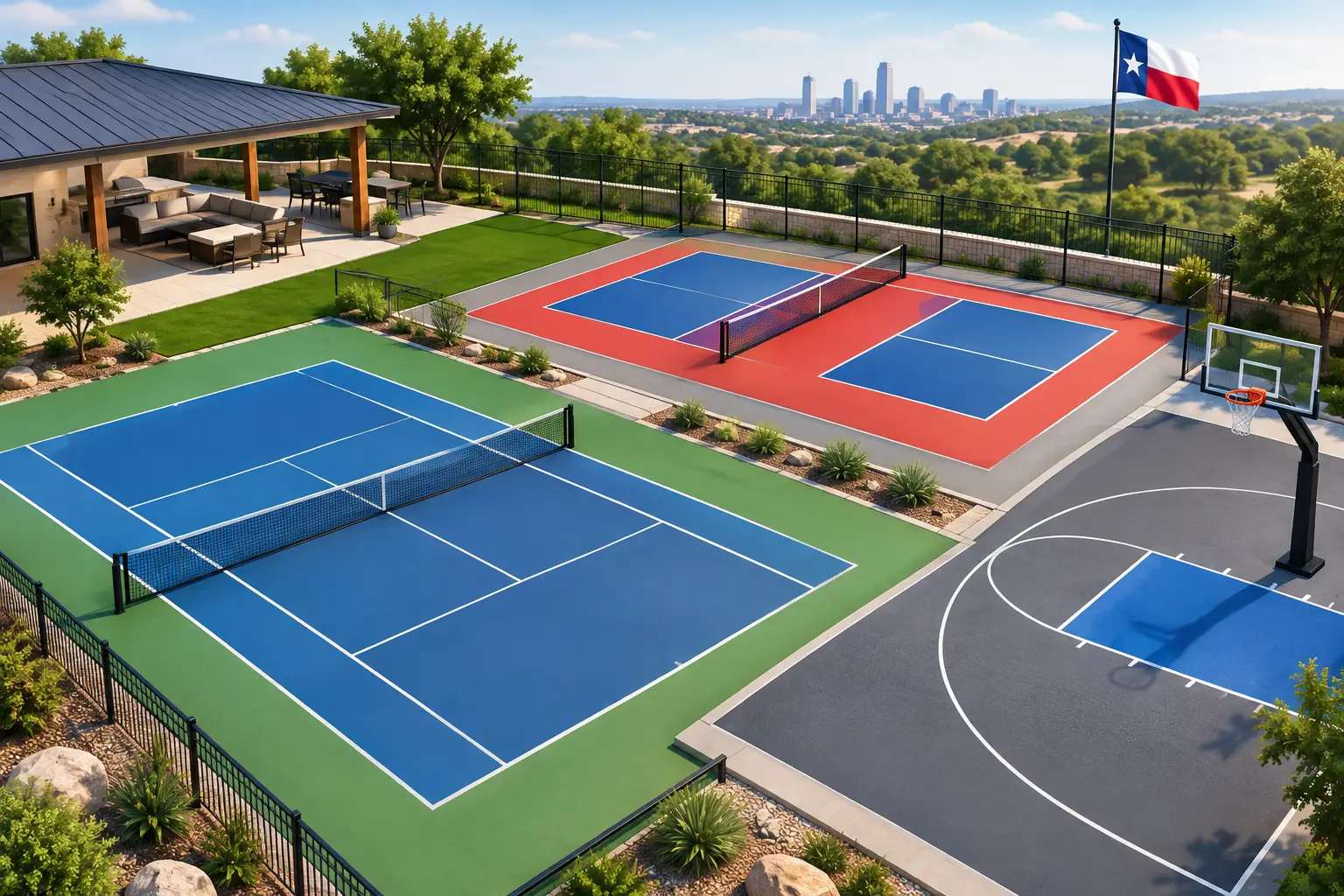
A basketball court that holds standing water after a hard Corpus Christi rain is not much use. Neither is a tennis surface that becomes slick, faded, or cracked after a few South Texas summers. The right sports court surface options start below the playing area, with proper grading, drainage, base preparation, and construction that accounts for heat, coastal moisture, and the way the court will actually be used.
A court is a long-term property improvement. Homeowners may want a clean, dependable place for family basketball and pickleball. Schools, apartments, HOAs, and commercial properties may need a surface that handles constant traffic with reasonable maintenance. Those goals can point to different materials, but the foundation work should never be an afterthought.
Start With the Court Base, Not the Finish
The visible surface gets most of the attention, but the slab or pavement beneath it determines how well the court performs over time. A coating cannot correct poor drainage, weak subgrade, or movement in the soil. If the base settles or cracks extensively, the playing surface will show it.
For many South Texas projects, a properly reinforced concrete slab provides the most reliable starting point. It creates a firm, consistent surface for basketball, tennis, pickleball, volleyball, and multi-sport layouts. The slab must be placed on a prepared base, graded to direct water away from the court, and reinforced according to the project’s soil conditions, dimensions, and intended traffic.
Expansion and control joints also matter. Concrete naturally moves as temperatures change. Well-planned joints help manage cracking, while poor joint placement can create uneven lines across a playing area. Existing concrete can sometimes be repaired and resurfaced, but a contractor should first determine whether cracks are cosmetic or signs of movement below the slab.
Sports Court Surface Options That Fit the Job
There is no single best surface for every property. Budget, sport type, player comfort, maintenance expectations, and the condition of the site all play a role.
Bare or Broom-Finished Concrete
Concrete is a practical choice for basic basketball courts, utility courts, and high-use outdoor recreation areas. It is durable, handles equipment well, and does not require a separate coating system to remain functional. A broom finish adds texture for traction, which can be useful around multi-use areas.
The trade-off is playability. Bare concrete is hard underfoot, can be rough on falls, and does not provide the ball response or visual finish most people expect from a dedicated tennis or pickleball court. It can also become hot in direct sun. For a straightforward backyard basketball pad or a durable community recreation space, it may be enough. For a more polished sports court, it is usually the base rather than the final surface.
Acrylic-Coated Concrete
Acrylic coatings are a common finish for tennis, pickleball, basketball, and multi-sport courts. Applied over properly cured and prepared concrete, these systems add color, line markings, traction, and a more controlled playing surface. They also make the court look like a purpose-built athletic area rather than a plain slab.
Acrylic systems are available in different textures and can be specified for the sport. Tennis and pickleball generally need predictable ball bounce and appropriate grip. Basketball courts often use a finish that balances traction with easier movement. Quality installation depends on surface preparation, crack treatment, correct coating application, and dry weather during the work.
Coatings will eventually need maintenance. Sun exposure, heavy use, and moisture can wear down color and texture over time. That does not make acrylic a poor choice. It means property owners should plan for cleaning, periodic inspection, and eventual recoating as part of ownership.
Cushioned Acrylic Systems
Cushioned systems place resilient layers below the acrylic finish to reduce impact on players’ knees, ankles, and backs. They are often considered for tennis and pickleball facilities where adults play frequently or where player comfort is a priority.
The added cushion comes with a higher initial cost and more specialized installation. It also does not replace good concrete work beneath it. If the slab moves, the cushioned surface can still develop visible cracking. For a high-use private court, club, or community amenity, the comfort benefit can justify the investment. For a basic driveway-style basketball court, it may be more than the project needs.
Modular Sport Tiles
Interlocking modular tiles are installed over a stable, level hard surface. They can provide a finished athletic look, add some comfort compared with bare concrete, and allow water to pass through the tile system. They are popular for outdoor basketball and multi-sport courts because they can be installed in various colors and layouts.
Their performance depends heavily on the slab below. A tile system will not level a badly sloped surface or repair structural cracks. Heat is another consideration in South Texas. Quality tiles are designed for outdoor use, but expansion, UV exposure, and fastening details must be handled correctly. Debris can also collect beneath the tiles, so periodic cleaning is necessary.
Asphalt With a Sport Coating
Asphalt courts can be a cost-conscious option for larger outdoor areas, especially where asphalt paving is already part of the site plan. When installed over a correctly prepared base and finished with an appropriate coating, asphalt can serve tennis, pickleball, and basketball uses.
However, asphalt is more flexible than concrete and can be more susceptible to depressions, oxidation, and cracking in demanding weather conditions. Standing water is especially hard on asphalt. It can be a sound choice when site conditions, budget, and maintenance planning line up, but it should not be selected simply because it has a lower upfront price.
Match the Surface to the Sport and the Users
Basketball usually calls for a firm, consistent surface with reliable bounce. Reinforced concrete with an acrylic coating or modular tile system is common for residential and community courts. If the court will also host pickleball, clear striping and proper dimensions need to be part of the plan from the beginning.
Pickleball and tennis demand more precision. Surface slope, texture, line layout, and net-post placement directly affect play. A court that drains well still needs to remain nearly level enough for fair ball movement. The goal is controlled drainage without creating a noticeable tilt across the court.
For multi-sport courts, durability and flexible layout often matter more than tournament-level performance. A well-built concrete slab with coating, game lines, and movable equipment can serve basketball, pickleball, volleyball, and casual recreation without building separate spaces for each activity.
Synthetic turf may work around a court or for certain recreational fields, but it is not a replacement for a hard court when basketball, tennis, or pickleball are the primary uses. The ball response and footing are entirely different.
Plan for Coastal Texas Conditions
South Texas courts deal with intense sun, high temperatures, heavy rain events, humidity, and, in coastal areas, salt exposure. These conditions affect more than appearance. Heat expands materials. Rain finds low spots. Moisture exposes weak drainage. Salt and humidity can speed up corrosion on metal fencing, posts, and hardware.
A court should be located where runoff can be managed without directing water toward a building, neighboring property, or low-lying section of the yard. The surrounding grade matters as much as the court slope. Drainage swales, compacted base materials, and site preparation may be necessary before concrete is ever poured.
Fencing also deserves planning. A basketball or pickleball court next to a pool, road, parking area, or neighboring property may need a properly installed fence and gate to keep balls contained and protect the area. Galvanized or coated materials can be a practical choice where coastal exposure is a concern.
Look Beyond the Lowest Initial Price
Comparing quotes only by square footage can lead to problems. One proposal may include excavation, base compaction, reinforcement, drainage corrections, and finish work. Another may be priced around a thinner slab or minimal site preparation. Those are not equivalent scopes, even if both are described as a court.
Ask what is included beneath the surface, how the contractor will manage drainage, what reinforcement is planned, and whether existing cracks or soil conditions have been evaluated. If a coating or tile system is included, confirm how the underlying concrete will be prepared and what maintenance the finished surface will require.
The best value is usually the court that fits the property and avoids premature repair work. A basic, well-built concrete court can outperform a more expensive finish installed over poor grading. On the other hand, a quality coating or cushioned system can make a properly constructed court more enjoyable to use for years.
Build the Court Around the Whole Site
A reliable sports court project may involve demolition of an old slab, removal of unsuitable material, grading, concrete placement, drainage improvements, fencing, lighting coordination, and final surface installation. Managing those pieces as one project helps prevent avoidable delays and mismatched work.
Haylo Construction approaches court work with the same focus used for concrete and site projects across the Coastal Bend: build the base correctly, manage water, and deliver a clean finished area made for real use. Before choosing a surface, have the site evaluated for access, grade, drainage, soil movement, and the sports your household or property will support.
A court should make people want to use the property more, not create a new maintenance problem. Choose the surface after the site work is clear, and the finished court will have a far better chance of staying level, draining properly, and holding up through Texas heat and daily play.