A parking pad has a simple job: carry the weight of vehicles without shifting, cracking prematurely, holding water, or tearing up the area around it. That job gets more demanding in the Coastal Bend, where intense rain, heat, sandy soils, clay pockets, and salt-laden air can all affect exterior concrete. This parking pad construction guide explains what separates a durable pad from a quick pour that creates problems later.
Whether you need additional parking at a home, a designated space beside a business, or a heavy-duty area for work trucks and equipment, the result depends on what happens below and around the concrete. A clean finish matters, but proper grading, base preparation, reinforcement, drainage, and curing do the real long-term work.
Start With the Use, Not the Concrete
The first question is not, “How big should the pad be?” It is, “What will park on it?” A pad for passenger vehicles does not need the same design as one that will regularly support a loaded pickup, boat trailer, RV, delivery vehicle, dumpster, or work equipment.
For a typical residential vehicle pad, a properly prepared concrete slab is often around 4 inches thick. Heavier or repeated loads may call for 5 or 6 inches, stronger concrete, added reinforcement, or all three. Increasing thickness without addressing a weak base can still lead to settlement, so the design has to work as a system.
Layout should also account for how vehicles enter and exit. A pad that is technically large enough can still be frustrating if it requires tight turns, blocks a gate, crowds a utility box, or leaves no room to open vehicle doors. On commercial sites, traffic flow, accessible parking requirements, fire access, drainage routes, and striping may affect the final footprint.
Check Site Conditions Before Breaking Ground
A parking pad is only as stable as the soil beneath it. In South Texas, one property may have compactable sandy soil while the lot next door has soft fill, expansive clay, or a low area that stays wet after every storm. Those differences should shape the preparation plan.
Before construction begins, identify existing drainage patterns, overhead and underground utilities, irrigation lines, property lines, nearby structures, and tree roots. Water should move away from buildings and should never be redirected onto a neighboring property. If the planned pad meets an existing driveway, sidewalk, or garage approach, elevations need to be set carefully so vehicles have a smooth transition without creating a low spot.
Permitting requirements vary by city, neighborhood, and property type. A residential pad may be subject to setback, drainage, impervious-cover, or right-of-way rules. Commercial work can involve additional site, accessibility, and stormwater requirements. Checking early is far less expensive than removing work after the fact.
Parking Pad Construction Guide: Build the Base Correctly
The most common reason parking pads fail is not bad concrete. It is poor subgrade preparation. Pouring over loose topsoil, grass, organic material, or uncorrected soft spots leaves the slab vulnerable to settlement and cracking.
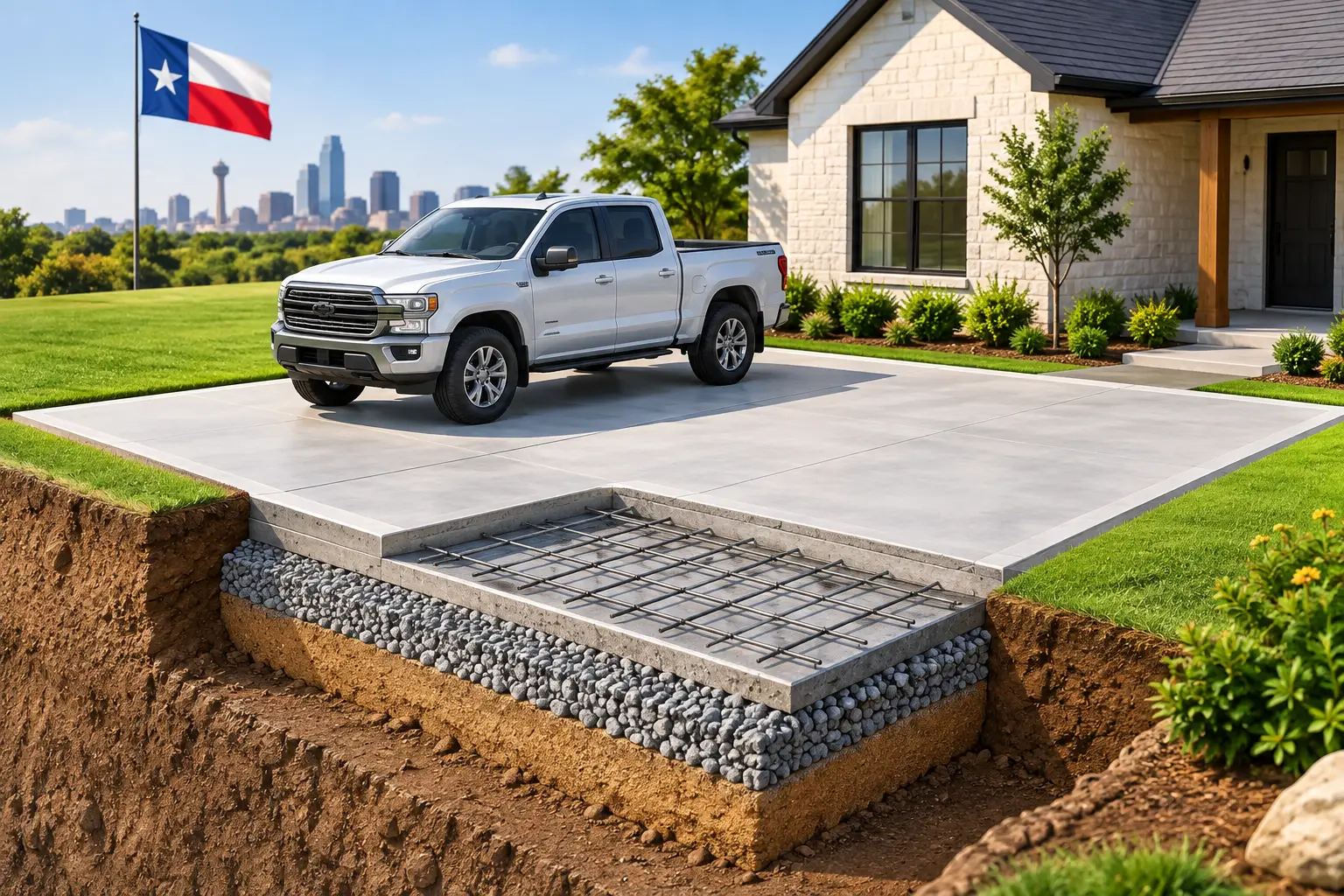
Construction starts by excavating to the depth required for the concrete and compacted base. The crew removes vegetation, roots, debris, and unstable material, then grades the exposed soil to the planned slope. Soft areas may need to be undercut and replaced with suitable fill before the base is installed.
A compacted aggregate base creates a more uniform surface under the slab and helps manage minor movement. The needed depth depends on soil conditions, expected loads, and design requirements. The key is compaction in controlled lifts, not simply spreading loose gravel and covering it with concrete.
Base preparation is where experienced site work pays off. A parking pad can look level on pour day and still settle months later if the ground was not shaped and compacted correctly. Good preparation also creates a predictable slab thickness, which matters when the pad must carry heavier vehicles.
Get the Slope and Drainage Right
Concrete needs slope. A flat-looking parking pad should still shed water in a controlled direction. As a general rule, a gradual slope of about 1/8 to 1/4 inch per foot is often used, though the proper slope depends on the site, drainage route, and adjacent surfaces.
Drainage becomes more complicated when a pad is installed beside a house, garage, fence, retaining wall, or existing pavement. Water cannot be allowed to collect along the structure or run toward a doorway. In some locations, a swale, channel drain, catch basin, or revised grading plan may be needed to move runoff safely.
Do not solve a drainage issue by making the concrete excessively steep. That can make parking uncomfortable, create a tripping concern, and make trailer loading more difficult. The better approach is to assess the full site and establish elevations before excavation begins.
Choose Reinforcement for the Conditions
Reinforcement helps concrete perform more reliably when it faces normal shrinkage, temperature changes, and vehicle loading. It does not replace a properly compacted base, and it will not prevent every crack. Concrete naturally cracks as it cures and moves. The goal is to control cracking and keep the slab performing as intended.
Depending on the application, a contractor may use welded wire reinforcement, rebar, fiber reinforcement, or a combination of methods. For heavier-duty pads, rebar placed on supports within the slab is often a better fit than reinforcement left on the ground where it provides little value.
Edges deserve attention as well. Concrete edges are more likely to chip or crack when vehicles regularly drive close to them. Thickened edges, proper forms, and a layout that keeps tires away from the slab perimeter can improve durability. If the pad connects to an existing driveway, the connection should be designed to reduce uneven movement between old and new concrete.
Control Joints Are Part of a Professional Finish
Control joints are planned grooves that encourage concrete to crack in straighter, less noticeable lines. They are not a sign of poor workmanship. Skipping them, placing them too far apart, or cutting them too late gives the slab fewer places to relieve normal stress.
Joint spacing is based on slab thickness, pad shape, and layout. Long narrow sections, sharp inside corners, and irregular shapes need special attention because they are common crack locations. A good layout keeps panels reasonably square where possible and aligns joints with changes in direction or connected concrete.
Expansion material may also be needed where a new pad meets a building, existing slab, or other fixed structure. This allows the surfaces to move independently instead of pushing against each other.
Placement, Finishing, and Curing Matter
Once the forms, base, reinforcement, and drainage elevations are ready, concrete placement needs to move efficiently. The crew places the mix, consolidates it as needed, strikes it to grade, and applies the selected finish. A broom finish is a practical choice for most parking pads because it provides traction without being difficult to maintain.
Overworking wet concrete can weaken the surface. Adding extra water on site to make finishing easier can also reduce strength and increase the chance of dusting, scaling, and premature wear. The mix should be selected for the application and placed within the proper working time.
Curing is not optional. Fresh concrete needs to retain moisture and develop strength at a controlled rate. Weather conditions in Corpus Christi and nearby communities can be tough on a new slab, especially during hot, windy periods. A curing compound, moisture-retention method, or other approved process helps protect the surface while the concrete gains strength.
The pad may be safe to walk on relatively soon, but vehicle traffic should wait until the concrete has developed sufficient strength. The exact timing depends on the mix, weather, thickness, and load. Rushing a heavy vehicle onto green concrete can damage edges and leave marks that cannot be repaired cleanly.
Plan for Long-Term Use
A finished parking pad should be maintained like any other exterior concrete surface. Keep drains and adjacent grades clear so water does not pond. Avoid using metal blades or sharp tools that can damage edges. Clean oil, fuel, and chemical spills promptly, particularly on pads used for work vehicles or equipment.
Hairline cracking can occur even on well-built concrete and is not always a structural concern. Cracks that widen, show vertical displacement, collect water, or develop near settlement areas should be inspected. Early repair is usually more manageable than waiting for movement to spread.
A quality parking pad is not just another rectangle of concrete. It is a load-bearing site improvement that must fit the property, handle the intended traffic, and manage water through South Texas weather. For homeowners and property managers who want the work planned and executed correctly, Haylo Construction can assess the site, explain the options, and provide a clear estimate before the work begins.
The right time to solve a parking problem is before tires create ruts, runoff damages the property, or a temporary fix becomes a larger repair. Start with the ground conditions, build for the actual load, and give the concrete the support it needs to last.