A parking lot can look solid on day one and still fail early if water has nowhere to go. That is why parking lot drainage design is not a side detail. It affects pavement life, trip hazards, standing water, curb damage, and how often a property owner ends up paying for repairs that could have been avoided.
For commercial properties, apartment complexes, retail sites, churches, and industrial yards, drainage has to work under real conditions. That means heavy rain, daily traffic, delivery trucks, clogged inlets, and the kind of wear that shows up fast in South Texas heat and coastal weather. A lot that sheds water the right way stays safer, lasts longer, and costs less to maintain.
Why parking lot drainage design matters from the start
Water is one of the fastest ways to shorten the life of pavement and concrete. When runoff ponds on the surface, it weakens the base, works into joints and cracks, and speeds up settlement. The surface problem is what people see. The base failure underneath is what gets expensive.
Good parking lot drainage design protects more than the paving itself. It helps reduce slip risks for customers and employees, keeps accessible routes usable, limits erosion around the site, and prevents water from moving toward buildings or neighboring properties. On a busy commercial site, poor drainage also creates a maintenance problem that never really goes away. Crews end up chasing the same puddles, edge failures, and broken sections over and over.
The hard part is that drainage is not one-size-fits-all. A small retail lot, a warehouse yard, and a multifamily property all move water differently. Soil conditions, slope, storm intensity, and how much traffic the lot carries all affect the right solution.
What good parking lot drainage design usually includes
At the most basic level, drainage design starts with positive flow. Water should move off the pavement surface instead of sitting on it. That sounds simple, but getting there takes proper grading, enough fall across the pavement, and collection points placed where water naturally concentrates.
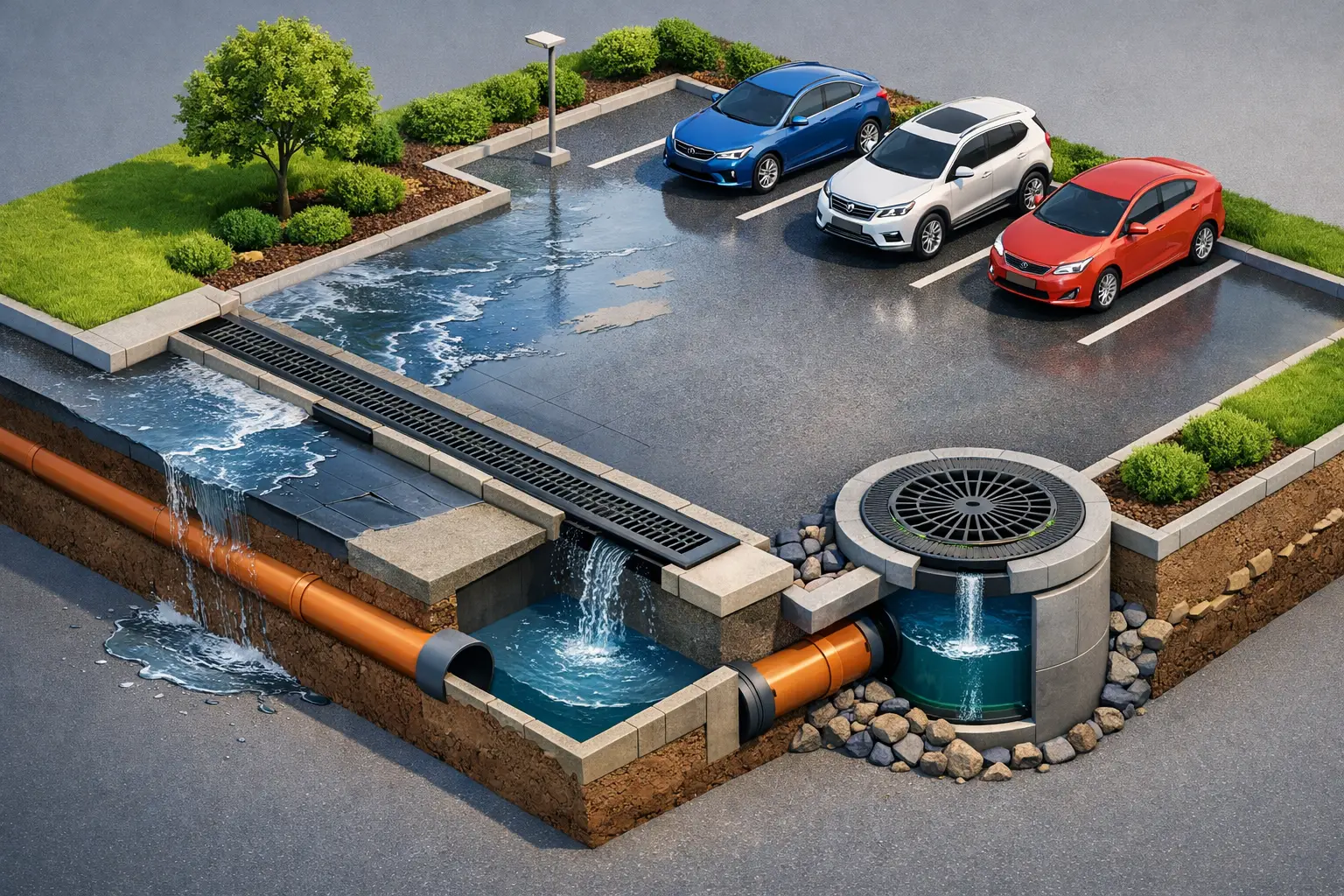
In most cases, the surface is designed to direct runoff toward inlets, trench drains, curb openings, swales, or other stormwater features. The pavement cross slope matters. So does the overall site layout. If the finished lot is flat in the wrong places, even a well-built surface can hold water.
Drainage planning also has to account for how runoff leaves the site or enters the site system. That can mean underground piping, detention requirements, tie-ins to existing storm infrastructure, or on-site control measures. The design has to work as a system, not as separate pieces.
For concrete parking lots, joint layout and subgrade preparation matter too. If the base is not compacted correctly or the grade is inconsistent, water problems tend to show up early. For asphalt lots, edge support and base stability are just as critical. The pavement type changes the construction details, but the drainage principle stays the same – move water quickly and predictably.
Slope is where most drainage problems begin
A parking lot does not need dramatic pitch, but it does need enough slope to drain. Too little slope creates standing water. Too much can cause drainage to move too fast, create uncomfortable walking surfaces, or complicate accessibility.
This is where experience matters. The right grade has to balance drainage with usable parking, ADA access, drive aisles, curb elevations, and tie-ins to surrounding pavement or sidewalks. A lot can drain well on paper and still perform poorly if those transitions are not built correctly in the field.
Inlets and trench drains only work if the layout works
Owners sometimes assume a few extra drains will fix a drainage issue. Sometimes they help. Sometimes they just collect debris while the water still ponds nearby because the lot was not graded to feed them.
Inlets have to be placed at low points that actually receive runoff. Trench drains can be effective near entries, loading areas, or wash-down zones, but they need maintenance and correct elevation control. More hardware is not always the answer. Often the better fix is reshaping the surface so the water reaches the collection point in the first place.
Common drainage failures property owners run into
The most obvious problem is standing water that stays long after a storm passes. That usually points to poor slope, settled pavement, clogged drainage structures, or a combination of all three. Puddling near storefronts, pedestrian crossings, and accessible spaces becomes a safety issue fast.
Another common issue is edge breakdown. When runoff spills over pavement edges without proper support or collection, the shoulder erodes and the slab or asphalt edge starts to fail. Cracking, raveling, and broken curbs often follow.
Water moving toward the building is another red flag. That can lead to foundation concerns, wet entry areas, and damage around sidewalks or ramps. In coastal areas, repeated storms make these flaws show up even faster. A drainage problem that seems minor in dry weather can become a major repair after a hard rain.
There is also the maintenance side. Sediment buildup, blocked inlets, and failing pipes can make a decent drainage layout perform badly. So it is not just about how the lot is built. It is also about whether the system can be maintained without constant trouble.
Drainage design in South Texas has local challenges
Parking lots in the Coastal Bend deal with conditions that make drainage more demanding. Intense rain events can push a site system hard in a short amount of time. Heat affects surface wear. Soil movement can change grades over time. Salt air and coastal exposure can also speed up wear on certain materials and site components.
That means local drainage design has to be practical, not theoretical. The lot needs to account for how the site actually behaves after storms, how traffic loads stress the surface, and how runoff moves across nearby properties. On some sites, a clean regrade and proper inlet placement solve most of the issue. On others, the drainage problem is tied to base failure, broken concrete, or a site layout that needs larger correction.
For property owners in and around Corpus Christi, the value of local experience is simple – you want a contractor who understands how regional weather and site conditions affect pavement performance over time.
New construction versus drainage correction
Drainage is easier and more cost-effective to handle during new construction. The grade can be established before paving, utilities can be coordinated, and collection systems can be installed without tearing out finished work. That gives the project team more control over elevations and long-term performance.
Drainage correction on an existing lot takes a different approach. The question is whether the issue is isolated or systemic. If one section has settled, a targeted repair may be enough. If the whole lot was built with poor fall, patching low spots may only buy time.
This is where honest evaluation matters. Some owners want the least disruptive repair possible, and that can be the right move. But if the drainage issue is tied to base problems or widespread grade failure, surface-level fixes usually do not last. Spending less today can mean spending twice later.
What to ask before starting a drainage project
Before any work begins, it helps to ask a few direct questions. Where does the water go now, and where should it go? Are the existing inlets sized and located correctly? Is the problem caused by surface grade, clogged structures, settlement, or failed pavement? Will the repair tie into the rest of the site without creating a new low point somewhere else?
It also makes sense to ask how the lot will be built for durability. That includes base prep, reinforcement where needed, concrete thickness or pavement section, compaction, and finish elevations. A drainage plan is only as good as the construction behind it.
A dependable contractor should be able to explain the problem in plain terms, not hide it behind technical language. Property owners do not need a lecture. They need a clear scope, realistic expectations, and work that solves the issue for the long haul.
The right result is simple
The best parking lot drainage design is not flashy. Most people never notice it, and that is the point. Water moves off the surface, entrances stay usable, pavement holds up, and the property does not keep fighting the same problem after every storm.
That kind of result comes from proper grading, solid site work, and a contractor who understands how drainage, paving, and structural durability fit together. If your lot is holding water, breaking down at the edges, or pushing runoff where it should not go, it is worth addressing before a drainage problem turns into a larger reconstruction job.