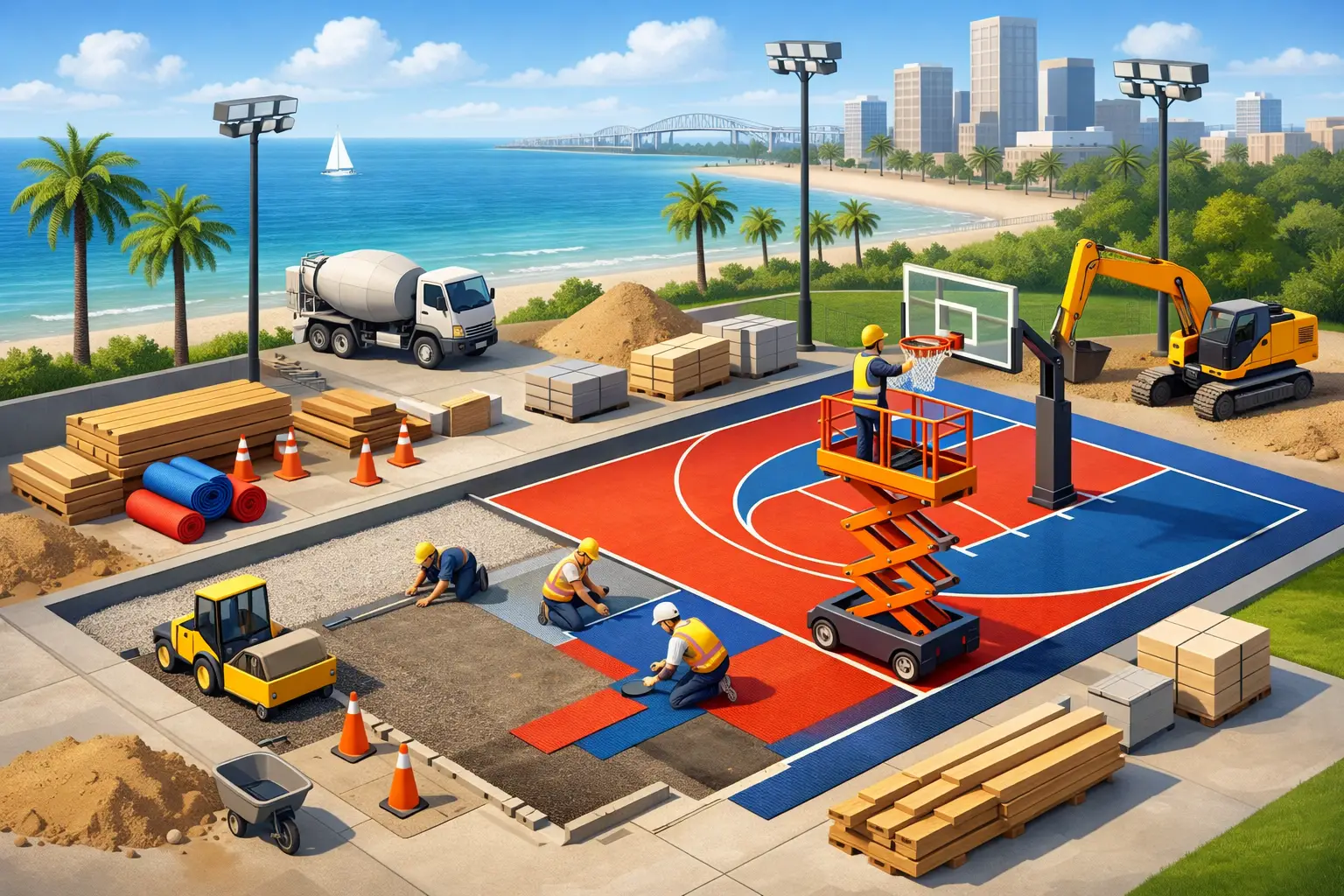
A basketball court looks simple until it starts holding water, cracking at the edges, or wearing out faster than it should. That is why basketball court construction Corpus Christi property owners invest in needs to be treated like real site work, not just a slab with paint. In South Texas, the finish matters, but the base, drainage, reinforcement, and concrete work matter more.
For homeowners, schools, churches, apartment communities, and commercial properties, a court has to do more than look clean on day one. It has to stay level, drain correctly, hold up to heat, and handle repeated use without becoming a maintenance problem. If the installation is rushed or the site prep is weak, you usually see the problems early – standing water, surface wear, uneven play, and cracks that spread.
What good basketball court construction in Corpus Christi really requires
A quality court starts below the surface. Before any concrete is poured, the site has to be evaluated for grading, soil conditions, access, drainage flow, and surrounding structures. That step is especially important in coastal areas where moisture, shifting ground, and heavy rains can affect long-term performance.
A properly built court is not just flat concrete. It needs a stable subgrade, the right thickness for the intended use, reinforcement that matches the demands of the project, and a finish that supports both playability and durability. Residential half courts and full commercial-use courts do not carry the same requirements, so the right scope depends on who will use the space and how often.
This is where working with a contractor that already handles concrete, site prep, grading, and exterior construction makes a difference. Sports court work is tied directly to the same fundamentals that make driveways, slabs, and paved surfaces last.
Site prep is where most long-term problems begin or get prevented
If the subgrade is unstable, the court above it will eventually show it. Soft spots, poor compaction, or incorrect grading can lead to settlement and surface failure. That is true whether the project is behind a home or part of a larger commercial property.
The first job is clearing and preparing the site. Sometimes that is straightforward. Other times it involves demolition of an old slab, removing damaged concrete, correcting drainage issues, or reshaping the area to direct water away from nearby structures. Skipping this work to save time usually costs more later.
In Corpus Christi, drainage deserves special attention. A court that traps water is not only frustrating to use, it also wears faster and creates safety concerns. Proper slope has to be built into the pad without affecting ball response or play. That balance takes planning and experienced execution.
Why grading matters as much as the concrete itself
Many property owners focus on the visible surface, which is understandable. But grading controls how the court behaves during storms and after repeated weather exposure. Too little slope and water ponds. Too much and the playing surface feels off.
Good grading also protects the surrounding property. Runoff should move where it is supposed to go, not toward a house, sidewalk, parking area, or neighboring structure. On a commercial site, poor drainage planning can create bigger liability and maintenance issues than the court itself.
Concrete choices affect play, maintenance, and lifespan
Concrete basketball courts are popular for a reason. When they are installed correctly, they offer durability, consistent performance, and lower long-term maintenance than many cheaper alternatives. But not every concrete pad is built to deliver the same result.
Thickness, mix design, reinforcement, control joints, and finishing methods all matter. A backyard court for family use may have different needs than a court intended for heavier, more frequent traffic at a school, multifamily property, or recreation space. There is no one-size-fits-all answer, and any contractor claiming otherwise is probably oversimplifying the project.
Surface finish also matters. The court needs enough texture for traction without becoming rough or inconsistent. If coatings or color systems are added, the concrete below still has to be right. Decorative layers do not fix poor construction. They only cover it until the underlying issues show up.
Reinforcement and crack control are part of doing the job right
Concrete cracks. That is a fact, not a flaw. The goal is to control cracking, limit movement, and build a slab that performs as intended over time. That is where reinforcement, joint placement, proper curing, and sound installation practices come in.
On a sports court, uncontrolled cracking is more than a cosmetic issue. It can affect safety, play quality, and long-term maintenance costs. A properly reinforced slab with well-planned joints gives the court a better chance of aging the right way under South Texas conditions.
Basketball court construction Corpus Christi projects should be built for local conditions
Coastal Texas is hard on exterior surfaces. Heat, humidity, salt air, heavy rain, and changing soil moisture all put stress on concrete and site-built structures. A court that might perform fine in another region can struggle here if it is not designed and installed with local conditions in mind.
That is one reason local experience matters. Knowing how the ground behaves, how drainage should be handled, and how weather affects concrete placement and curing helps prevent avoidable problems. It also helps keep the project moving with fewer surprises.
For property owners in Corpus Christi and surrounding areas, that local understanding often matters as much as the materials themselves. Good construction is not just about what gets poured. It is about how the site is evaluated, how the schedule is managed, and how each step is adapted to real jobsite conditions.
Residential and commercial courts are not the same job
A homeowner may want a half court for family use, training, and added property value. In that case, the priorities are usually available space, drainage, finish quality, and long-term durability with manageable upkeep. The work still needs to be done right, but the layout and use are different from a heavier-duty public or commercial installation.
For commercial properties, apartment complexes, schools, churches, and community spaces, the stakes are higher. These courts often see more foot traffic, more repetitive play, and more exposure to liability concerns. The layout, access, safety clearances, and surrounding site features need closer coordination.
That is why experienced contractors ask practical questions early. Who is using the court? How often? Is this new construction or replacement? Does the site need demolition, excavation, or drainage correction first? A serious contractor will not treat every court as the same package.
What to expect from a professional court build
A dependable process starts with a site visit and a clear scope. That includes measuring the area, reviewing drainage and access, discussing intended use, and identifying whether any removal, grading, or prep work is required before concrete work begins.
From there, the project should move through prep, base work, forming, reinforcement, concrete placement, finishing, curing, and any final court detailing. Communication matters at every stage. Property owners should know what is being done, what the schedule looks like, and where any site limitations or trade-offs exist.
Trade-offs are part of real construction. A tighter site may require different equipment access. An older property may need more prep than expected. Drainage corrections may add cost up front but save money over the life of the court. Straight answers on those points are a good sign. Vague promises are not.
Choosing the right contractor for a basketball court
The best contractor for a court project is not the one with the flashiest sales pitch. It is the one that understands concrete, grading, drainage, site conditions, and project execution. A basketball court is a specialty surface, but it still depends on core construction discipline.
Look for a contractor that is licensed and insured, communicates clearly, and has real experience with concrete and exterior site work. If demolition, grading, or adjacent flatwork is part of the job, it helps to work with one team that can handle the project from start to finish instead of splitting responsibility across multiple companies.
That is especially useful when the goal is a clean, durable result with fewer delays and fewer handoff problems. For property owners who want one local contractor that can manage court construction along with concrete and site-related work, Haylo Construction fits that need.
A basketball court should add value, function, and usable space to a property, not become another surface that needs constant attention. When the work starts with solid prep, proper grading, and reinforced concrete built for local conditions, the finished court has a much better chance of staying safe, playable, and dependable for years. If you are planning a new court or replacing a failing one, get the site looked at first and build it right from the ground up.